
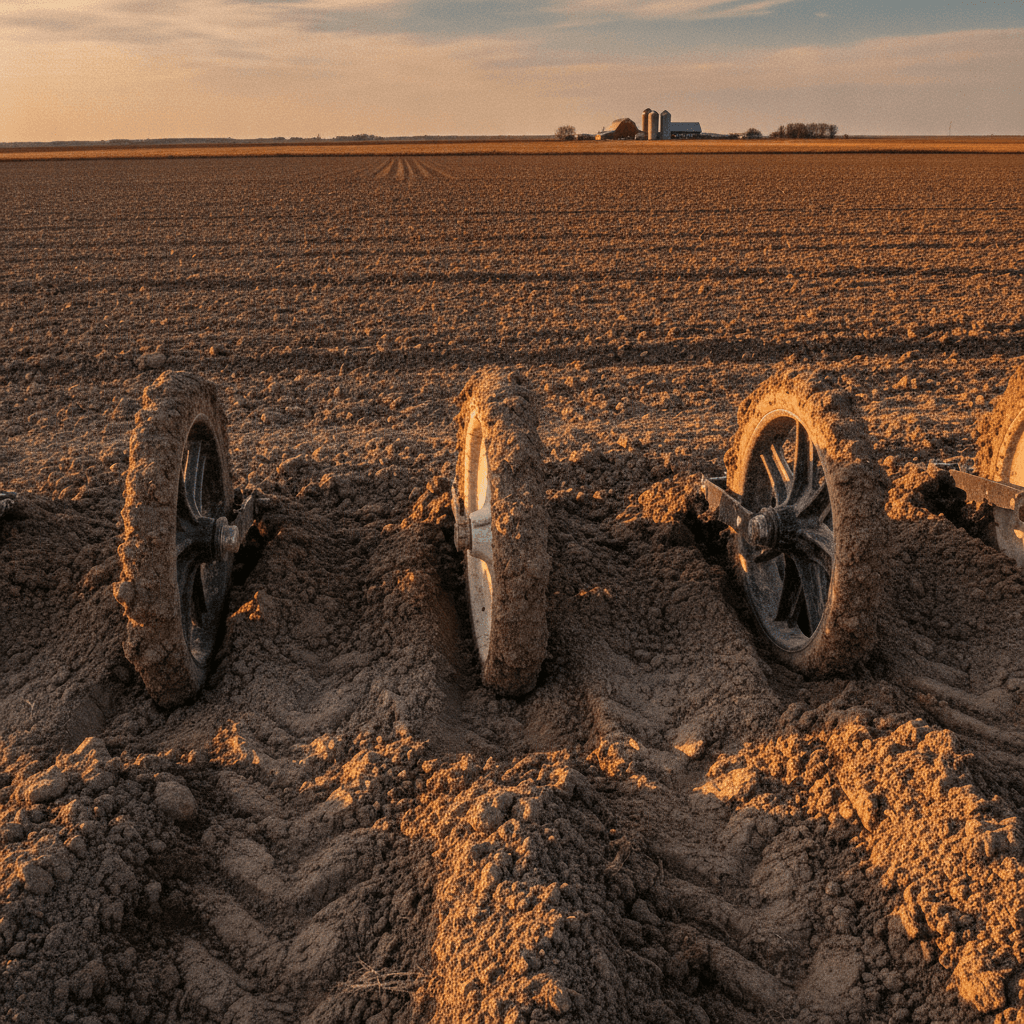
How Do Farmers Near Pierre Know Whether Their Planter’s Gauge Wheel Tire Material Is Actually Shedding Mud — Or Just Moving It Around?
If you’re farming in the gumbo country around Pierre, you already know what heavy, wet clay does to a planter in early May. Your gauge wheels can pull through the field looking fine from the cab, but if the tire material is holding mud instead of releasing it, you’re not running at full planting depth — you’re running on a mud shell that’s half an inch or more thick and getting worse by the hour. The question isn’t whether mud is a problem. It’s whether your gauge wheels are actually built to deal with it, or whether you just haven’t stopped to look closely enough yet.
Why Tire Material Matters More Than Most Operators Think
Most planter operators think about gauge wheel tire compound in terms of hardness — whether the tire is too soft and deforming under load, or too hard and not making full contact with the furrow wall. That’s a real consideration. But what often gets overlooked is how the surface of the tire interacts with sticky, high-clay soils across central South Dakota.
A tire that is technically the right durometer can still have a surface texture or compound chemistry that allows clay to adhere and build up, especially when soils are wet but not saturated. This is different from full mud plugging, where you’d notice it immediately. Partial buildup is subtler — your depth might drift by a quarter inch across a field pass, corn populations look fine on paper, but germination is inconsistent because seed-to-soil contact is off. You won’t catch it until you’re pulling row units apart post-season wondering what happened.
The fix isn’t always a new tire compound. Sometimes it’s the overall design of the wheel itself.
Solid Disc vs. Open Spoke: The Gap Competitors Don’t Talk About
Browse through most gauge wheel manufacturer websites and you’ll find plenty of information about tire durometer, bearing specs, and compatibility charts. What you won’t find much of is a direct comparison of how solid-disc-style gauge wheels perform against open-spoke designs in terms of actual mud management across the wheel body itself — not just the tire surface.
This is a real gap, and it matters in fields like the ones west of Pierre or down near Huron where clay content is high and spring soils hold moisture deep into the planting window.
A solid or near-solid gauge wheel gives mud nowhere to go. It packs into the hub area, around the tire bead, and along the wheel face. Once it builds, it stays. You’re either stopping to clean it or dragging it through the rest of the field.
An open-spoke design works differently. The spokes allow soil to move through the wheel rather than accumulate on it. When paired with a tire material that doesn’t give clay a rough surface to grip, the wheel stays cleaner through more passes before you’d need to stop. Jung Enterprise’s Curved Spoked Gauge Wheels are built specifically around this principle — the curved spoke geometry allows mud and debris to shed as the wheel rotates, rather than packing in and riding along for the next three passes.
What to Actually Check on Your Gauge Wheels Before Planting
Before the planter rolls in the spring, run through these checks on every row unit. It takes less time than pulling a plugged unit out of a field in mid-plant:
- Spin each gauge wheel by hand. If it drags or wobbles, the bearing may be compromised — but also look at whether there’s a ring of hardened mud packed between the tire bead and the wheel body from last season. That won’t clean off with a rinse.
- Look at the tire surface under good light. A tire that’s checked, cracked, or has a rough, pitted surface will hold clay better than a smooth, properly compounded tire. If the surface looks weathered, the tire is done.
- Check spoke or disc clearance. On open-spoke designs, confirm that no spokes are bent or deformed in a way that would allow mud to bridge across them. Even a slight bend creates a ledge that accumulates material.
- Run a hand around the inside of the wheel. Hardened buildup near the hub or around the axle mount area is a sign the design isn’t shedding cleanly. That buildup will be worse in-season when soil is wet.
The Role of the Steel Ring in Keeping the Tire Clean
One thing that rarely gets discussed alongside gauge wheel tire material is what’s happening at the tire lip itself. The outer edge of the gauge wheel tire takes a beating in abrasive soils, and once the lip starts to deform or wear unevenly, mud has more surface area to grab onto. A worn lip also changes the effective contact profile of the tire against the furrow wall, which drifts your depth.
Jung Enterprise’s Steel Ring (patented under US 11,707,013 B2 and related patents) addresses this directly. It mounts to the gauge wheel with six screws, protects the tire lip from abrasive wear, and doubles as a built-in scraper to clear debris before it can pack in. After field testing across 13,000 planted acres over three seasons, wear measured at just 1/16 of an inch — that’s not a marketing claim, it’s a field number. And because the scraper function is built into the ring, you’re not adding a separate component or another potential failure point.
For Pierre-area farmers running corn and soybeans through clay-heavy ground, that combination — a well-designed open-spoke wheel paired with a steel ring keeping the tire lip clean — removes two of the most common mud-related depth problems at once.
Frequently Asked Questions
Does gauge wheel tire compound actually change how much mud sticks to the wheel?
Yes, to a degree. Smoother, properly compounded rubber releases clay more readily than a worn or rough tire surface. But tire compound alone won’t solve heavy buildup — open-spoke wheel design does more work in genuinely heavy soils.
How do I know if mud buildup on my gauge wheels is actually affecting planting depth?
Check your planted depth in the first quarter mile of a wet field entry versus mid-field. If seeds are shallower near the field edge where mud was worst, buildup is shifting your depth. It won’t always be obvious from the surface — pull a few seeds and measure.
Are curved spoked gauge wheels compatible with my existing planter or air seeder?
Jung Enterprise’s Curved Spoked Gauge Wheels are built to fit multiple OEM planter and air seeder configurations. Contact them directly with your row unit make and gauge wheel size to confirm fitment before ordering.
Will a steel ring work on gauge wheels that are already slightly worn?
The Steel Ring is designed to protect the tire lip going forward — it’s most effective when installed before wear becomes severe. If the tire bead area is already significantly deformed, the tire itself may need replacement first.
How early should I be thinking about gauge wheel mud problems before spring planting?
Pre-season inspection in February or March gives you time to order and install without rushing. In central South Dakota, wet April conditions can push planting windows tight, and you don’t want to be sourcing parts when the ground is fit to plant.
If you’re running fields around Pierre or anywhere in central South Dakota where clay and gumbo soils are part of the deal, gauge wheel tire material and wheel design are worth looking at closely before planting season — not after the first muddy field tells you something’s wrong. Jung Enterprise builds these parts in Ipswich, field-tests them in real conditions, and can answer specific questions about your setup. Reach out directly to talk through what your planter needs before the window opens.