
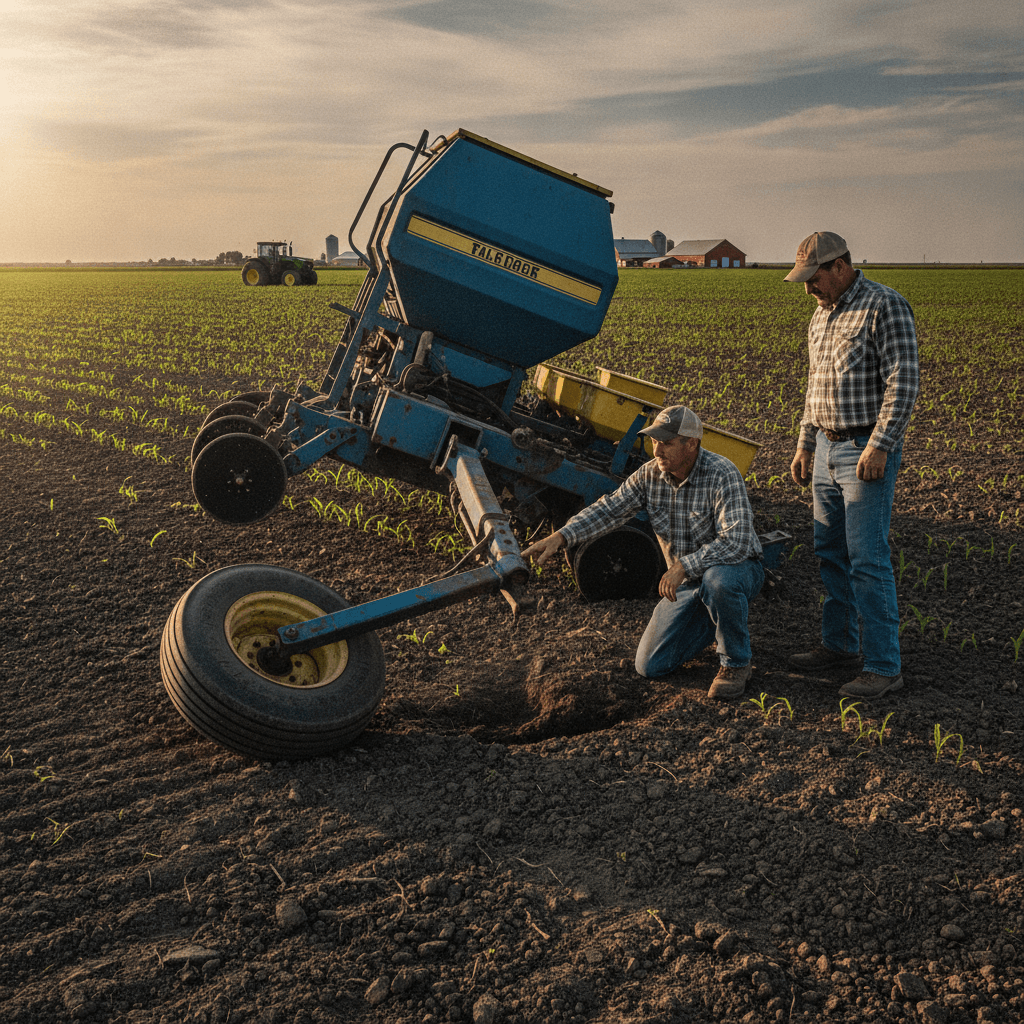
How Do Farmers Near Fargo Know Whether Their Planter’s Gauge Wheel Retainer Is Actually Holding Up Across a Full Season — Or Just Making It to the First Service Call?
If you’re farming near Fargo and you’ve never had a gauge wheel walk off mid-pass, you’re either lucky or you’ve been running the right retainer. For most operators in this part of North Dakota — and across the Red River Valley into Minnesota — the wheel retainer is one of those parts that doesn’t get thought about until it fails. And when it fails, it doesn’t give you a warning. One row stops planting, you figure it out on the next headland turn, and you’ve just wasted time you don’t have during a planting window that may only be open for a week.
The real question isn’t just whether your retainer is installed. It’s whether it’s actually going to hold through an entire season — through wet fields, heavy clay, river-bottom soils, and the constant pounding of a planter running at speed across uneven ground.
What a Wheel Retainer Actually Does — And Why It’s Not as Simple as It Looks
The wheel retainer’s job is straightforward: it keeps the gauge wheel seated on the row unit so it can’t dislodge during operation. Without it, the gauge wheel can walk off the hub under lateral load, vibration, or soil pressure — especially in heavy, wet ground conditions where the forces on the row unit are constantly changing.
What makes this part trickier than it looks is that it’s under stress all season. Every time the row unit flexes over a clod, drops into a low spot, or rides through a compacted zone, the retainer is holding the gauge wheel in place against forces that are trying to push it off. A retainer that’s the wrong design, the wrong fit, or made from marginal materials will start to give. Sometimes it lets go all at once. More often it loosens gradually, and you don’t notice until the wheel has shifted enough to affect depth consistency — or until it comes off entirely.
Farmers in the Fargo area deal with conditions that make this especially relevant. Spring soils here can go from frozen to saturated fast. You’re often putting the planter into ground that’s wet on top and firm underneath, or soft all the way through. The row unit is working hard, and every component on it — including the retainer — is taking more abuse than it would in a dry year on light soils.
What Most Competitor Products Don’t Tell You About Long-Term Retainer Performance
Spend some time on the websites of the major gauge wheel suppliers — Yetter, Schaffert, Copperhead Ag, Exapta — and you’ll find plenty of content about gauge wheel tire design, mud shedding, and planting depth. What you won’t find much of is honest, specific guidance on what separates a retainer that holds all season from one that gives out at the worst possible time.
That’s a real content gap in this space. Retainer design differences matter — the fit tolerance, the material, the clamping force, and whether the design accounts for the lateral movement the gauge wheel experiences under real field conditions. A retainer that fits loosely from the start, or that’s made from material that deforms under load, isn’t going to make it to the end of a 1,500-acre planting season in one piece. But you’d have a hard time figuring that out from most product pages.
At Jung Enterprise in Ipswich, we’ve focused on designing the Wheel Retainer to actually prevent dislodgement under working conditions — not just hold the wheel in place on a flat surface in the shop. The design is straightforward to install, fits correctly, and keeps the gauge wheel where it belongs from the first field to the last.
Signs Your Current Retainer Isn’t Going to Make It Through the Season
You don’t always need to wait for a wheel to come off to know the retainer is failing. Here’s what to check during your pre-season inspection or after the first few fields:
- Any visible play in the gauge wheel: If you can rock the wheel laterally by hand with more than minimal movement, the retainer isn’t holding it properly. A properly retained wheel should be snug.
- Retainer deformation or cracking: If the material has started to deform, crack, or show stress marks, it won’t hold under field loads. Replace it before you go.
- Inconsistent depth on one side of the row unit: A gauge wheel that’s shifted slightly off-center because the retainer has loosened will affect depth on one side. If you’re seeing uneven emergence row to row, check the retainer before you start adjusting down pressure.
- Mud packing behind the retainer: In wet conditions, packed mud can put additional lateral force on the gauge wheel. If your retainer isn’t designed to handle that, it’ll start to back off over time.
Full-Season Durability: What the Numbers Actually Show
The durability standard we hold our products to at Jung Enterprise isn’t a lab test — it’s field results. Our steel ring, for example, showed only 1/16 inch of wear after 13,000 planted acres over three years of field testing. That’s the kind of proof point that matters to a farmer running 800 to 2,000 acres a season in conditions like what you see near Fargo or across South Dakota.
We apply the same standard to the wheel retainer. It needs to hold through the whole season, not just the first service interval. If you’re buying parts that need to be replaced mid-season, you’re paying twice — once for the part and once for the downtime during the narrowest window of the year.
For operators running no-till or strip-till setups in North Dakota and Minnesota, where the row unit is dealing with residue, uneven surface conditions, and variable soil resistance, full-season retainer reliability isn’t a luxury. It’s what keeps the planter in the ground and the seed going in at the right depth. Learn more about the full line of Jung Enterprise planting products designed for these conditions.
What to Check Before the Season Starts — A Short Pre-Plant Retainer Checklist
This doesn’t need to take long. Before you pull the planter out for the season, spend a few minutes on each row unit:
- Check lateral play on every gauge wheel — both sides of the row unit
- Inspect the retainer visually for deformation, cracking, or wear
- Confirm the gauge wheel spins freely without wobble
- Make sure the retainer is fully seated — not just present
- Replace any retainer that shows wear or doesn’t feel solid, before the season starts
Parts that look like they’ll make it usually do — unless you’re farming the kind of wet, heavy clay ground common in the Red River Valley or along the James River drainage in South Dakota. In those conditions, borderline parts don’t make it. Budget for replacements before the season, not during it.
Frequently Asked Questions
How do I know if my wheel retainer fits my specific planter or gauge wheel size?
Jung Enterprise’s wheel retainer is designed to fit across multiple OEM gauge wheel sizes and row unit configurations. If you’re unsure whether it fits your setup, contact us directly at jungenterprise.net/contact-us with your planter make, model, and gauge wheel diameter and we’ll confirm compatibility before you order.
Can a bad wheel retainer affect planting depth even if the gauge wheel hasn’t come off yet?
Yes. A retainer that’s loose or deformed will allow the gauge wheel to shift slightly off-center, which changes the effective depth contact on one side of the row unit. You may see this as inconsistent trench depth or uneven emergence before the wheel fully dislodges.
How often should wheel retainers be replaced in heavy soil conditions like those near Fargo or in South Dakota’s gumbo soils?
At minimum, inspect them every season and replace any that show play, cracking, or deformation. In heavy clay and wet conditions, checking mid-season is worth the few minutes it takes per row unit. A retainer that looks marginal at planting won’t get better under field loads.
Is the Jung Enterprise Wheel Retainer compatible with no-till and strip-till setups?
Yes. The retainer is designed for use on planters, air seeders, and no-till drills across multiple configurations. No-till setups in particular benefit from a reliable retainer because the row unit experiences more variation in soil resistance, which puts more lateral stress on the gauge wheel.
Where is the Jung Enterprise Wheel Retainer made?
It’s made in the United States. Jung Enterprise is based in Ipswich, South Dakota, and the products are designed and field-tested here in the Northern Plains — not sourced overseas and relabeled.
Contact Jung Enterprise Before the Season Starts
If you’re farming near Fargo, across North Dakota, or anywhere in the Northern Plains and you want to know whether your wheel retainers are actually going to hold through the season, reach out to the team at Jung Enterprise in Ipswich. We’ll tell you straight whether what you’re running is built for the conditions you’re working in — and what it’ll take to fix it if it isn’t.
Contact Jung Enterprise to ask about compatibility, place an order, or talk through your specific row unit setup. Don’t wait until a wheel comes off at the worst possible time in the middle of a short planting window to find out your retainer wasn’t up to the job.