
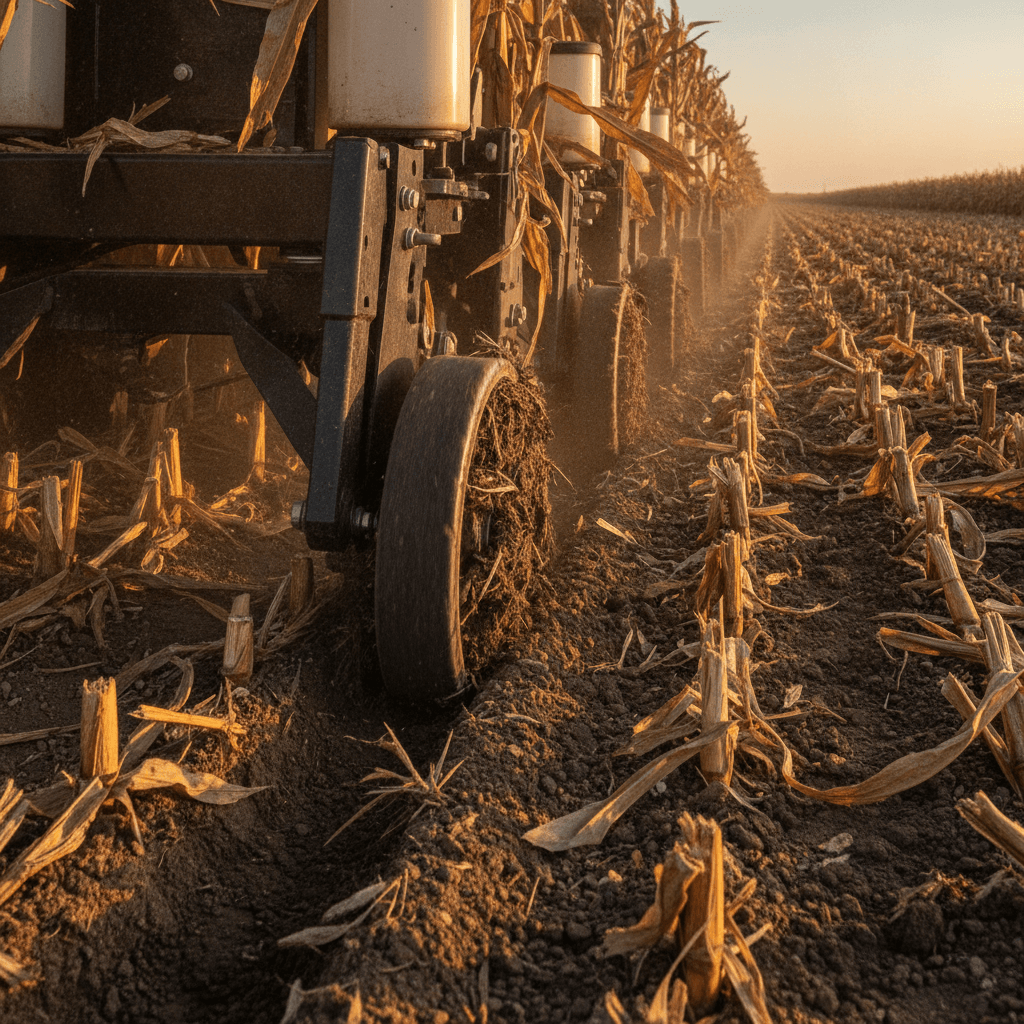
How Do Farmers Near Huron Know Whether Their Planter’s Gauge Wheels Are Actually Shedding Residue in Heavy No-Till Corn Stalks — Or Just Dragging It Into the Trench?
If you’re no-till planting corn after a corn year near Huron, you already know what a heavy residue field looks like. Thick stalks, loose chaff, and mat-packed crown roots that didn’t break down over winter. The question most farmers don’t ask until they’re standing behind a row unit at the end of a pass is a simple one: is that gauge wheel clearing residue out of the way, or is it riding on top of it and dragging it straight into the seed trench? Because those are two very different situations — and one of them quietly wrecks your stand before you even know it happened.
- What Residue Dragging Actually Does to Your Planting Depth
- The Design Feature That Actually Matters Here: Spoke Pattern and Spoke Shape
- What Competitor Content Misses on This Topic
- How to Check Your Gauge Wheels Before Corn Planting Season
- Durability in the Same Package
- Frequently Asked Questions
- Ready to Sort Out Your Gauge Wheel Setup Before Corn Planting?
What Residue Dragging Actually Does to Your Planting Depth
When a gauge wheel picks up residue and carries it forward rather than shedding it to the side, a few things happen in sequence. First, the material builds up between the tire and the soil surface, effectively lifting the row unit slightly — even just a quarter inch of residue mat under a gauge wheel tire is enough to throw your planting depth off. Second, if the residue gets pushed into the trench itself, it creates an air gap under the seed. The seed sits on straw or stalk material instead of firm soil, and germination suffers. Third, in wet springs — which Huron and the surrounding Beadle County area sees regularly — damp residue packs tighter and takes longer to clear once it starts accumulating.
None of this shows up as a blinking warning light on your planter monitor. It shows up as uneven emergence across the field, or patchy stands in the rows that ran through the thickest stalk areas. By then, the window to replant is usually gone.
The Design Feature That Actually Matters Here: Spoke Pattern and Spoke Shape
Solid or semi-solid gauge wheel designs — the kind that look like a flat disc with minimal cutouts — are particularly prone to residue packing. There’s nowhere for the material to go, so it wraps around the hub, compresses against the tire, and builds a ring of debris that rides along with the wheel instead of being thrown clear.
Open-spoke gauge wheels change that dynamic significantly. When the spoke configuration is curved rather than straight, the wheel generates a slight lateral throw as it rotates — residue that contacts the spoke gets deflected outward rather than captured and carried forward. In heavy corn stalk conditions, that difference is measurable. You’re not relying on the soil surface to scrape the wheel clean. The wheel geometry itself is doing the work.
Jung Enterprise’s Curved Spoked Gauge Wheels are built specifically around this principle. The open-spoke design sheds mud and residue as the wheel turns, keeping the contact zone between the tire and the soil surface clear through the pass — not just at the start of the field when everything is still moving freely.
What Competitor Content Misses on This Topic
Most of what you’ll find on competitor websites about gauge wheel residue focuses narrowly on mud — wet soil sticking to the wheel in spring conditions. That’s a real problem, and it’s worth addressing. But residue management in dry or transitional conditions, particularly in heavy corn-on-corn no-till rotations, gets almost no coverage. There’s very little written about how spoke design interacts with corn stalk material specifically, or how to diagnose residue-dragging as a planting depth variable rather than just a cleanup issue. Farmers near Huron, Watertown, and Aberdeen who are running full no-till rotations in corn need information that goes beyond “clean your wheels at the end of the day.”
The practical question — is my wheel shedding residue or dragging it — doesn’t have a single answer that applies to every field. It depends on wheel design, residue volume, ground speed, and row unit down pressure working together. But wheel design is the one variable you can change before the season starts.
How to Check Your Gauge Wheels Before Corn Planting Season
You don’t need special tools to evaluate your current gauge wheels for residue risk. Walk the field after your first pass on a heavy residue field and look at three things:
- Residue buildup on the wheel itself: Is stalk material wrapping around the hub or packing between the spokes? If it’s accumulating rather than shedding, the design is working against you.
- The seed trench: Open a section of trench in a heavy-residue zone and look at what’s in the bottom. Loose stalk fibers or chaff in the trench are a direct sign that residue is being dragged in rather than displaced.
- Gauge wheel tire contact: If the tire appears to be riding slightly elevated over a mat of residue rather than sitting on mineral soil, your effective planting depth is not what your settings say it is.
If you’re seeing any of these, the fix isn’t to slow down (though that helps marginally). The fix is a gauge wheel design that handles the residue mechanically rather than depending on operator adjustments to compensate.
Durability in the Same Package
One concern farmers raise when looking at open-spoke gauge wheel designs is longevity. An open spoke design sounds like it might be more fragile than a solid wheel — more surface area to crack, more geometry to distort under load. In practice, the durability question comes down to material and manufacturing quality, not spoke design. Jung Enterprise’s curved spoked gauge wheels are field-tested to only 1/16″ of wear after 13,000 planted acres over three years. That’s the kind of number that matters when you’re deciding whether a wheel is a season purchase or a multi-year investment.
For farmers near Ipswich and across South Dakota who are putting in 1,500 to 3,000 acres a year, a wheel that lasts three-plus seasons without meaningful wear degradation is a different economic calculation than replacing OEM rubber wheels every year or two.
If you’re also dealing with tire lip wear on your current gauge wheels — a separate but related problem — the Steel Ring addresses that directly by protecting the tire lip and acting as a built-in scraper, which is one fewer separate part to track down and install.
Frequently Asked Questions
Does planting speed affect how much residue a gauge wheel drags in?
Yes, to a degree. Higher speeds give residue less time to clear, so wheels that are marginal at 4.5 mph may struggle more at 6 mph. But if the wheel design is trapping residue rather than shedding it, slowing down only delays the problem — it doesn’t eliminate it.
Are curved spoked gauge wheels harder to clean between fields?
No — the open spoke design typically sheds material during operation, so there’s less accumulated debris to deal with between fields compared to solid or semi-solid wheels that pack residue in.
Do Jung Enterprise gauge wheels fit my planter without modifications?
Jung Enterprise’s curved spoked gauge wheels are designed to fit multiple OEM gauge wheel sizes and planter configurations. Check the product page or contact the team directly to confirm fit for your specific row unit setup.
I’m in a corn-soybean rotation, not corn-on-corn. Is residue still an issue for me near Huron?
Soybean residue is lighter and breaks down faster than corn stalks, so the problem is less severe. That said, in wet falls where soybean straw doesn’t fully decompose before spring, residue dragging can still occur. Corn-on-corn no-till is the worst-case scenario, but it’s not the only scenario where wheel design matters.
How does the Steel Ring interact with residue management?
The Steel Ring’s primary function is protecting the gauge wheel tire lip from wear and scraping debris off the tire face during operation. It doesn’t replace the residue-shedding function of an open-spoke wheel design, but the two work together — a clean tire face and a spoke design that clears material give you the best combination for high-residue no-till conditions.
Ready to Sort Out Your Gauge Wheel Setup Before Corn Planting?
Jung Enterprise is based in Ipswich and works directly with farmers and dealers across South Dakota, North Dakota, and Minnesota. If you’re running no-till corn near Huron or anywhere in the Northern Plains and you’re not confident your current gauge wheels are handling residue the way they should, it’s worth a conversation before planting season. Reach out to the team here — we can help you figure out whether your current setup is working or whether a design change makes sense for the acres you’re putting in.