
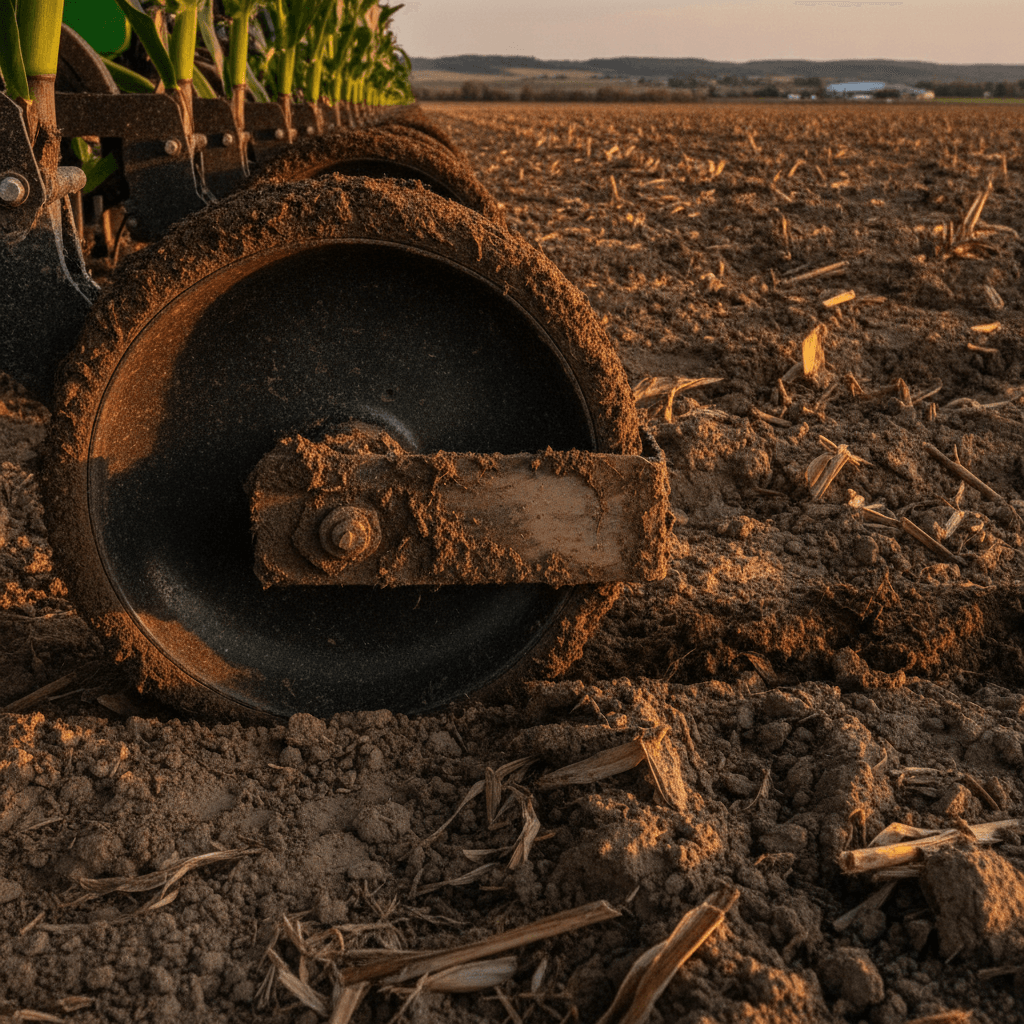
How Do Farmers Near Ipswich Know Whether Their Planter’s Steel Ring Scraper Is Actually Doing Its Job — Or Just Riding Along While Mud Builds Up on the Gauge Wheel?
If your scraper looks fine but your gauge wheels are still packing mud by the end of the row, the scraper isn’t working — it’s just mounted. For farmers around Ipswich planting corn or soybeans in the heavy clay and gumbo soils that show up every wet spring across South Dakota, that distinction isn’t academic. A scraper that isn’t making real contact with the tire face is no better than no scraper at all, and you’ll pay for it in depth inconsistency before you ever realize what’s causing it.
- Why Scrapers Fail Without Looking Broken
- How to Actually Check Whether Your Scraper Is Working
- What Makes a Built-In Scraper Different From a Bolt-On Afterthought
- What Competitors Don't Tell You About Scraper Wear
- When a Scraper Problem Is Actually a Gauge Wheel Problem
- Frequently Asked Questions
- Ready to Stop Guessing Whether Your Scraper Is Working?
Why Scrapers Fail Without Looking Broken
This is the problem most equipment guides don’t address directly: a scraper can be installed correctly, look undamaged, and still be doing almost nothing. It happens because scrapers wear, flex, or shift out of position gradually — and unless you’re pulling row units and checking contact at the tire face, you won’t catch it until your stand counts tell you something’s off.
Here’s what actually goes wrong:
- Gap between scraper and tire grows over time. A scraper that made good contact at the start of the season may have worn or shifted to the point where there’s a quarter-inch of clearance. At planting speeds, that’s enough for a mud wedge to form and hold.
- The scraper is mounted to a part that moves independently of the tire. If the scraper doesn’t travel with the gauge wheel as it flexes or deflects under load, it loses contact right when conditions are worst — exactly when you need it most.
- Wear on the scraper’s leading edge rounds it off. A sharp, close-tolerance edge clears mud. A rounded, worn edge smears it or deflects it sideways without clearing the tire face.
- Mud type matters. The sticky gumbo soils common around Aberdeen and Huron are far more aggressive on scrapers than sandy loam. If your scraper was adequate in lighter soils, it may not keep up when conditions get heavy.
How to Actually Check Whether Your Scraper Is Working
You don’t need special tools. You need to stop and look — which most operators don’t do until something breaks.
Pull into the field, run a few hundred feet, stop, and pull the row unit. Look at the tire face directly where the scraper contacts it. If there’s a consistent mud film remaining on the tire even after the scraper has passed, the scraper isn’t clearing it. If you see a clean, dry band on the tire where the scraper runs and residue only outside that band, it’s doing its job.
Also check: can you slide a business card between the scraper’s working edge and the tire face when the wheel is seated? If yes, you’ve got a gap problem. The contact needs to be close — not digging in, but genuinely close. Any daylight between the scraper and the tire at rest means it’s likely losing contact under field load.
Run the same check mid-season, not just at planting time. Scrapers that start the season adjusted correctly often drift during the first 300–400 acres as parts settle.
What Makes a Built-In Scraper Different From a Bolt-On Afterthought
Most bolt-on scrapers are designed to mount to whatever’s convenient on the row unit frame — which means they’re positioned relative to the frame, not relative to the tire face. When the gauge wheel deflects laterally or the row unit bounces over residue, that frame-relative position changes. The scraper either digs in or loses contact depending on conditions, and neither outcome is what you want.
The Jung Enterprise Steel Ring approaches this differently. The scraper function is built directly into the steel ring itself, which mounts to the gauge wheel with six screws and travels with the tire. Because the scraper is part of the ring — not a separate component mounted to the frame — it maintains consistent contact with the tire face regardless of what the row unit is doing. There’s no adjustment to drift, no separate bracket to loosen, and no gap to develop over the season.
That design also means you’re not buying and installing two separate parts: the ring handles tire lip protection and scraping in a single patented assembly (US 11,707,013 B2 and related patents). For operators running 16, 24, or 48 rows, that’s a real difference in installation time and in-season maintenance.
What Competitors Don’t Tell You About Scraper Wear
Here’s a gap in the information most manufacturers publish: they’ll tell you a scraper is included or compatible, but almost none of them publish wear data on the scraper itself over a full season or across multiple years. You’re expected to trust that it works without any field-verified numbers to back that up.
The Jung Enterprise Steel Ring has been field-tested to show only 1/16 inch of wear after 13,000 planted acres across three years of use. That wear data covers the full ring — including the scraper edge — under real planting conditions in row-crop operations. If a part is going to fail or wear out of spec, you’ll see it in that kind of long-run testing. One-sixteenth of an inch over three seasons is a number worth putting in front of a farmer before they buy.
For farmers in South Dakota and North Dakota running no-till or strip-till through heavy residue, that durability matters even more. Residue-heavy conditions put additional stress on the scraper edge every pass, and a part that can’t hold its geometry across a full season is going to underperform right when your fields are at their worst.
If you’re evaluating gauge wheel products before next planting season, the full Jung Enterprise product line covers steel rings, wheel retainers, and curved spoked gauge wheels — all designed for the conditions that actually show up in Northern Plains row-crop farming.
When a Scraper Problem Is Actually a Gauge Wheel Problem
One more thing worth knowing: if you’re fighting chronic mud buildup despite a functional scraper, the issue might be the gauge wheel itself. Solid-face gauge wheels don’t give mud anywhere to go — it packs into the tire face and stays there. An open-spoke gauge wheel design sheds mud through the wheel rather than letting it accumulate. If your scraper is doing its job but you’re still seeing buildup on the tire sidewall or in the wheel cavity, a change in gauge wheel design may solve the problem the scraper can’t.
That’s a conversation worth having before you assume the scraper is the only variable at play — especially heading into spring in wet years like the ones that roll through the Ipswich and Aberdeen areas on a fairly regular basis.
Frequently Asked Questions
How do I know if my scraper has worn out of adjustment during the season?
Stop mid-field and pull the row unit. Look for mud film remaining on the tire face where the scraper contacts it. If the tire face isn’t clean in that zone, the scraper has either worn or shifted out of position. A business-card gap between the scraper edge and the tire at rest is enough to cause problems under field load.
Does a scraper built into the steel ring actually stay in contact better than a frame-mounted scraper?
Yes, because it moves with the tire rather than being fixed to the frame. When the row unit deflects or the gauge wheel shifts under load, a frame-mounted scraper loses contact. A ring-mounted scraper travels with the wheel and maintains consistent positioning regardless of what the row unit is doing.
Is the scraper function on the Jung Enterprise Steel Ring a separate part I need to buy?
No. The scraper is integrated into the steel ring itself. One part handles tire lip protection, scraping, and mud shedding. You don’t buy a separate scraper or install a separate bracket — it’s all one assembly that mounts with six screws.
Will the scraper on a steel ring work in the heavy gumbo soils around Huron and the Missouri River breaks?
Yes. The field-test data behind the Jung Enterprise Steel Ring — 1/16 inch of wear across 13,000 acres over three years — comes from real row-crop conditions, not controlled lab settings. Heavy, sticky soils are exactly the conditions a ring-mounted scraper is designed for, because mud has nowhere to accumulate on the tire lip when the scraper is maintaining consistent contact every rotation.
Should I replace the scraper separately, or replace the whole steel ring when it wears?
Because the scraper is part of the ring, you replace the ring when it’s worn — but given the 13,000-acre, three-year wear data, that replacement interval is far longer than most bolt-on scrapers. You’re not buying a scraper every season. You’re buying a ring that does both jobs across multiple planting seasons.
Ready to Stop Guessing Whether Your Scraper Is Working?
If you’re heading into another planting season near Ipswich unsure whether your gauge wheel scrapers are actually clearing mud — or just looking like they are — that’s worth settling before the window opens. Jung Enterprise builds the Steel Ring right here in Ipswich, and it’s designed specifically for the conditions that show up in South Dakota and Minnesota springs: wet fields, heavy soils, short planting windows, and no time to pull row units twice because a scraper failed.
Reach out to Jung Enterprise to talk through what you’re running, what your fields look like in a wet year, and whether the Steel Ring is the right fit for your planter setup. We’re at 1111 5th Ave, Ipswich, SD — call us at (605) 281-0497 or email help@jungenterprise.net.