
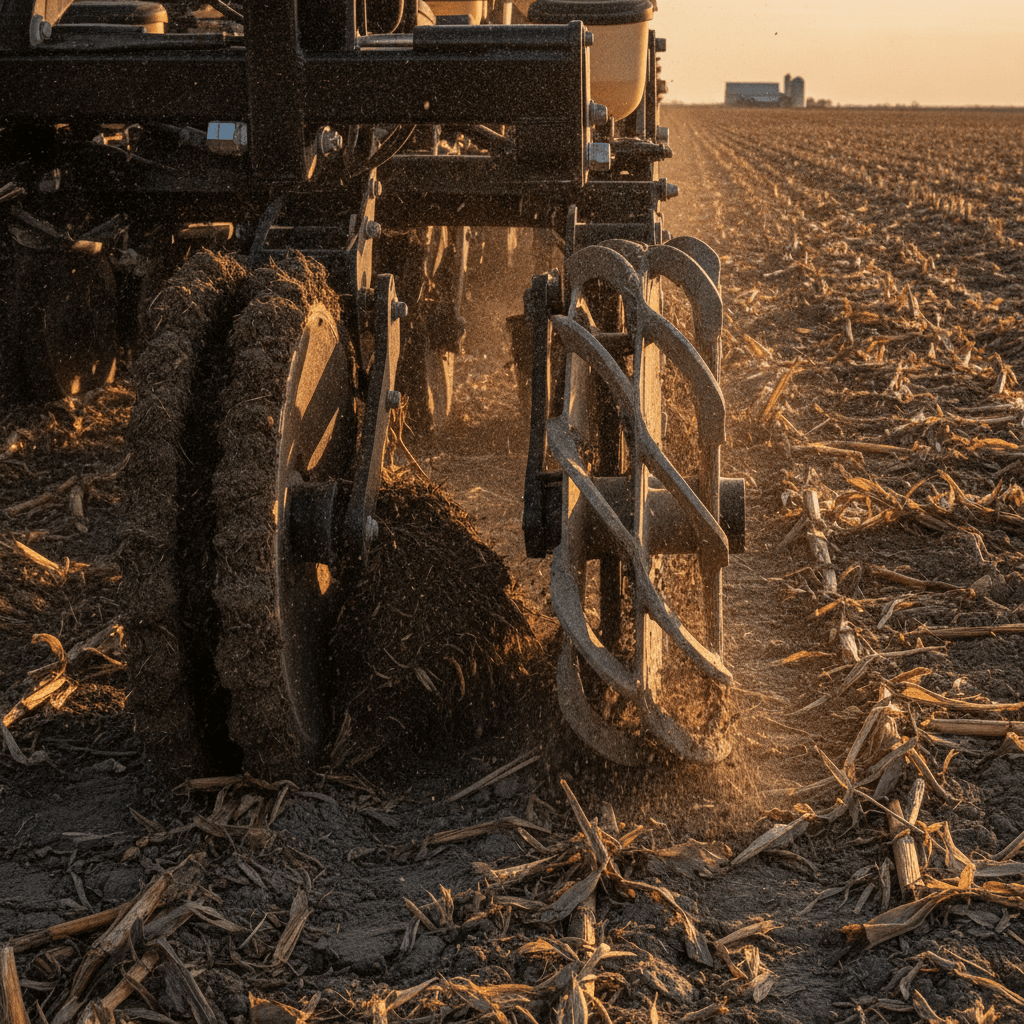
How Do Farmers Near Bismarck Know Whether Their Planter’s Gauge Wheel Spokes Are Actually Shedding Residue in Heavy No-Till Conditions — Or Just Packing It Tighter With Every Pass?
If you’re running no-till or reduced-till corn near Bismarck and you’ve ever stopped mid-field to dig packed residue out from between your gauge wheel spokes, you already know the answer. Spoke design is not cosmetic. A gauge wheel that can’t shed corn stalk fragments, chaff, and wet soil in the first 30 acres of a no-till field is going to ride too high, lose depth control, and leave you guessing at emergence. The spoke geometry — straight versus curved — makes a measurable difference in whether residue flows off the wheel or wraps around it. Here’s how to diagnose what’s actually happening on your planter, and what a better-designed wheel actually looks like in the field.
- Why Spoke Design Gets Overlooked Until It's a Problem
- What Curved Spokes Actually Do Differently
- How to Tell If Your Current Wheels Are Packing Instead of Shedding
- The Gap Most Competitors Don't Address: Spoke Geometry in Residue-Heavy No-Till
- What This Means for Your Planting Operation
- Frequently Asked Questions
Why Spoke Design Gets Overlooked Until It’s a Problem
Most farmers don’t think about spoke design when they’re shopping for gauge wheels. They’re looking at diameter, tire durometer, bearing quality, and price. Spoke geometry doesn’t show up on a spec sheet, and most manufacturers — including several well-known ones — don’t address it directly in their product literature. What you get is a stock photo and a vague claim about durability.
The problem is that a straight-spoked gauge wheel creates a cupping effect as it rotates through residue. The spaces between spokes act like little buckets. In dry, light-residue conditions, this isn’t a big deal. But in heavy no-till corn stalk situations — which is exactly what a lot of North Dakota and South Dakota farmers deal with every spring — those pockets fill up fast. Once they’re packed, your gauge wheel is effectively larger in diameter than it should be. You’re not planting at 1.75 inches anymore. You might be at 1.5 inches, or shallower, and you won’t know it until you start digging seeds to check.
Wet conditions make it worse. Around Bismarck and east across the state toward Fargo, spring soils are often saturated by snowmelt and April rains right when you need to be planting. Wet residue doesn’t shed — it sticks. A packed straight-spoked wheel in those conditions turns into a drum, and your row unit is riding on packed material instead of soil.
What Curved Spokes Actually Do Differently
A curved spoke creates a natural exit path for material as the wheel rotates. Instead of the residue getting trapped in a pocket, the curve deflects it outward and away from the hub. The physics are straightforward: material that has a direction to travel will travel that direction. Straight spokes give residue nowhere to go except deeper into the pockets with each rotation.
Jung Enterprise’s Curved Spoked Gauge Wheels are built specifically around this principle. The open-spoke, curved design keeps the wheel clearing itself as it runs — meaning less stopping to clean, less depth variation across the field, and more consistent seed placement from the first acre to the last. In a short planting window where you might be covering 800 to 1,200 acres in 10 to 14 days, stopping to dig packed residue out of 16 or 24 row units is time you don’t have.
How to Tell If Your Current Wheels Are Packing Instead of Shedding
You don’t need a lab test for this. Go check your gauge wheels at the end of the first day in heavy residue. If you’re pulling out packed stalk material from between the spokes by hand, that’s your answer. If the wheel looks clean, it’s shedding. If it looks like a drum with material wedged into every cavity, you’re carrying ballast and losing depth control.
The more diagnostic check is to dig seeds at 20-row intervals across the planter width. If your outside rows are consistently shallower than your center rows, it’s worth looking at whether your gauge wheels are packing unevenly — some row units may have heavier residue burden than others depending on where they track relative to the previous year’s rows.
Also pay attention to how your row unit down-pressure is behaving. If you’re adding down-pressure mid-season to compensate for gauge wheels that seem to be riding high, packed residue between spokes is a likely culprit — especially before you’ve blamed springs, parallel arms, or anything else.
The Gap Most Competitors Don’t Address: Spoke Geometry in Residue-Heavy No-Till
Most gauge wheel suppliers and major aftermarket brands will tell you their wheel sheds mud and residue. Very few of them explain the mechanism — how the spoke geometry actually accomplishes that, or what the failure mode looks like when it doesn’t. That’s a real gap in the information available to farmers shopping for gauge wheel upgrades.
At Jung Enterprise, we’ve put these wheels through more than 13,000 planted acres over three years of field testing. The wear result: roughly 1/16 of an inch of wear. That’s durability data, not a marketing claim. And the design isn’t accidental — the curved spoke geometry came directly from field feedback about what happens to straight-spoked alternatives in Northern Plains conditions. Farmers near Ipswich, across South Dakota, and up into North Dakota were dealing with the same residue problem, and the curved design was the answer that actually worked.
Browse all Jung Enterprise gauge wheel and planter components here.
What This Means for Your Planting Operation
If you’re running a no-till or strip-till operation near Bismarck, or anywhere in the Northern Plains where heavy corn residue and wet spring soils are the norm, spoke design should be a real factor in your gauge wheel decision — not an afterthought. A wheel that packs residue will cost you depth consistency, cost you stopping time, and ultimately cost you yield in the rows where depth variability was worst.
The fix isn’t complicated. A curved open-spoke design that clears itself as it runs will outperform a straight-spoked alternative in those conditions every time. The question is whether you want to find that out mid-planting or before the season starts.
Frequently Asked Questions
Does spoke design matter as much in conventional tillage as in no-till?
Less so, but it still matters. In tilled ground with low residue, straight spokes may perform adequately. In no-till or heavy-residue conditions — which is where most Northern Plains farmers are headed — curved spoke geometry makes a measurable difference in whether the wheel self-clears.
Will Jung Enterprise’s Curved Spoked Gauge Wheels fit my planter?
They’re designed to be compatible across multiple OEM brands and gauge wheel sizes, covering planters, air seeders, and no-till drills. Contact Jung Enterprise directly to confirm fitment for your specific equipment before ordering.
How do I know if residue packing is actually affecting my planting depth — versus a different root cause?
Dig seeds at multiple points across the planter width and compare against your target depth. If outer rows are consistently shallower than center rows, or if depth varies row-to-row in a pattern that tracks with residue load, packed gauge wheel spokes are a likely factor. Also inspect the wheels physically at the end of each day in heavy residue conditions.
Is this a problem only in corn stalks, or does it also happen in soybean residue?
Corn stalks are the worst offender because of stalk diameter and volume, but heavy soybean residue — especially in wet conditions — can cause similar packing. The curved spoke design handles both.
What’s the difference between a gauge wheel plugging with mud and packing with residue?
Mud plugging typically builds up on the tire sidewall and inside the wheel cavity due to wet soil. Residue packing happens between the spokes specifically, because stalk and chaff material gets caught and compresses with each rotation. Both problems affect depth control, but they have different causes and different solutions. Jung Enterprise’s Steel Ring addresses mud plugging at the tire lip, while the curved spoke design addresses residue packing between the spokes.
If you’re farming no-till ground near Bismarck or anywhere across the Northern Plains and you want to know whether our Curved Spoked Gauge Wheels are the right fit for your planter, reach out to the team at Jung Enterprise. We’re based in Ipswich and we work directly with farmers and ag dealers across South Dakota, North Dakota, and Minnesota. Contact us here and we’ll get you the information you need before planting season.