
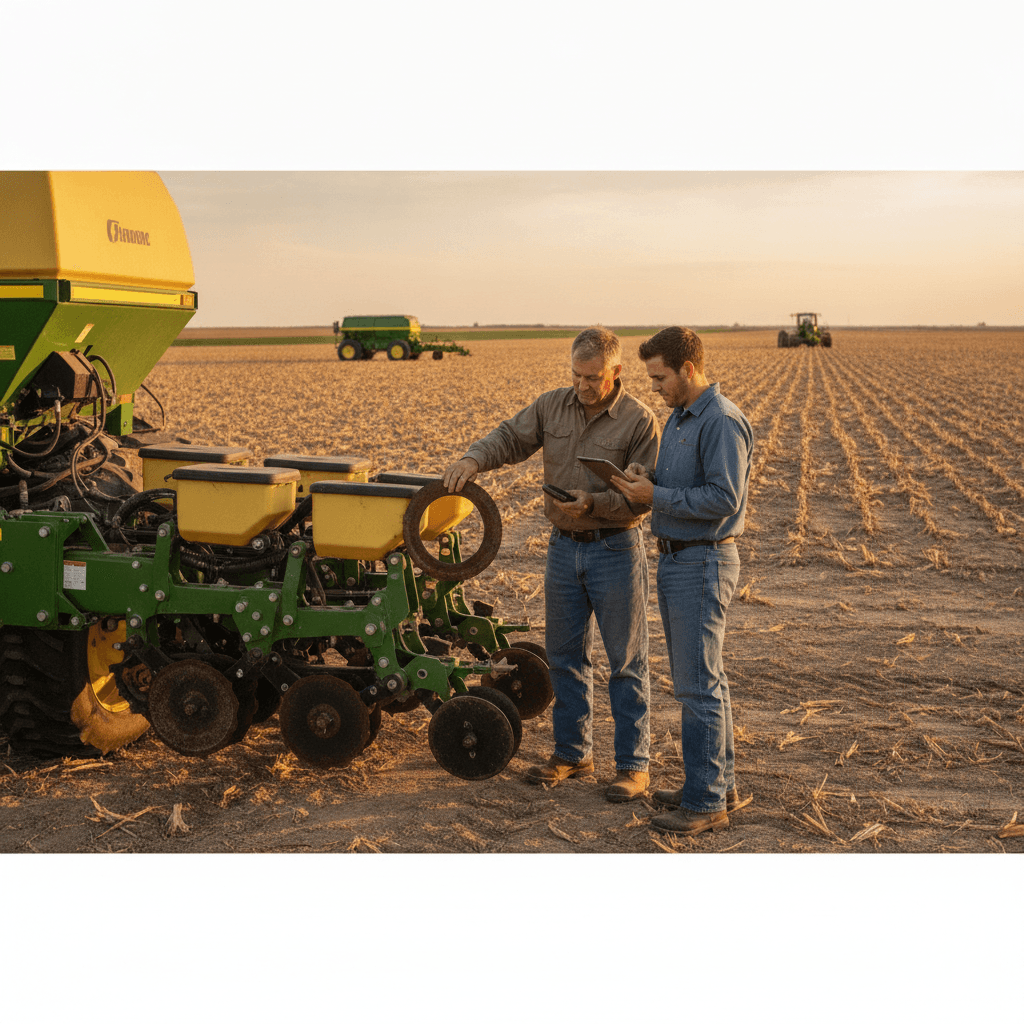
How Do Farmers Near Pierre Know Whether Their Planter’s Gauge Wheel Steel Ring Is Actually Worth Upgrading Mid-Season — Or Better Saved for a Full Pre-Plant Overhaul?
If your steel ring is showing wear partway through planting season near Pierre, the honest answer is: it depends on what the ring is actually doing — or failing to do — right now. A steel ring that’s cracked, no longer scraping, or letting the tire lip grind on soil debris every pass is costing you something every acre you plant. One that’s just showing surface scuff but still seated, still scraping, and still protecting the tire lip is probably fine to run through the season. The key is knowing which situation you’re actually in, and that requires looking at more than the ring itself.
- The Real Cost Question Farmers Near Pierre Are Asking
- What Competitors Don't Tell You About Steel Ring Wear Timelines
- Mid-Season Upgrade: When It Makes Sense to Stop and Swap
- Pre-Plant Overhaul: The Smarter Default for Most Situations
- A Note for Custom Planters Running Multiple Operations
- Frequently Asked Questions
- Get the Right Answer for Your Operation
The Real Cost Question Farmers Near Pierre Are Asking
South Dakota’s planting window is tight. Between late April and mid-May, a lot of corn and soybean ground in the Pierre area needs to go in — and any hour the planter sits in the shed is an hour you can’t get back. That pressure leads a lot of operators to push through with worn or marginal parts rather than stop to swap something out. Sometimes that’s the right call. Sometimes it costs you way more in the long run.
The question isn’t really “is the steel ring worth replacing?” — it almost always is, given what the part does. The real question is what condition is your ring in right now, and what happens if you don’t act until pre-plant next year?
Here’s what to look at:
- Is the scraper still making contact? The steel ring doubles as a built-in scraper. If it’s migrated, cracked, or the mounting screws have loosened enough to shift the ring’s position, it’s not cleaning the gauge wheel anymore — it’s just riding along.
- Is the tire lip still protected? Run your hand around the inside lip of the gauge wheel tire. If you feel a groove, a flat spot, or the rubber is visibly abraded, the ring has either worn past its useful position or was never seated correctly.
- Are you seeing mud buildup mid-row? In heavier soils west of the Missouri River, a steel ring that’s lost its scraper function will let clay pack onto the gauge wheel fast. That buildup throws off depth, slows the wheel, and creates real inconsistency in seed placement.
- How many acres are left this season? If you’re 60–70% through your planting acres, running through and replacing at pre-plant is probably fine — provided the ring isn’t actively causing damage to the tire. If you’re early in the season with 80% of your acres ahead of you, a quick mid-season swap is worth the two hours it takes.
What Competitors Don’t Tell You About Steel Ring Wear Timelines
This is actually a topic that most competitor content skips entirely. You can find plenty of information about what a steel ring does, but very little about how to evaluate whether a ring mid-season still has life in it versus needs to come off now. That’s a real gap — and it’s a question operators in Central South Dakota are facing every spring.
Jung Enterprise’s patented steel ring (US Patent 11,707,013 B2 and related) has been field-tested across 13,000 planted acres over three years, with documented wear of only 1/16″ over that entire span. That’s not a marketing number — that’s what the ring showed after a full three-season run across real field conditions. For most operations near Pierre, Huron, or Mitchell, that means one ring should realistically carry you multiple planting seasons before you’re making any replacement decision at all.
If your current ring is wearing faster than that, the issue is usually one of three things: incorrect mounting, a ring that wasn’t designed to the right dimensional spec for your gauge wheel, or a lower-grade material that looks similar but doesn’t hold up the same way in abrasive clay soils.
Mid-Season Upgrade: When It Makes Sense to Stop and Swap
There are specific situations where stopping to replace a steel ring mid-planting is the right move — even with the pressure of a tight planting window:
- The ring is cracked or missing a section and is no longer providing full tire lip coverage
- You’re seeing active tire lip wear developing on a gauge wheel that was fine at the start of the season
- The scraper function is clearly lost — mud is packing on the wheel in fields where it wasn’t before
- You have a multi-day rain delay coming anyway, giving you dry time to make the swap without cutting into field time
Jung Enterprise’s steel ring mounts with six screws and is designed for a straightforward install. If you have the part on hand, the swap itself doesn’t have to be a half-day job. The bigger mistake is waiting when you can see the damage compounding acre by acre.
Pre-Plant Overhaul: The Smarter Default for Most Situations
For most row-crop operators in South Dakota, the pre-plant window — typically February through early April — is the right time to assess and upgrade gauge wheel components. You’re not racing a weather window, you can lay out every row unit and inspect systematically, and you have time to order and receive parts without expediting.
If your steel ring made it through the current season without active tire lip damage or scraper failure, run it through and plan the upgrade as part of your pre-plant checklist. Order before February if you can — demand picks up fast once the Corn Belt starts thinking about planting, and lead times on quality American-made parts tighten up.
While you’re doing that pre-plant inspection, it’s also worth checking your wheel retainer at the same time. A retainer that’s been flexing for a full season under field loads can be close to failure without showing obvious wear, and a gauge wheel that walks off the row unit mid-field is a worse problem than a worn steel ring.
A Note for Custom Planters Running Multiple Operations
If you’re custom planting across Central South Dakota — running ground near Pierre one week and moving toward Huron or Mitchell the next — the calculus changes. A marginal steel ring on your own farm is one thing. Running that same ring across a customer’s acreage in heavy gumbo conditions is a different risk. A single blown component can put you out of action during someone else’s planting window, which costs more than a field reputation — it costs the contract.
Custom operators should be treating steel ring inspection as part of every field-to-field transition, not just a seasonal event. If there’s any doubt, swapping the ring between jobs takes less time than explaining to a customer why their planter sat for two days waiting on a part.
Frequently Asked Questions
How do I know if my steel ring scraper is still working?
The simplest check: run the planter a short distance and stop. Look at the gauge wheel face. If you see mud buildup despite the ring being present, the scraper has either shifted position or worn past the point where it’s making effective contact with the tire surface. A functioning steel ring should keep the wheel face clean in normal field conditions.
Can I install a Jung Enterprise steel ring on my planter mid-season without special tools?
Yes. The ring mounts with six screws and is designed for field installation without specialty tooling. The more important factor is having the correct ring size for your gauge wheel diameter — confirm fitment before you order to avoid a wasted trip.
How long should a quality steel ring actually last?
Field-tested results from Jung Enterprise show 1/16″ of wear over 13,000 planted acres across three seasons. For most row-crop operations in South Dakota, that’s multiple years of use before a replacement is necessary — assuming correct installation and proper gauge wheel sizing.
Does running a worn steel ring actually damage the gauge wheel tire?
It can. The steel ring’s primary job is protecting the tire lip from contact with the furrow wall and soil debris. Once that protection is compromised, the tire lip takes the abrasion directly. In abrasive soils common across Central and Western South Dakota, tire lip damage can develop faster than you’d expect — and gauge wheel tire replacement is a significantly larger cost than a steel ring swap.
Is there a meaningful difference between upgrading at mid-season vs. pre-plant in terms of what I’ll be buying?
The part is the same. The difference is in availability and lead time. Pre-plant orders placed in late winter give you the best chance of having parts in hand before you need them. Mid-season orders — especially during a wet spring when every planter in the Northern Plains is fighting mud — can face delays. Keep a spare ring in the shop if your operation depends on zero unplanned downtime.
Get the Right Answer for Your Operation
Jung Enterprise is based in Ipswich, SD and builds patented steel rings, gauge wheels, and wheel retainers for row-crop planters, air seeders, and no-till drills across South Dakota, North Dakota, Minnesota, Iowa, and Nebraska. If you’re trying to figure out whether your current steel ring has enough life in it or you need to plan an upgrade, we can help you think through it — without the sales pitch.
Reach out directly through our contact page, call us at (605) 281-0497, or email help@jungenterprise.net. Tell us what you’re running, how many acres you’ve got left this season, and what you’re seeing on the ring — we’ll give you a straight answer.