
How Do Farmers Near Sioux Falls Know Whether Their No-Till Drill’s Steel Ring Is Actually Protecting the Gauge Wheel Tire Lip — Or Just Wearing Down With It?
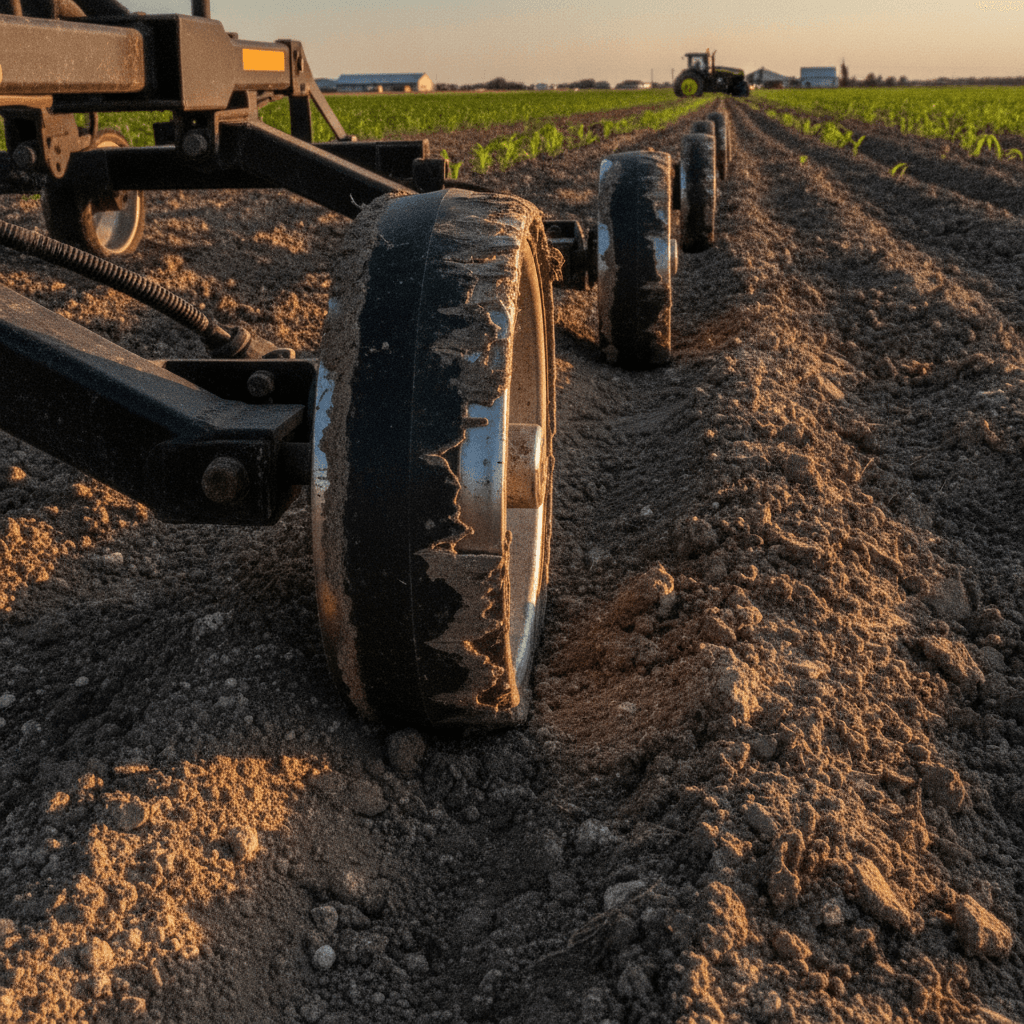
If you’re running a no-till drill in the heavy, abrasive soils east of Sioux Falls, your gauge wheel tire lips are under a different kind of stress than what a standard row planter sees. The drill opener forces through undisturbed ground, residue, and compacted soil layers — and the gauge wheel runs right beside that opener under pressure, lap after lap, field after field. The tire lip takes the brunt of it. If your steel ring is doing its job, the lip is protected. If it’s not, you’ll find out when you pull the drill out of the shed and notice the tire has worn into a groove where the lip used to be. By that point, you’re looking at a replacement tire, not just a ring.
This is a scenario that doesn’t get talked about nearly enough. Most of the conversation around steel rings focuses on row planters — protecting the tire lip, preventing mud buildup, scraping residue off the gauge wheel face. Those are real problems. But no-till drill operators deal with the same wear issues, often compounded by heavier row spacing, more aggressive soil contact, and the fact that drills tend to run at higher speeds across more acres per season than a corn or soybean planter. The wear curve is different, and so is the consequence of getting it wrong.
- Why No-Till Drill Gauge Wheel Tire Lips Wear Differently Than Planter Gauge Wheels
- What Most Steel Ring Manufacturers Don't Tell You About Drill Compatibility
- How to Tell If Your Current Ring Is Actually Working
- When to Replace vs. When to Upgrade
- Frequently Asked Questions
- Talk to Jung Enterprise Before Planting Season Gets Here
Why No-Till Drill Gauge Wheel Tire Lips Wear Differently Than Planter Gauge Wheels
On a standard row planter, the gauge wheel rides alongside a disc opener in freshly worked or at least disturbed ground. On a no-till drill, you’re dropping that opener into sod, heavy corn residue, or hard-crusted clay — and the gauge wheel has to maintain consistent depth contact the entire time. In the soils you find heading south from Ipswich down toward Sioux Falls and into eastern South Dakota, that ground gets abrasive. Sandy loam fields cut differently than the gumbo and clay-heavy soils in the James River Valley, but neither one is easy on rubber.
The tire lip — the outer edge of the gauge wheel tire where it contacts the opener disc or the furrow wall — is the first thing to go. It rounds off, then it grooves, then the tire starts to deform under load and you lose depth consistency. At that stage, you’re not just buying a new tire. You’re also questioning every planting depth decision you made for the last hundred acres.
A properly fitted steel ring changes that equation. The ring mounts to the outer face of the gauge wheel with six screws and creates a protective barrier between the tire lip and the opener disc. It absorbs the contact wear that would otherwise go straight into the rubber. It also functions as a built-in scraper, which matters on no-till drills that run through wet residue-heavy conditions — exactly the kind of spring you get across eastern South Dakota and into Minnesota and Iowa.
What Most Steel Ring Manufacturers Don’t Tell You About Drill Compatibility
Here’s a gap worth addressing directly: most steel ring options on the market are designed with a specific row planter in mind. You’ll find plenty of content out there about fitting rings to John Deere, Kinze, or Case IH row planters. What you won’t find is much honest guidance on how those same rings perform — or don’t perform — on air seeders and no-till drills where gauge wheel geometry, load, and contact angle may differ.
The Jung Enterprise Steel Ring (US Patent 11,707,013 B2 and related patents) is built to fit multiple gauge wheel sizes and is compatible across planters, air seeders, and no-till drills. That’s not an afterthought — it’s part of the design. If you’re running a drill with a different gauge wheel diameter or a non-standard hub configuration, it’s worth a direct conversation before you order. The fit has to be right or the scraper position won’t hold, and neither will the protection.
Durability data on no-till applications is hard to come by from most suppliers. What we can tell you is that in field testing across 13,000 planted acres over three years, Jung Enterprise steel rings showed only 1/16 inch of wear. That’s across row planter conditions. No-till drill conditions are harder on parts — which makes the design quality of the ring even more important, not less.
How to Tell If Your Current Ring Is Actually Working
The honest answer is that most operators don’t check until something is obviously wrong. Here’s what to look for instead:
- Check the tire lip, not just the tread face. Run your hand around the outer edge of the tire where it contacts the opener disc. If you feel a groove or a sharp undercut, the lip is already compromised — and your ring either wasn’t seated properly or wasn’t protecting that contact point.
- Look for mud bridges behind the gauge wheel. If you’re pulling the drill through wet field conditions and seeing mud accumulate on the backside of the wheel, the scraper function isn’t working. A ring that’s migrated out of position or wasn’t snugged down at the right angle won’t scrape consistently.
- Check ring screw torque mid-season. Six-screw mounting sounds like a lot, but vibration in no-till conditions is real. If screws are backing off, the ring walks, and protection drops. This is a ten-minute check that saves a tire.
- Compare left and right gauge wheels on the same unit. Uneven wear between sides usually points to an installation issue, a disk blade that’s out of spec, or inconsistent down pressure — not always a ring problem, but worth ruling out.
When to Replace vs. When to Upgrade
If you’re running no-till in eastern South Dakota or western Minnesota and you haven’t put a steel ring on your drill gauge wheels yet, post-harvest is the right time to evaluate — not mid-planting season. Farmers near Sioux Falls who run no-till into corn residue know that spring planting windows are short and the ground doesn’t always cooperate. You don’t want to be pulling gauge wheels in the field during a three-day planting window because a tire lip finally gave out.
If you’re already running rings and they’re more than two or three seasons old on a high-acre drill, measure the wear. If you’re past 1/8 inch of wear on the ring face, you’re getting close to the point where the ring itself starts transferring stress back to the tire rather than absorbing it. That’s when you replace the ring — not the tire.
For a closer look at the full product lineup and compatibility details, visit the Jung Enterprise products page or reach out directly.
Frequently Asked Questions
Do steel rings designed for row planters actually fit no-till drills?
Not always — and that’s the honest answer most suppliers skip. Gauge wheel geometry, diameter, and hub spacing vary between planter and drill configurations. Jung Enterprise steel rings are designed to fit across planters, air seeders, and no-till drills, but you should confirm compatibility for your specific drill model before ordering. A wrong fit means inconsistent scraper contact and reduced protection.
How often should I inspect steel rings on a no-till drill?
Check screw torque and ring position at least once mid-season on a high-acre drill. No-till conditions create more vibration than conventional planting, and a ring that’s loosened even slightly will lose scraper alignment. Full visual inspection at the start and end of every planting season is the minimum.
Is the tire lip the only part the steel ring protects?
The ring’s primary job is protecting the tire lip from contact wear against the opener disc. But the scraper function also protects the gauge wheel face from mud and residue buildup — which, left unchecked, throws off depth control and accelerates wear on both the tire and the disc. It’s two functions in one part, which matters when you’re deciding whether to buy a ring with a separate scraper or one that handles both.
My no-till drill runs at higher speeds than my row planter. Does that change how fast the steel ring wears?
Higher ground speed does increase abrasion on the gauge wheel system, including the ring. That’s exactly why the material and fit quality of the ring matters more on a drill than on a planter running at four or five miles per hour. A ring that measured only 1/16 inch of wear over 13,000 acres of planter use is a strong benchmark — but drilling conditions warrant close attention to wear rate on your specific setup.
What’s the real cost of skipping a steel ring on a no-till drill?
Gauge wheel tires are not cheap, and on a 30- or 40-foot drill, you’re replacing a lot of them if the lips fail. Beyond the tire cost, worn tire lips compromise depth consistency — which means you’re gambling on seed placement across every acre that drill touches. In a no-till system where you’re already fighting residue and variable soil conditions, that’s a risk that compounds fast.
Talk to Jung Enterprise Before Planting Season Gets Here
If you’re running a no-till drill near Sioux Falls, or anywhere across South Dakota, Minnesota, or Iowa, and you’re not sure whether your current gauge wheel setup is actually protecting the tire lip — or just looking like it is — we’re worth a call. Jung Enterprise is based in Ipswich and has been building patented, American-made gauge wheel parts for row-crop farmers and no-till operators across the Northern Plains. We’ll tell you straight whether our parts fit your drill and what to expect.
Reach out to Jung Enterprise here — before the next planting window, not during it.