
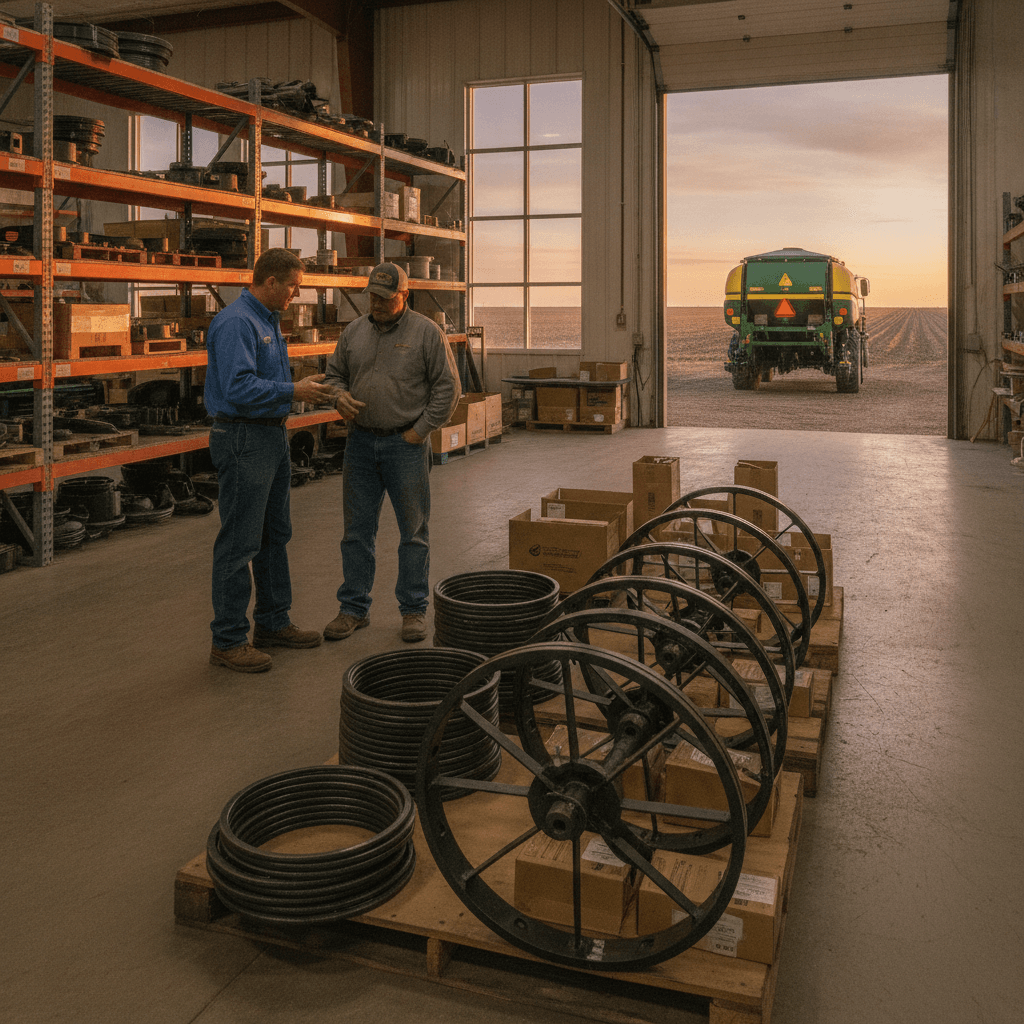
How Do Ag Dealers Near Watertown Know Whether Their Gauge Wheel Parts Inventory Is Actually Set Up for Planting Season — Or Just Stocked for Last Year’s Demand?
If you’re running an ag dealership near Watertown, South Dakota, you already know how fast planting season can turn a slow March into a parts counter that’s buried under customer requests you can’t fill. The farmers you serve don’t have time to wait on back-ordered gauge wheel parts once the soil temperature hits planting range. When a row unit goes down in a wet field, they need the fix on the shelf — not on a truck somewhere between a regional distributor and your dock. The question most dealers aren’t asking until it’s too late: is your gauge wheel parts inventory actually built for the season you’re about to have, or is it just a carryover from last year that may or may not match what your customers actually need?
- Why Gauge Wheel Part Demand Shifts Year to Year
- What Dealers Near Watertown Are Actually Stocking Wrong
- How to Evaluate Whether Your Current Supplier Is Actually Supporting You
- Building an Inventory Strategy That Actually Matches Your Customer Mix
- Frequently Asked Questions From Dealers Near Watertown
- Talk to Jung Enterprise Before Your Inventory Deadline
Why Gauge Wheel Part Demand Shifts Year to Year
Inventory that worked in a dry spring can leave you completely exposed in a wet one. Across the Northern Plains — including the areas east of Aberdeen and north of Huron that Watertown-area dealers typically serve — wet clay and gumbo soils put serious wear on gauge wheel tires, tire lips, and the hardware holding those wheels on the machine. When soils pack up and mud starts building on gauge wheels, you’ll see three or four specific parts driving the bulk of your urgent customer calls: replacement gauge wheels, steel tire-lip protection rings, wheel retainers, and in some cases the full assembly.
What dealers often miss when stocking for planting season is that demand for these parts isn’t evenly distributed across your customer base. No-till and strip-till operations — which make up a growing share of acreage in South Dakota and across into North Dakota and Minnesota — put more stress on gauge wheels per pass than conventional tilled ground. If your customer mix is shifting toward no-till and you’re still stocking for a tilled-ground spring, you’ll run short on the parts that matter most right when demand peaks.
What Dealers Near Watertown Are Actually Stocking Wrong
Here’s the gap most competitor suppliers don’t talk about directly, but it’s worth saying plainly: a lot of dealers stock gauge wheel tires and basic hardware, but overlook the protection and retention components that prevent those tires from wearing out prematurely in the first place.
The tire lip is one of the first things to go on a gauge wheel operating in abrasive South Dakota soils. Once the lip wears down, the tire loses its seat against the hub and the gauge wheel starts losing its ability to hold consistent planting depth. A steel ring mounted over that tire lip — like the patented steel ring from Jung Enterprise — stops that wear before it starts. It also doubles as a built-in mud scraper, so you’re not selling your customers a separate scraper attachment just to keep the gauge wheel from packing up in heavy residue. Six screws, done. That’s the install.
Similarly, wheel retainers are a part that frequently gets overlooked until a gauge wheel physically walks off a row unit mid-field. By then, the farmer isn’t just looking for a retainer — they may be looking for a new gauge wheel, too, because the one that came off got run over or damaged in the process. Stocking wheel retainers proactively is exactly the kind of margin-protecting, repeat-business move that keeps customers loyal to your counter instead of calling someone else.
How to Evaluate Whether Your Current Supplier Is Actually Supporting You
This is where a lot of dealers near Watertown get burned, and it’s worth being direct about it. Some suppliers look great on paper — broad catalog, decent pricing — but when planting season stacks up and you’re calling in urgent orders, their lead times stretch out or they go direct to your customers online and cut you out of the margin entirely.
When you’re evaluating a gauge wheel parts supplier, ask these questions before you commit inventory budget:
- Do they sell direct to farmers at the same price they sell to dealers? If they do, you’re not a distribution partner — you’re just doing their logistics for them.
- Can they document real-world durability? Field-tested numbers matter. Jung Enterprise’s steel rings have logged 13,000 planted acres over three years with only 1/16″ of measured wear. That’s not a spec sheet claim — that’s documented field performance your customers can count on.
- Are the parts patented and American-made? Imported knock-off gauge wheel hardware is out there, and it undercuts pricing in ways that don’t hold up after a full season. Patented designs (U.S. Patent No. 11,707,013 B2 and related patents) backed by American manufacturing give you something real to stand behind at the counter.
- What’s their lead time when things get tight? A supplier based in Ipswich, SD — not six states away — is a different conversation when you need parts moving quickly across the Northern Plains.
Building an Inventory Strategy That Actually Matches Your Customer Mix
A practical starting point for Watertown-area dealers going into a planting season is to look at your previous two seasons’ parts counter data by row unit type, not just by part number. If you serve a customer base with a high percentage of no-till corn and soybean acres, your gauge wheel component demand will skew differently than a dealer serving primarily tilled-ground operators.
For no-till and strip-till operations, curved spoked gauge wheels are worth stocking specifically because the open-spoke design actively sheds residue and mud instead of packing it. A standard solid gauge wheel will plug up in heavy corn stalk residue and drag material into the seed trench — that’s a depth consistency problem that shows up at harvest, not in the field during planting. Dealers who stock the curved spoked gauge wheels built for those conditions are solving a problem their customers haven’t always articulated yet, which is exactly the kind of value that builds long-term counter loyalty.
Timeline matters, too. The February through April window is when most of your gauge wheel demand will hit. If you’re waiting until late March to place stocking orders, you’re already behind in a tight spring. Post-harvest — September through November — is actually a better time to assess your inventory gaps and get ahead of what your customers will need the following year.
Frequently Asked Questions From Dealers Near Watertown
Does Jung Enterprise sell direct to farmers, or do they support their dealer network?
Jung Enterprise works with ag dealers and distributors as real partners — not as a workaround to get to their customer base. Dealer relationships matter to us the same way they matter to the farmers you serve.
What gauge wheel sizes and planter brands do Jung Enterprise products fit?
Jung Enterprise parts are built to fit multiple OEM gauge wheel sizes and are compatible across planters, air seeders, and no-till drills from major brands. Contact us directly with your customers’ specific equipment list to confirm compatibility before you commit to stocking quantities.
How hard is the steel ring to install? Will my customers need a shop to do it?
The steel ring mounts with six screws. Most operators can install it in the field without a shop visit. That’s a real selling point at the counter — especially when your customers are in a narrow planting window and can’t afford downtime.
What’s the realistic wear life dealers should be quoting customers on these parts?
Field-tested across 13,000 acres over three seasons, the steel ring showed only 1/16″ of wear. That’s concrete durability your customers can plan around — and a number that holds up against anything else on the market.
Can dealers in South Dakota and North Dakota get parts quickly enough for in-season urgent orders?
Jung Enterprise is based in Ipswich, SD — not on a coast or overseas. For dealers across South Dakota, North Dakota, and into Minnesota, that proximity makes a real difference when a customer calls with an in-season emergency.
Talk to Jung Enterprise Before Your Inventory Deadline
If you’re an ag dealer near Watertown — or anywhere across the Northern Plains — and you want to build a gauge wheel parts inventory that actually holds up when planting season pressure hits, we’re worth a conversation before you finalize your stocking orders. Jung Enterprise is a family-owned American manufacturer based in Ipswich, SD, and we work directly with dealers and distributors who want patented, field-proven parts they can put their name behind.
Reach out to Jung Enterprise here to talk through your inventory needs, confirm part compatibility for your customer base, or get set up as a dealer or distributor. Don’t wait until April to have this conversation — the dealers who are ready in February are the ones their customers remember come fall.