
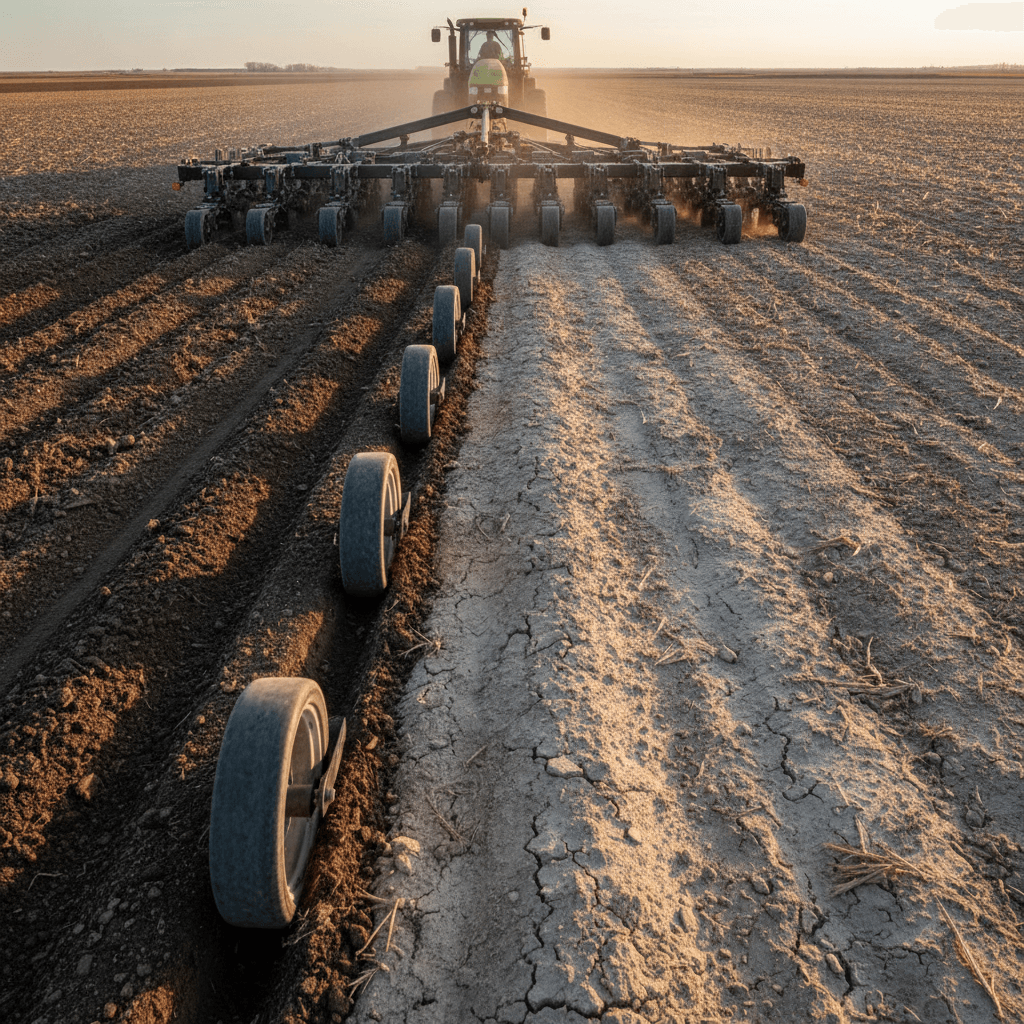
How Do Farmers Near Fargo Know Whether Their Planter’s Row Unit Downforce Is Actually Responding to Soil Conditions — Or Just Set and Forgotten at the Start of the Season?
Most farmers near Fargo set row unit downforce before the first field of the season and don’t touch it again. That’s understandable — planting windows in North Dakota and across the Northern Plains are short, and stopping to adjust springs or air bags mid-run feels like lost time. But if your downforce isn’t matching your actual soil conditions, you’re either bouncing row units across dry, firm ground or overloading gauge wheels into heavy, wet soils. Neither one is giving you the seed depth consistency you need to maximize your corn or soybean stand.
- Why Downforce and Gauge Wheel Load Are More Connected Than Most People Think
- What the Competitors Aren't Telling You About Downforce and Gauge Wheel Wear
- The Field-by-Field Reality in the Red River Valley and Northern Plains
- Practical Signs Your Downforce Is Wrong for Current Conditions
- How Gauge Wheel Parts Factor Into This
- Frequently Asked Questions: Row Unit Downforce and Gauge Wheel Performance Near Fargo
- Get the Right Setup Before the Next Planting Season
Why Downforce and Gauge Wheel Load Are More Connected Than Most People Think
Row unit downforce doesn’t just determine how hard the opener pushes into the ground. It directly determines how much load your gauge wheels are carrying. When downforce is too high for current soil conditions, the gauge wheels bear the excess — they’re literally the stop that keeps the opener from going too deep. Run that situation across 40 acres of firm, dry ground north of Fargo and you’re putting serious side load and grinding pressure on the gauge wheel tire lip every single pass.
That’s not a theoretical problem. It’s one of the most common causes of accelerated gauge wheel tire wear that we see, and it’s almost always traced back to a downforce setting that was dialed in for wet spring conditions and never adjusted when the field dried out three days later.
Conversely, too little downforce in heavy clay or the gumbo soils that show up across parts of eastern North Dakota and into Minnesota means the opener isn’t maintaining consistent depth. The row unit floats, seed depth varies by an inch or more across the same pass, and you get uneven emergence — which is a yield problem, not just an aesthetic one.
What the Competitors Aren’t Telling You About Downforce and Gauge Wheel Wear
Most of the well-known gauge wheel and planter attachment manufacturers — and there are several — spend their content explaining why their gauge wheel design sheds mud better or lasts longer. That’s fair. But almost none of them address the upstream cause: when downforce is set wrong, even a good gauge wheel is fighting a losing battle. You can put the best gauge wheel on the market on a row unit that’s running 40 pounds of excess downforce, and you’re still going to chew through that tire lip faster than you should.
The honest answer is that gauge wheel durability and planting depth consistency depend on the whole system working together — downforce, gauge wheel condition, tire lip protection, and residue management all feed into each other. At Jung Enterprise out of Ipswich, that’s the way we think about it: the Steel Ring protects the gauge wheel tire lip from the kind of accelerated wear that comes from excess load and abrasive soil contact, but it works best when the row unit is also set up to run at reasonable downforce for the conditions you’re actually in.
The Field-by-Field Reality in the Red River Valley and Northern Plains
The soils around Fargo and the broader Red River Valley are not uniform. You can go from heavy, wet clay near a drainage ditch to light, sandy loam within the same field. Farmers running air bag downforce systems have an advantage here because they can adjust on the go — but only if they’re actually watching what’s happening at the row unit level and making changes. Farmers on spring-tension systems are more locked in, which makes pre-season setup and in-season awareness even more critical.
In wet spring conditions — which are common across North Dakota and into Minnesota — gauge wheel plugging with mud is a related problem. Mud packs into the wheel, the gauge wheel stops rolling cleanly, and depth control goes out the window. That’s where an open-spoke curved gauge wheel design and a built-in tire lip scraper both earn their keep. But again, none of that helps if the downforce setting is loading the gauge wheel beyond what it’s meant to handle.
Practical Signs Your Downforce Is Wrong for Current Conditions
You don’t need a monitor to catch obvious downforce problems. Here’s what to watch for:
- Gauge wheel tire lip wear that’s faster than expected — if you’re replacing gauge wheel tires well before 10,000 acres, excess downforce on firm ground is a likely contributor
- Seed depth that’s inconsistent across the same field — shallow on ridges, deeper in low spots, when the field is otherwise uniform
- Row unit bouncing visibly on firm ground — a sure sign downforce is excessive for dry conditions
- Gauge wheels skating across the surface rather than rolling under load — too little downforce, especially in residue-heavy no-till fields
- Mud bridging under the gauge wheel in wet conditions — this happens faster when downforce is pushing the wheel harder into soft soil
How Gauge Wheel Parts Factor Into This
If you’re already dealing with accelerated tire lip wear from years of heavy downforce on firm ground, protecting what you have left — and making sure replacement wheels hold up longer — matters. The patented components from Jung Enterprise are specifically designed to address the wear and plugging failures that show up when gauge wheels are working hard in difficult conditions.
The Steel Ring mounts with six screws directly to the gauge wheel, protects the tire lip from the grinding contact that kills OEM tires early, and doubles as a built-in scraper — so you’re not buying a separate scraper bracket and hoping it stays adjusted. Field testing over 13,000 planted acres showed only 1/16 inch of wear over three seasons. That’s not a marketing claim — that’s a documented field result from real no-till acres.
Pair that with a curved spoked gauge wheel design that sheds residue and mud instead of packing it, and you’ve got a gauge wheel assembly that can actually keep up with the variable soil conditions that Northern Plains farmers deal with every spring.
Frequently Asked Questions: Row Unit Downforce and Gauge Wheel Performance Near Fargo
How much downforce should I be running on heavy clay soils in eastern North Dakota?
There’s no single right number — it depends on your planter, row unit weight, and whether you’re running no-till or conventional. The practical test is whether your gauge wheels are carrying load without being overloaded. If you’re seeing gauge wheel tire wear faster than expected on firm ground, downforce is likely too high for those conditions.
Does gauge wheel tire lip wear always mean my downforce is too high?
Not always, but it’s one of the most common causes that gets overlooked. Abrasive soils, excessive sidewall flex from low tire pressure, and running without any tire lip protection can all contribute. Downforce is worth checking first because it’s often the root cause.
Can a steel ring on the gauge wheel actually compensate for high downforce loads?
It helps significantly by protecting the tire lip from direct soil abrasion and preventing the lip deformation that accelerates wear under load. It’s not a substitute for getting downforce right, but it will extend the life of your gauge wheel tires even in demanding conditions.
Do curved spoked gauge wheels shed mud better than solid wheels in the gumbo soils around Fargo?
Yes — the open spoke design gives mud somewhere to go instead of packing solid. In heavy, wet conditions typical of the Red River Valley during early planting, this makes a real difference in whether the gauge wheel keeps rolling cleanly or starts to act like a mud paddle.
Can I get Jung Enterprise parts to fit my current planter without replacing the whole gauge wheel assembly?
The Steel Ring and Wheel Retainer are designed to mount on your existing gauge wheels without a full assembly replacement. Curved spoked gauge wheels are available in sizes compatible with multiple OEM planters and air seeders. Contact Jung Enterprise directly to confirm fitment for your specific setup.
Get the Right Setup Before the Next Planting Season
Whether you’re farming near Fargo, across North Dakota, into Minnesota, or back south through the Dakotas, the planting window doesn’t give you time to troubleshoot gauge wheel and downforce problems in the field. Getting that sorted now — before February pre-season prep turns into crunch time — is the right call.
If you want to talk through gauge wheel protection, downforce interaction, or fitment for your specific planter, reach out to Jung Enterprise in Ipswich. We build these parts, we field-test them, and we can give you a straight answer about what’s going to work for your operation.