
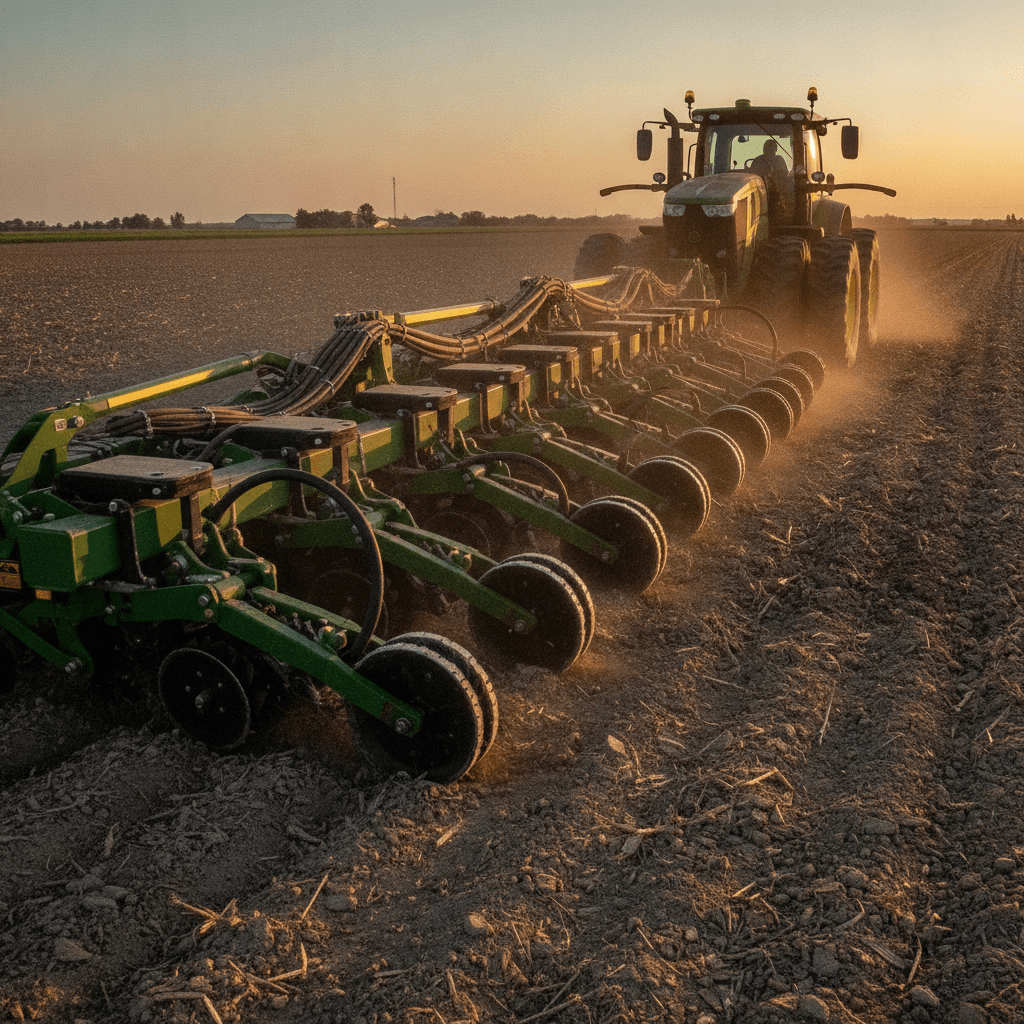
How Do Custom Planters Near Brookings Know Whether Their Steel Ring Is Actually Surviving the Jump Between Multiple Farms — Or Just Holding Up on One Field?
If you’re running a custom planting operation near Brookings, you already know you’re not farming one field type. You might start the week in tight clay ground south of town, move to a sandier no-till operation by midweek, and finish on fields that haven’t seen a tillage pass in five years with two-inch corn residue mats still sitting on top. That kind of variety is hard on everything — and your gauge wheel steel ring takes a beating that most equipment wasn’t designed to handle field after field, farm after farm, without a real inspection between stops.
The problem isn’t that steel rings fail catastrophically. It’s that they degrade gradually across the season, and custom operators are the last people with time to catch it. By the time you notice the tire lip is grinding or the scraper isn’t clearing mud like it was in April, you’ve already put the wrong planting depth on someone else’s crop.
Why Multi-Farm Operations Put More Stress on Steel Rings Than Most People Realize
A typical owner-operator puts a planter on one farm, maybe two, and the soil conditions are fairly consistent. You get a feel for how your equipment is performing because you’re in the same ground every day. Custom planters don’t have that luxury. You’re adapting constantly — different residue loads, different moisture levels, different soil textures — and the cumulative stress on your gauge wheel components reflects that.
Here’s what that actually means for a steel ring:
- Abrasion variation: Sandy soils wear the ring face faster. Heavy clay gumbo, the kind you find in wet springs across eastern South Dakota and western Minnesota, packs into every gap and forces the scraper to work harder on every rotation.
- Residue loading: High-residue no-till fields — especially corn-on-corn — load more debris against the ring than tilled ground. If the ring isn’t actively shedding that material, it’s packing it.
- Road transport cycles: Custom operators load and unload the planter more often. Every planter fold and road transport cycle puts lateral stress on mounted components. A ring that’s loosening on its screws can migrate out of alignment between farms without anyone catching it until depth control gets sloppy.
- Inspection gaps: When you’re moving from farm to farm with a tight planting window, you’re not pulling the planter apart between every stop. Wear that would get caught on a Monday pre-plant check on a home farm can go unnoticed for two or three farms on a custom rig.
What to Actually Check Between Farm Stops — Not Just at Season’s End
Most competitor content on steel rings focuses on pre-season setup or post-season inspection. That’s fine for an owner-operator running one set of fields. For a custom planting operation, you need a mid-season and between-farm check routine that doesn’t eat your whole lunch break.
When you’re pulling out of one farm and staging for the next, take five minutes to check these specific things on your gauge wheel steel ring:
- Scraper position: Is the scraper still seated flush against the tire? A ring that’s walked even a few millimeters will start letting mud bypass the scraper edge. You’ll see a buildup pattern on the tire that tells you exactly where it’s slipping.
- Screw torque by feel: You don’t need a torque wrench in the field, but grab each of the six mounting screws and check for any that have backed off. Loose screws on a six-screw mount are the number-one cause of ring migration between farms.
- Tire lip contact: Look at the contact edge between the steel ring and the tire lip. Even wear is normal. Uneven wear — especially heavy wear on one side of the lip — tells you the ring has been running cocked, which means your depth control has been off on that row unit.
- Visible cracking or deformation: A ring that’s taken a hard hit from a rock or a root mass in heavy no-till can deform subtly without cracking all the way through. If it’s no longer sitting flat, replace it before the next farm.
The Jung Enterprise Steel Ring is built with this kind of use in mind. It’s patented (US 11,707,013 B2) and field-tested to only 1/16″ of wear after 13,000 planted acres over three years — and those acres weren’t all the same soil type. The built-in scraper is part of the ring itself, not a separate clip-on piece that can get knocked loose between farm moves. That matters when you’re not doing a full teardown every time you relocate.
The Gap Nobody’s Talking About: Custom Operators vs. Owner-Operators in Equipment Design
Most of the major gauge wheel component manufacturers — and most of the content you’ll find from competitors — target the owner-operator: one farm, one set of soil conditions, one planting window. Custom planters near Brookings, Huron, Sioux Falls, and across eastern South Dakota and southwestern Minnesota are running equipment under fundamentally different conditions, and the design and maintenance assumptions don’t always translate.
A ring designed primarily for consistent tilled ground is going to behave differently after three farms of wet clay, a high-residue no-till field, and a strip-till pass where the berm geometry is loading the gauge wheel sideways. The scraper geometry, the mounting system, and the material hardness all matter in ways that a product spec sheet doesn’t always make clear.
That’s one reason Jung Enterprise, based in Ipswich, focused on a patented design rather than a generic bolt-on. The six-screw mount holds position under lateral load. The scraper is machined into the ring profile, not added as an afterthought. And the steel hardness is selected for wear resistance across varied abrasion conditions — not just optimized for one soil type.
If you’re a custom operator and you’re evaluating gauge wheel components, ask the supplier directly: has this been tested across multiple soil types and residue conditions, or just one farm’s worth of acres? The answer tells you a lot about whether the product was designed for how you actually work. You can learn more about how Jung Enterprise approaches this at our about page.
When to Replace vs. When to Keep Running
This is the honest tradeoff question that custom operators actually face in-season. You’re mid-May, you’ve got three more farms booked, and you’re looking at a ring that’s showing wear but hasn’t failed yet. Do you swap it now or push through?
A few practical guidelines:
- If the scraper is still clearing the tire face consistently and the ring is seated flat, keep running and monitor it.
- If you’re seeing mud buildup on the tire that wasn’t there two farms ago, the scraper is losing contact. Replace it — depth consistency is already compromised.
- If the tire lip shows uneven wear patterns, the ring has been running cocked and the row unit hasn’t been seeding at consistent depth. Replacing the ring won’t fix the depth problem retroactively, but it stops the damage from compounding.
- At 1/16″ of wear over 13,000 acres, a properly functioning Jung steel ring has significantly more service life than most operators expect. If you’re replacing rings more often than that, it’s worth checking whether the ring is correct for your gauge wheel size and whether the mount is getting proper torque on initial install.
FAQ: Steel Rings for Custom Planting Operations
Do Jung Enterprise steel rings fit multiple planter brands?
Yes. The steel ring is designed to be compatible across multiple OEM brands and gauge wheel sizes. If you’re running different planter setups across your custom operation, contact Jung Enterprise directly to confirm fitment for your specific gauge wheel dimensions before ordering.
Can I install a steel ring in the field between farm stops, or does it need a shop?
Installation is straightforward — six screws, no special tooling required. Most operators can swap a ring in the field in under fifteen minutes once they’ve done it once. That said, doing your first install in the shop before the season starts is the right call so you know what correct seating looks like before you’re doing it in a muddy field.
I’m a custom planter running corn and soybeans across eastern South Dakota and western Minnesota. Will one ring design work across both?
For most operators in that geography, yes — but residue conditions and soil moisture vary enough that it’s worth discussing your specific rotation and field types with Jung Enterprise. Corn residue in no-till conditions loads the scraper differently than soybean stubble, and knowing what you’re working with helps confirm you’re getting the right spec.
How do I know if the scraper is still doing its job mid-season without pulling the planter apart?
Watch the tire face on the gauge wheel after a muddy field. If the tire is running clean, the scraper is working. If you’re seeing a consistent mud ring or buildup pattern on the tire, the scraper has lost contact — either because the ring has shifted or worn past its effective range. That’s your signal to inspect and likely replace.
Does Jung Enterprise sell directly to custom operators, or only through dealers?
Jung Enterprise sells direct and works with ag dealers and distributors across the region. If you’re a custom operator with a high annual acre count and want to talk about volume or timing for pre-season orders, reach out directly — they work with operators across South Dakota, North Dakota, Minnesota, Iowa, and Nebraska.
Custom planting is a different game than farming your own ground, and your equipment decisions need to reflect that. If you’re putting 10,000 or 15,000 acres a season across a half-dozen farms and you’re relying on gauge wheel components that were designed and tested for one soil type on one farm, you’re leaving performance and reliability on the table. Contact Jung Enterprise to talk through your specific operation and get the right steel ring, wheel retainer, or curved spoked gauge wheel spec for how you actually work — not how the average owner-operator works.