
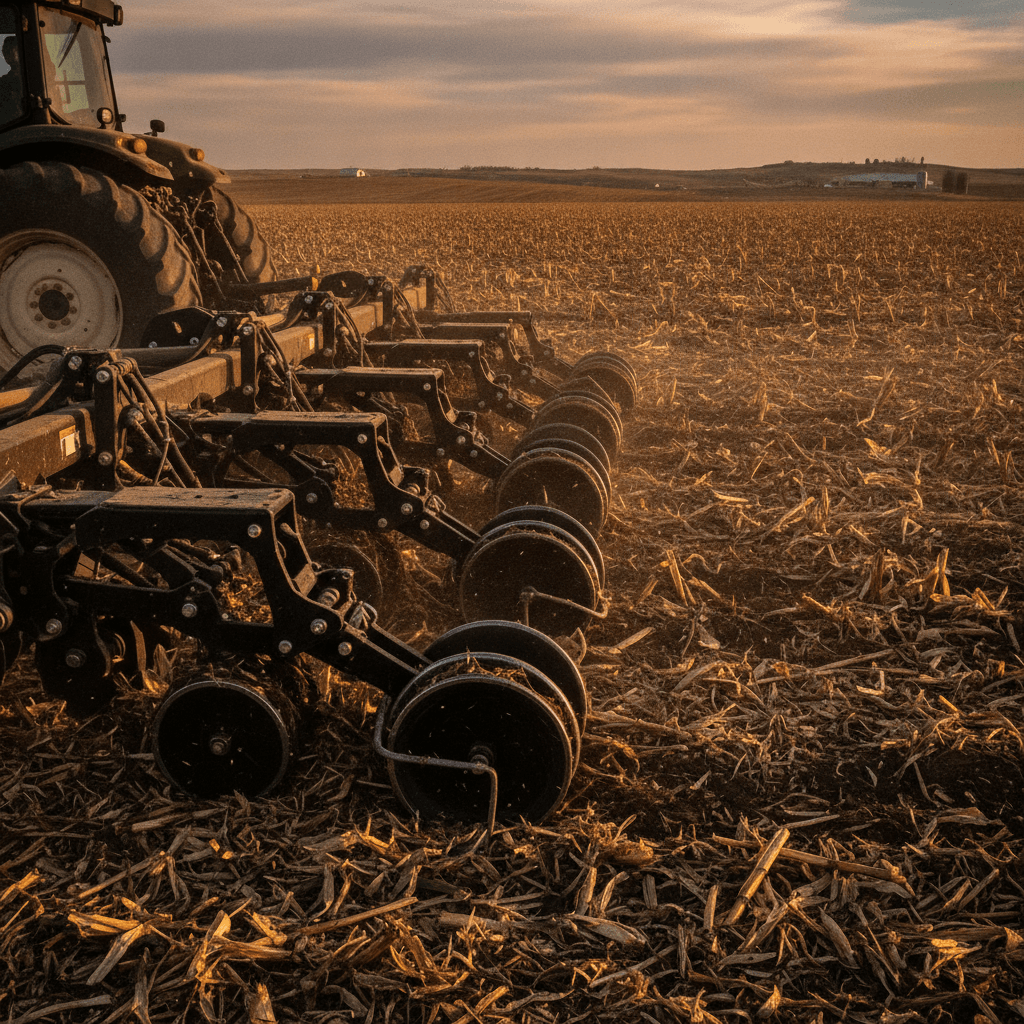
How Do Farmers Near Huron Know Whether Their Planter’s Steel Ring Is Actually Protecting Gauge Wheel Performance When Planting Into Standing Corn Residue — Or Just Getting Chewed Up Before Corn Even Gets in the Ground?
If you’re farming near Huron and running a no-till or minimum-till corn program, your gauge wheels are hitting a completely different wall than they would on worked ground. Standing corn stalks, heavy surface mat, and the unpredictable wet springs across central South Dakota put a specific kind of stress on your tire lips and steel ring mounts — one that most product marketing quietly skips over. The short answer: if your steel ring wasn’t built to handle repeated contact with abrasive residue while staying locked in place and shedding mud at the same time, it’s likely wearing faster than you think, and you may not notice until depth control starts drifting.
What Corn Residue Actually Does to Your Gauge Wheel Components
Most conversations about gauge wheel wear focus on soil abrasion — sandy or rocky ground grinding down the tire lip over thousands of acres. That’s a real problem. But the wear pattern in corn residue fields looks different and hits different parts of the assembly.
Corn stalks and cobs don’t just pass under the gauge wheel. They get pushed sideways, forced into the gap between the tire lip and the furrow opener disk, and dragged through that contact zone with every row unit pass. That lateral pressure concentrates on the inner tire lip edge — exactly where an unprotected gauge wheel is most vulnerable. Without a steel ring in place, the rubber at that lip starts to abrade, deform, and eventually cup. Once the lip profile changes, you’ve lost the consistent side pressure that holds your seeding depth steady.
There’s also the plugging issue. Corn residue mixed with wet soil — common in the Huron area and across the James River valley during a typical South Dakota spring — packs into the spoke openings on standard gauge wheels and doesn’t clear easily. That packed material adds rotational drag, and if it builds unevenly across row units, your depth starts varying row to row without you realizing it.
Where Most Steel Ring Options Fall Short in Residue Conditions
Here’s the gap that most competitor products don’t address directly: a steel ring that protects the tire lip from soil abrasion doesn’t automatically handle residue-related wear the same way. The loading is different. Residue contact is more lateral, more intermittent, and often more aggressive in short bursts than steady soil friction.
What you need in a residue-heavy environment is a steel ring that stays mechanically fixed under that variable side loading — not one that can work loose between fields. Rings that rely on friction alone or use minimal fastening points are the ones that migrate out of position after a few hundred acres of stalk-heavy ground. Once the ring shifts, it stops functioning as a scraper, and the tire lip it was protecting is exposed again.
Jung Enterprise’s patented steel ring (US 11,707,013 B2) mounts with six screws, which distributes clamping force evenly around the ring and keeps it from rotating or walking under the kind of variable lateral loads that corn residue creates. That’s not a minor detail — it’s the reason the ring can hold its scraper position across an entire planting season rather than starting the season correctly and drifting by the time you’re halfway through your acres.
The Built-In Scraper Advantage You’re Not Getting With Add-On Solutions
One thing that comes up consistently when farmers around Aberdeen and Mitchell are comparing gauge wheel protection options is whether they need a separate mud scraper in addition to a steel ring. With most designs, the answer is yes — the ring protects the lip, but something else has to clear the buildup between the ring and the tire sidewall.
Jung Enterprise’s steel ring doubles as a built-in scraper. The geometry of the ring is designed so that as the wheel rotates, the ring edge works against residue and mud accumulation rather than letting it pack in. You’re not bolting on a second component, adjusting a separate arm, or losing a standalone scraper in a field at the wrong time. One part handles both functions, which also means one fewer thing to check, adjust, or replace mid-season.
In the field, this matters most during the wet stretches that hit central South Dakota every few springs. When the ground is wet enough that every pass through a corn residue field is pulling mud up into the row unit, having a scraper function built into the tire lip ring keeps the gauge wheel rotating cleanly instead of progressively dragging more material with each revolution.
What Field-Tested Durability Actually Looks Like Through Residue Seasons
Numbers matter here more than claims. Jung Enterprise’s steel ring has been field-tested across 13,000 planted acres over three years, with measured wear of only 1/16 inch over that entire span. That’s across varied field conditions — not a controlled trial on clean, tilled ground.
For a farmer near Huron running 1,500 to 2,000 acres of corn annually, that durability profile means you’re looking at a steel ring that should realistically carry you through multiple full seasons before replacement becomes a real conversation. That’s a different math than buying a cheaper ring that needs replacement every season or every other year because it couldn’t handle the residue and mud loading specific to no-till and minimum-till corn ground.
If you want to see the full product specs and sizing compatibility before your next pre-plant equipment check, the Jung Enterprise products page has the details you need to confirm fitment for your row units.
How to Actually Check Whether Your Current Ring Is Holding Up
Don’t wait for a depth problem to tell you the ring failed. Check these three things after every 200–300 acres during your planting run, especially in heavier residue fields:
- Scraper position: The ring edge should still be riding flush against the tire sidewall. If you see a gap or the ring has rotated out of its original position, it’s no longer scraping effectively.
- Fastener torque: With a six-screw mount, check that none of the screws have backed out. Variable loading in residue fields can work fasteners loose if they weren’t torqued to spec during install.
- Tire lip profile: Run your hand around the inner tire lip edge. If you feel a distinct lip or cupping that wasn’t there at the start of the season, the ring shifted at some point and the tire has been wearing unprotected.
FAQs: Steel Rings and Gauge Wheel Protection in Corn Residue Near Huron
Does a steel ring actually make a difference in no-till corn residue versus conventional tillage?
Yes — and arguably more so. In conventional tillage, the soil is looser and residue is incorporated, so tire lip wear is mostly from soil abrasion. In no-till and minimum-till, you’re adding residue contact and lateral stalk forces on top of that. A ring designed for residue conditions handles both wear types; one designed only for soil abrasion may not hold up as well in heavy residue.
Will a steel ring work on air seeders, or just row planters?
Jung Enterprise’s steel ring is compatible with planters, air seeders, and no-till drills across multiple OEM gauge wheel sizes. If you’re running an air seeder for your small grain acres in addition to a corn/soybean planter, check the sizing specs to confirm compatibility on both machines.
How hard is installation — can I mount it myself in the shop?
Installation is straightforward. The ring mounts with six screws and doesn’t require special tooling. Most operators can mount it in the shop without a service call. The key is torquing the fasteners to spec so the ring doesn’t work loose in the field.
Is the built-in scraper function enough, or do I still need a separate residue manager for the row unit?
The steel ring handles mud and residue buildup on the gauge wheel tire lip specifically. Separate row-unit residue managers (like row cleaners) address residue on the soil surface ahead of the opener. Both serve different functions — the steel ring isn’t a substitute for a row cleaner if your fields need one, but it does eliminate the need for a separate tire scraper component.
Where is Jung Enterprise located, and can I talk to someone about fitment for my specific planter?
Jung Enterprise is based in Ipswich, South Dakota, and serves farmers across the Northern Plains including the Huron area, Aberdeen, Mitchell, and beyond. You can reach the team directly to discuss compatibility and fitment for your row units.
If you’re heading into post-harvest equipment review or planning your pre-plant overhaul, now is the right time to look at what your gauge wheel steel rings actually survived this season — and whether they’ll hold up through another residue-heavy spring. Contact Jung Enterprise to talk through your setup and get the right parts on order before the rush hits.