
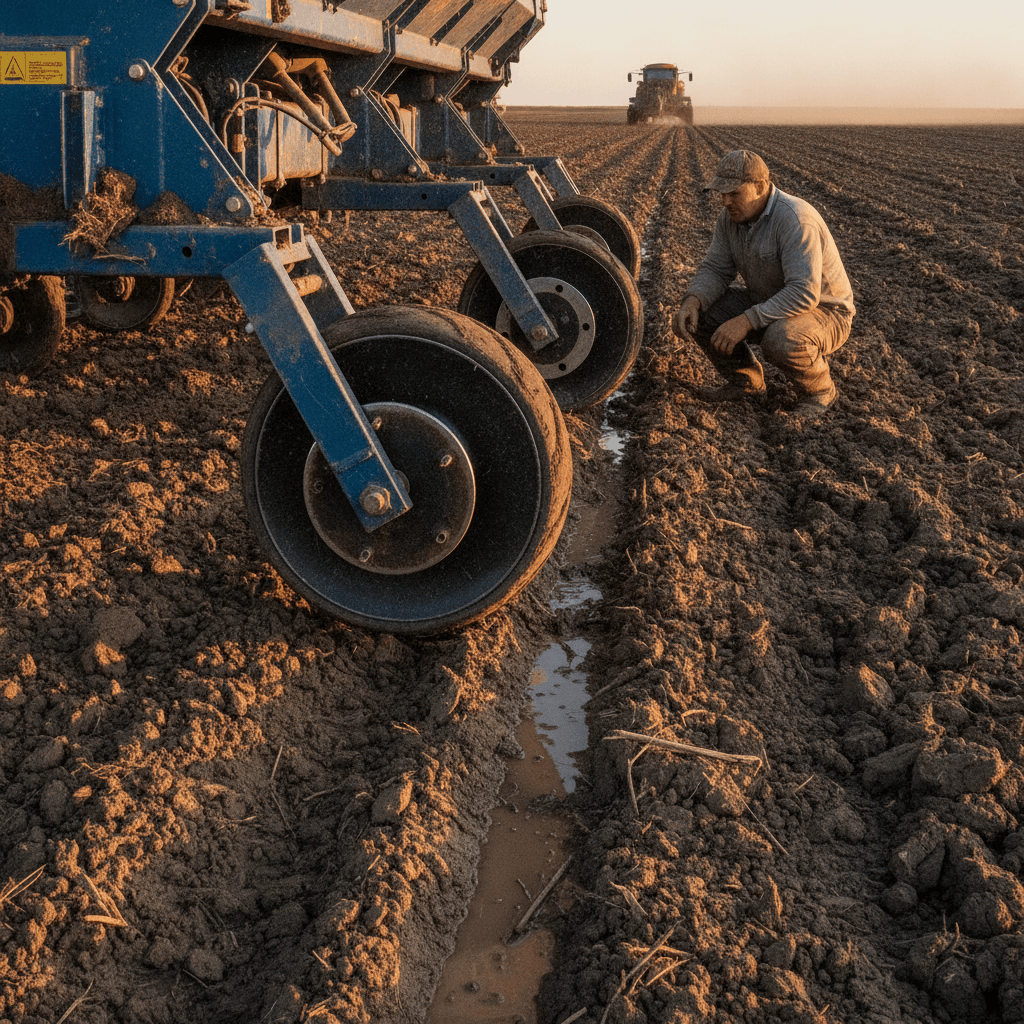
How Do Farmers Near Aberdeen Know Whether Their Planter’s Gauge Wheel Retainer Is Actually Keeping the Wheel From Dislodging — Or Just Waiting to Fail Mid-Field?
If you’re running a planter near Aberdeen and your gauge wheel pops off mid-pass, you don’t just lose a few minutes — you lose a pass, you lose depth consistency on that row for the rest of the field, and depending on how far you went before you noticed, you’ve got a section of corn or soybeans planted with no gauge wheel riding that disk at all. That’s not a close call. That’s a yield problem you won’t be able to trace until July. The wheel retainer is the part standing between your gauge wheel staying seated and it walking off the axle under load. And yet it’s one of the least-talked-about components in the entire row unit conversation.
Why Gauge Wheel Retainer Failure Gets Overlooked Until It’s Too Late
Most farmers inspect their gauge wheel tires before planting. Some check the hubs. Very few pull the retainer and actually examine whether it’s still holding the gauge wheel securely against the axle shoulder the way it’s supposed to. The retainer isn’t something that announces its failure early. It doesn’t make noise. It doesn’t show visible wear the way a tire does. It just quietly loosens, loses its grip, and eventually lets the wheel walk off — usually when you’re running through a wet, heavy stretch of ground where lateral forces are at their worst.
In the clay and gumbo soils common across Brown County and the surrounding area near Aberdeen, that scenario plays out more often than it should. Wet spring conditions put serious lateral stress on the row unit. The gauge wheel is being pushed sideways by soil that doesn’t want to move, and the retainer is the only thing keeping it from sliding off the axle in those conditions. If the retainer is worn, cracked, improperly installed, or just a cheap stamped piece that wasn’t designed for real field loads, you’re going to find out about it the hard way.
What a Failing Retainer Actually Looks Like Before It Lets Go
You won’t always get advance warning, but here’s what to check during pre-plant inspection and between fields:
- Side play on the gauge wheel. Grab the wheel and push it laterally. There should be minimal play. If it rocks noticeably side to side on the axle, the retainer isn’t holding it tight enough against the shoulder.
- Visible deformation or cracking on the retainer itself. A stamped retainer that’s been stressed repeatedly will show it — look for bowing, stress cracks near the mounting points, or flattening where it contacts the wheel.
- Retainer that’s no longer flush or fully seated. If it’s sitting proud or has shifted position on the axle, it’s not providing the clamping force it should be.
- A gauge wheel that spins freely but feels loose relative to the arm. The wheel should spin freely, but the assembly shouldn’t feel like it’s floating laterally.
None of these checks take more than two minutes per row unit. Run through them before the season starts, not after you’re already 80 acres in and a wheel is missing.
What Most Competitors Don’t Tell You About Retainer Design
Here’s a gap worth addressing directly: most of the major gauge wheel suppliers — whether you’re looking at aftermarket parts from national brands or OEM replacements — focus their marketing on the tire compound, the spoke design, or the hub configuration. The retainer gets mentioned as an afterthought, if it gets mentioned at all. That’s a problem, because the retainer isn’t a secondary component. It’s the mechanical interface that keeps the entire gauge wheel assembly on the planter.
At Jung Enterprise, the Wheel Retainer is designed specifically to prevent the gauge wheel from dislodging off the planter or air seeder during field operation. It’s not a generic clip or a stamped bracket sourced from wherever was cheapest. It’s built to hold under the kind of lateral loads that wet gumbo soil in South Dakota and North Dakota actually generates — the kind of load that a test stand in a climate-controlled facility won’t replicate.
The Cost of Getting This Wrong During Planting Season Near Aberdeen
Planting windows in northeast South Dakota are not forgiving. The stretch between when the ground is fit and when a late cold snap or a week of rain shuts you back down can be shorter than farmers in corn-belt states further south are used to dealing with. When you lose time to a gauge wheel walking off a row unit, you’re not just losing the hour it takes to find the wheel, track down a replacement retainer, and get the row unit back together. You’re losing planting-condition time that may not come back. Fields near Huron and Aberdeen that are fit today may have standing water in the low spots by Thursday.
That’s the real cost calculation. The retainer itself is not an expensive part. Losing a half-day of planting in a tight window costs orders of magnitude more than the part that would have prevented it.
How Jung Enterprise’s Wheel Retainer Fits Into Your Row Unit Setup
The Jung Enterprise Wheel Retainer is designed for compatibility across multiple OEM gauge wheel configurations — planters, air seeders, and no-till drills. Installation is straightforward. You don’t need a shop full of specialty tools or a service call to get it on. It’s meant to be the kind of part a farmer or equipment operator can install in the field or in the shop without a half-day of downtime.
If you’re already looking at your gauge wheel setup before planting season — checking tires, inspecting hubs, considering upgrades — the retainer should be part of that inspection, not an afterthought. And if you’re running a custom planting operation or managing equipment for multiple operators across different farms, standardizing on a retainer that’s proven to hold is worth more than saving a few dollars per row unit on a part that might cost you a full day mid-season.
Frequently Asked Questions: Gauge Wheel Retainers Near Aberdeen, SD
How do I know if my gauge wheel retainer needs to be replaced before planting season?
Check for side play in the gauge wheel by pushing it laterally on the axle. If there’s noticeable wobble or the retainer looks deformed, cracked, or no longer fully seated, replace it before you go to the field. A few minutes of inspection now is worth far more than a mid-planting breakdown in heavy South Dakota clay.
Can a gauge wheel dislodge even if the retainer looks okay on visual inspection?
Yes. A retainer that looks intact can still be fatigued or have lost its clamping force from repeated stress cycles. If you’re seeing any lateral movement in the wheel, don’t trust the visual inspection alone — do a hands-on check for side play every season.
Does Jung Enterprise’s Wheel Retainer fit my planter brand?
Jung Enterprise designs its Wheel Retainer for compatibility across multiple OEM brands and gauge wheel configurations. Contact Jung Enterprise directly with your planter make and model to confirm fitment before ordering.
Is a wheel retainer the same as a hub cap or dust cap?
No. A wheel retainer is a functional retention component that keeps the gauge wheel from dislodging off the axle under field loads. A hub cap or dust cap is a protective cover for the hub assembly. These serve different purposes — replacing one with the other won’t solve a retention problem.
How often should I inspect my gauge wheel retainers during the planting season?
At minimum, check retainers at the start of the season and after the first field or two when you’re working in difficult soil conditions — particularly in heavy, wet clay where lateral forces on the row unit are highest. If you’re running multiple farms with different soil types, check again when conditions change significantly.
Talk to Jung Enterprise Before Planting Season Starts
Jung Enterprise is based in Ipswich and builds gauge wheel parts for row-crop farmers, air seeder operators, custom planters, and ag dealers across South Dakota, North Dakota, and Minnesota. If you’re not sure whether your current wheel retainer setup is going to hold up through a full planting season — especially in the wet, heavy conditions that show up every spring across northeast South Dakota — reach out before you find out the hard way in the middle of a field.
Contact Jung Enterprise to ask about the Wheel Retainer, get compatibility information for your planter or air seeder, or talk through your gauge wheel setup for the upcoming season. We’d rather answer your questions now than have you troubleshoot a dislodged wheel at 7 PM during a two-day planting window.