
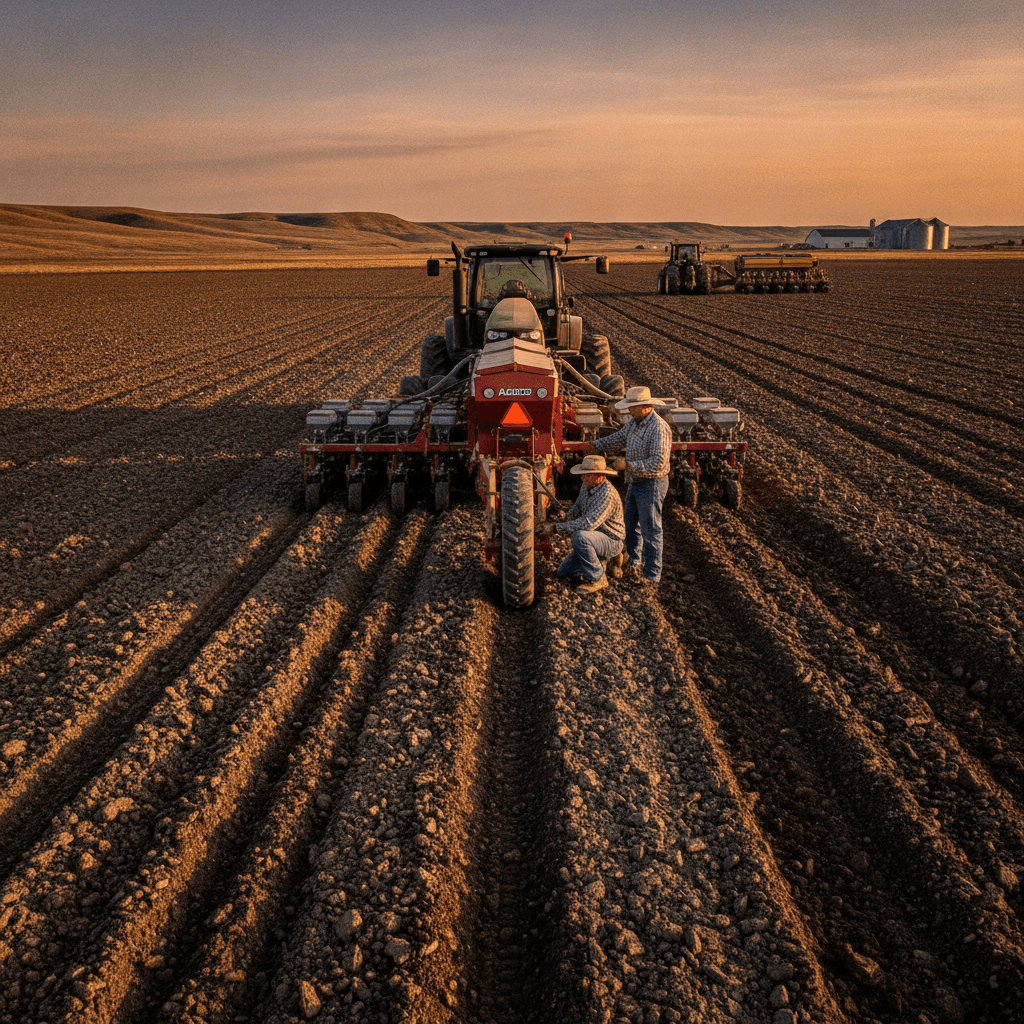
How Do No-Till Farmers Near Pierre Know Whether Their Air Seeder’s Gauge Wheel Spacing Is Actually Matched to Their Soil Type — Or Just Set the Same as Last Year’s Tilled Ground?
If you’re running an air seeder near Pierre into the kind of heavy gumbo and tight clay soils that dominate Hughes and Stanley counties, your gauge wheel setup from last season’s tilled acres may be working against you right now. The short answer is: if your depth is inconsistent across the field, your seed trench is smearing instead of cutting, or your gauge wheels are packing mud into the furrow instead of staying clear of it, your setup probably isn’t dialed in for your actual soil conditions. It’s one of the most common problems air seeder operators overlook — and one of the least discussed topics in the industry.
Why Tilled-Ground Settings Don’t Translate to No-Till Conditions
This is a gap most planter parts manufacturers don’t talk about directly. If you search around on competitor sites, you’ll find plenty of content on gauge wheel wear, residue clearance in heavy corn stalks, and depth control in general terms. What you won’t find much of is a straightforward explanation of how soil type — specifically the high-clay, low-drainage soils common across central and western South Dakota — changes the way your gauge wheels need to behave on an air seeder.
On tilled ground, the surface is already broken. Your gauge wheels are riding on a relatively uniform seedbed. The depth they register is close to actual seed depth. In no-till conditions on heavy clay or gumbo, you’re dealing with a firm, often uneven crust with residue on top. Your gauge wheels aren’t just measuring depth — they’re fighting to stay in consistent contact with a surface that can vary dramatically in hardness within the same field pass.
Set your gauge wheels too shallow for these conditions and you’re placing seed into the residue mat or the crust, not into the soil. Set them with the wrong lateral spacing or run them without adequate mud clearance, and in a wet spring they’ll pack up and start carrying a load of clay that throws off your depth entirely. Neither outcome is what you need when the planting window near Pierre is only a few days wide.
What to Actually Check on Your Air Seeder Before You Go to the Field
Before you pull out of the yard in April, here’s what’s worth looking at on your gauge wheel setup — not as a general checklist, but specifically for no-till clay and gumbo conditions:
- Spoke design and mud clearance: Solid or flat-spoke gauge wheels pack mud in wet conditions. If your current wheels don’t have an open-spoke design that actively sheds debris, you’re going to lose depth consistency the moment the soil moisture rises. A curved spoked wheel with adequate clearance between spokes is what keeps mud from bridging across the wheel face and building up pass after pass.
- Tire lip condition: In heavy clay and gumbo, the lateral friction on your gauge wheel tire lip is higher than in sandy or tilled loam. If the tire lip is already showing wear or cracking, it won’t hold the wheel at a consistent angle on the furrow edge — and your depth drifts. Check this before planting, not after your first bad pass.
- Wheel seating and retention: Air seeders take more abuse between field transitions than most row planters — more road time, rougher transport, more row units to inspect. If your gauge wheels aren’t positively retained, a bumpy road between fields can shift a wheel just enough to create a problem you won’t notice until you’re checking stand counts two weeks later.
- Lateral pressure and down-pressure balance: In firm no-till soils, gauge wheels need enough down-pressure to stay in contact with the surface without digging in. Too little and the wheel floats; too much and you’re compressing the furrow sidewall in wet clay.
How Jung Enterprise Addresses These Conditions Specifically
From Ipswich, we build parts that are tested in the same Northern Plains conditions you’re farming — not in a lab in a different climate. The Curved Spoked Gauge Wheels from Jung Enterprise use an open-spoke design engineered to shed mud rather than carry it. That’s not marketing language — it’s the functional difference between a wheel that stays clean and one that becomes a mud paddle in your first wet-field pass near Pierre.
The curved spoke geometry does two things in heavy clay: it deflects mud away from the wheel face as the wheel rotates, and it keeps the contact surface consistent even as soil conditions shift across the field. That’s what depth consistency in no-till gumbo actually requires.
For tire lip protection, the Jung Enterprise Steel Ring (US Patent 11,707,013 B2) mounts directly to the gauge wheel with six screws and serves as both a lip protector and a built-in scraper. You don’t need a separate scraper part. In tight clay where abrasion on the tire lip is constant, that matters — field testing shows only 1/16″ of wear after 13,000 planted acres across three seasons. That’s not a number we invented; it’s what we’ve documented in real field use.
And for operators running air seeders across rough terrain between farms, the Wheel Retainer keeps the gauge wheel positively seated on the planter hub — so a hard stop or a rough road doesn’t shift your setup before you get to the next field.
The Soil Type Conversation Most Parts Suppliers Skip
Most of the major planter parts manufacturers don’t distinguish their product recommendations by soil type. You’ll see specs for gauge wheel sizes, compatibility charts, and wear ratings — but very little guidance on how to set up your air seeder differently for heavy clay versus lighter soils. That’s a real gap, and it matters especially across central South Dakota and into North Dakota where gumbo conditions can swing dramatically from one field to the next based on drainage and land position.
The practical takeaway: don’t assume your gauge wheel setup from a well-drained field translates to your low-ground fields with tight clay subsoil. Check mud clearance, verify tire lip condition, and make sure your wheels are retained and running true before the window opens. Those adjustments cost you an hour in the shop. Losing seed placement consistency across a 1,200-acre seeder pass costs you a lot more at harvest.
Frequently Asked Questions
Do curved spoked gauge wheels work on both air seeders and row planters?
Yes. Jung Enterprise’s Curved Spoked Gauge Wheels are compatible with multiple OEM gauge wheel sizes across planters, air seeders, and no-till drills. If you’re running both a row planter and an air seeder, it’s worth confirming the specific size match for each machine — contact us and we can help verify compatibility before you order.
How much does soil type actually affect gauge wheel wear near Pierre?
Significantly. High-clay and gumbo soils are more abrasive on tire lips and create more lateral load on the wheel than lighter soils. Tire lip wear that might take four or five seasons on sandy loam can show up in two seasons on heavy gumbo if the wheel isn’t protected. The Jung Steel Ring is specifically designed to intercept that wear before it reaches the tire.
Can I install the Steel Ring on existing gauge wheels, or do I need new wheels?
The Steel Ring mounts onto your existing gauge wheel using six screws — it’s an add-on, not a full wheel replacement. In most cases you can install it in the shop during your pre-plant prep without pulling the wheel off the machine entirely.
What’s the difference between a gauge wheel retainer and standard OEM retention hardware?
OEM retention hardware on many planters and air seeders is designed to hold the wheel under normal field conditions. The Jung Wheel Retainer is built specifically to prevent dislodgement under the kind of side-load and transport stress that air seeder operators deal with more frequently than row planter operators — particularly when moving between farms on rough roads or across field edges with sharp grade changes.
Do I need to change my gauge wheel setup between corn and soybean planting?
For most no-till operations in South Dakota, the bigger variable is soil condition at planting time, not the crop itself. That said, soybean planting depth is shallower and more sensitive to variation than corn — so any depth inconsistency from mud buildup or tire lip wear will show up faster in soybean stands. It’s worth re-checking your gauge wheel condition between crops rather than assuming the setup that worked for corn will carry over.
Ready to Set Up Your Air Seeder for Real No-Till Conditions?
If you’re farming heavy clay soils near Pierre, running an air seeder across rough country between farms, or just not confident your current gauge wheel setup is matched to what you’re actually planting into, Jung Enterprise can help. We build American-made, patented gauge wheel parts specifically for the kind of conditions Northern Plains farmers deal with — not generic solutions built for every soil type and effective for none of them.
Reach out to Jung Enterprise directly to talk through your machine, your soil conditions, and what setup makes sense before your planting window opens. We’re based in Ipswich and we work with farmers and ag dealers across South Dakota and the surrounding region. No sales pitch — just a straight conversation about what you need and whether we can help.