
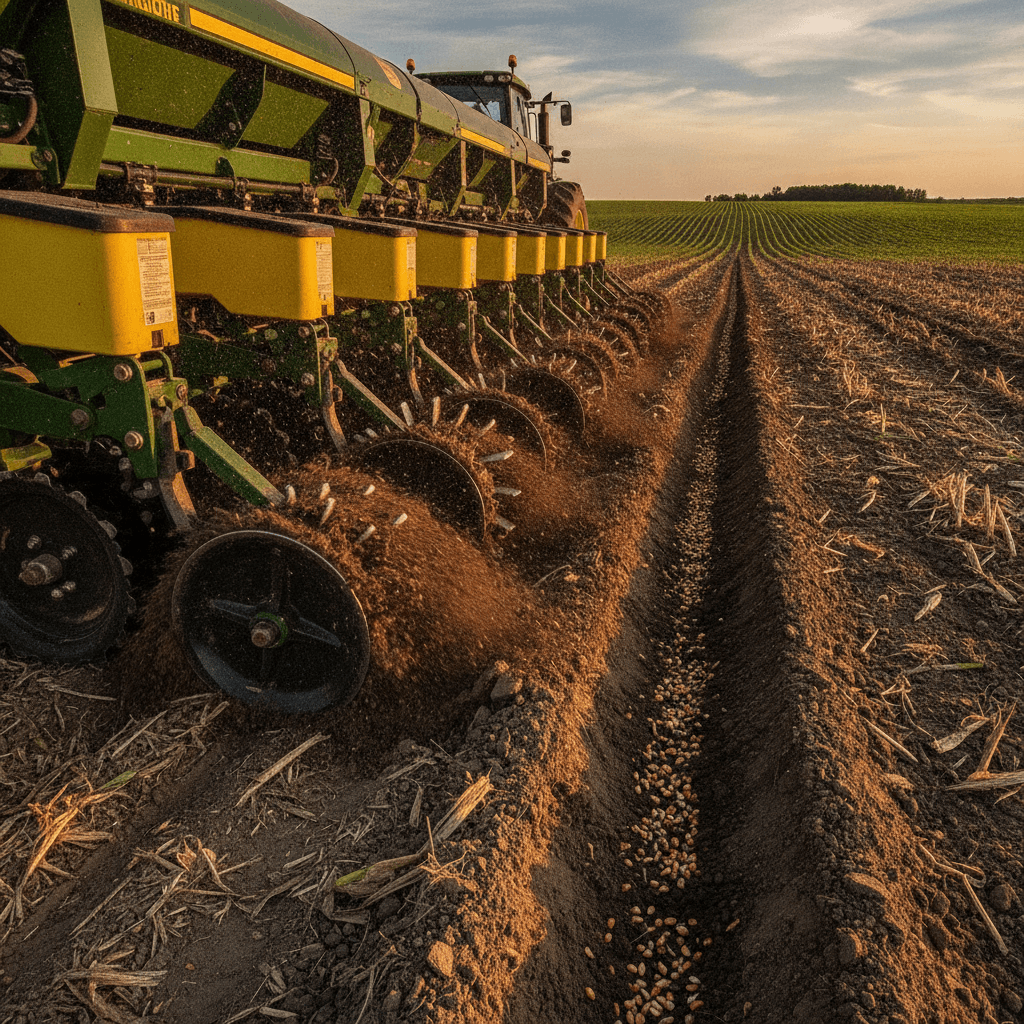
How Do Farmers Near Ipswich Know Whether Their No-Till Drill’s Closing Wheel Is Actually Firming the Seed Trench — Or Just Pushing Soil Back Over the Top?
If your no-till drill is running through heavy residue and wet ground near Ipswich and you’re not stopping to dig up seeds and check the trench, you’re guessing. Loose, poorly closed trenches are one of the most common and quietly expensive germination killers in no-till corn and soybean operations — and most farmers don’t catch it until they see a patchy stand two weeks later. By then, the window is gone. Here’s how to actually know what your closing wheel is doing, what causes it to fail silently, and what the rest of your row unit needs to be in order for closing wheel performance to even matter.
What a Properly Firmed Seed Trench Actually Looks Like
A closing wheel’s only job is to collapse the sidewalls of the seed trench back down around the seed and press them firm enough to restore soil-to-seed contact. That’s it. It’s not supposed to mound soil. It’s not supposed to leave a ridge. And it definitely isn’t supposed to leave a hollow channel with a thin crust of loose soil bridging the top.
The test is simple and takes about 90 seconds: stop the drill, walk back 30 feet, dig up five or six seeds with your finger, and feel what surrounds them. The soil should be snug against the seed on all sides — not packed like concrete, but firmly in contact with no air gap. If you can feel a void, if the seed rolls around when you probe it, or if the trench collapses inward when you touch it rather than holding its shape, the closing wheel isn’t doing its job. You’re going to see uneven emergence, and depending on how wet or cold the soil is, some of those seeds may rot before they ever crack.
In the heavier gumbo soils common across central South Dakota — the kind that runs from the fields south of Aberdeen all the way down toward Huron — loose trench closure is especially punishing. Those clay soils can form a hard cap over an unfirmed trench as soon as they dry, which means the seedling has to punch through a crust with no firm soil to push against underneath. Stand counts suffer before the crop ever had a fair shot.
The Problem Most Operators Miss: The Closing Wheel Can’t Fix What the Rest of the Row Unit Gets Wrong
Here’s the angle you won’t find spelled out clearly on most competitor sites: the closing wheel gets blamed for a lot of problems it didn’t actually cause. If your gauge wheels aren’t controlling depth accurately — if one side is riding high because the tire lip is worn down or the gauge wheel is wobbling because the retainer has played loose — the opener disc isn’t cutting a consistent trench in the first place. You can’t close a trench cleanly that was never opened cleanly.
That means closing wheel performance depends directly on what’s happening upstream on the row unit. Specifically:
- Gauge wheel depth control: If your gauge wheels are bouncing or inconsistently riding the soil surface, your opener depth changes with every rock, clod, or residue mat the unit crosses. The trench geometry changes with it. Closing wheels calibrated for a consistent 1.75-inch trench can’t compensate for a trench that’s 1.5 inches in one spot and 2.25 inches in the next.
- Tire lip wear: As the tire lip on a gauge wheel wears down, the effective depth reference shifts. A worn gauge wheel tire isn’t holding depth — it’s slowly letting the disc run deeper than the setting indicates. The trench gets wider and rougher at the bottom, and the closing wheel has more work to do and less consistent geometry to work with.
- Gauge wheel stability: A gauge wheel that dislodges or wobbles on its mount — because the wheel retainer has worn or failed — creates lateral trench irregularity. That makes it harder for the closing wheel to apply even, centered pressure across the trench walls.
If you’re chasing closing wheel problems and your gauge wheels haven’t been inspected this season, start there. Jung Enterprise’s full lineup of gauge wheel components is built specifically to restore the depth accuracy and stability that closing wheel performance depends on.
When Mud Plugging Upstream Kills Closing Wheel Performance Downstream
Wet spring conditions in the Northern Plains create another problem that’s often misdiagnosed as a closing wheel issue: mud packing on the gauge wheel itself builds up until the wheel stops rotating freely or starts deflecting the disc opener. When that happens, the trench isn’t cut — it’s dragged. The sidewalls are smeared rather than cleanly sliced, and no closing wheel on the market can firm a smeared trench wall back into clean seed-to-soil contact.
This is where the design of your gauge wheel’s protective components matters more than most operators realize. A steel ring that doubles as a built-in scraper keeps mud from packing against the tire lip and allows the gauge wheel to keep rotating and riding the soil surface consistently through wet conditions. Jung Enterprise’s patented steel ring (US Patent 11,707,013 B2) mounts with six screws, protects the tire lip from wear, and scrapes mud continuously — without needing a separate scraper component bolted on separately. After 13,000 planted acres over three years of field testing, total wear measured at only 1/16 inch. That’s not a marketing number — it’s a real field result on real Northern Plains ground.
How to Check Whether Your Row Unit Is Set Up to Let the Closing Wheel Succeed
Before you assume the closing wheel itself is the problem, run through this quick check at the start of any planting season — or right now, post-harvest, while you still have time to fix it before spring:
- Spin each gauge wheel by hand. It should rotate freely with no drag, wobble, or grinding. Resistance often means bearing wear or mud-packed buildup.
- Check the tire lip on both gauge wheels on each row unit. If the lip is visibly flattened or the edge has rounded off, depth control is compromised — and so is everything downstream of it.
- Check the wheel retainer on every row unit. A wheel retainer that has loosened or worn keeps the gauge wheel from seating properly on the opener disc arm. That translates directly into trench inconsistency that the closing wheel can’t recover.
- Look at spoke condition if you’re running open-spoke gauge wheels. Clogged or damaged spokes mean the wheel is carrying mud instead of shedding it, which changes the effective diameter and the depth reference.
- After running 100 yards in your field conditions, stop and dig. Do it on both light and heavy soil zones. Don’t assume what happens in one soil type is happening across the whole field.
FAQ: Closing Wheel and Row Unit Performance for No-Till Drills
Can I fix a loose seed trench just by adding closing wheel downforce?
Sometimes, but only if the trench geometry itself is consistent. More downforce on a closing wheel that’s working against a badly opened or smeared trench can make things worse — you’re compressing irregular sidewalls rather than firming clean ones. Fix the upstream components first.
How often should I check gauge wheel tire lip condition during the season?
At minimum, pull one row unit completely at the start of the season and measure lip condition. If you’re putting on heavy acres in no-till corn residue, check again mid-season. Lip wear accelerates in abrasive conditions, and it happens gradually enough that you won’t notice it until depth is already off by a measurable amount.
Does a mud-plugged gauge wheel always show visible buildup I can see from the tractor cab?
No. Some mud packing starts at the tire lip and in the spoke gaps before it becomes visible as a full buildup. By the time you can see it clearly from the cab, it’s already been affecting depth control and trench quality for some time. Regular field stops to physically inspect gauge wheels during wet planting days are worth the two minutes they take.
Is a wheel retainer the same as a gauge wheel clip or snap ring?
Not exactly. Generic snap rings and clips wear or deform under field loads and can allow the gauge wheel to work loose over time — especially across rough ground. Jung Enterprise’s wheel retainer is purpose-built to keep the gauge wheel properly seated under the dynamic loads of no-till drilling, not just in static assembly. The difference shows up mid-field, not in the shop.
Do Jung Enterprise gauge wheel components fit no-till drills from multiple manufacturers?
Yes. The steel ring, wheel retainer, and curved spoked gauge wheels are designed to fit planters, air seeders, and no-till drills across multiple OEM brands and gauge wheel sizes. If you’re not sure about your specific drill, reach out directly and we’ll confirm compatibility before you order.
Get Your Row Units Ready Before the Ground Freezes
Post-harvest is the right time to audit every row unit on your no-till drill — not the week before planting when there’s no margin to fix anything. If you’re running ground near Ipswich or anywhere across south-central South Dakota and you’ve had closing wheel or stand consistency problems this past season, there’s a good chance the real issue starts at the gauge wheel, not the closing wheel.
Jung Enterprise builds patented, American-made steel rings, wheel retainers, and curved spoked gauge wheels specifically for the conditions Northern Plains no-till farmers deal with every spring. Field-tested. Real numbers. No separate scraper to buy or install.
Contact Jung Enterprise to talk through your row unit setup, confirm compatibility with your drill, or get the right components ordered before spring demand hits. We’re based in Ipswich, and we’re here to help you get this right before the window opens.