
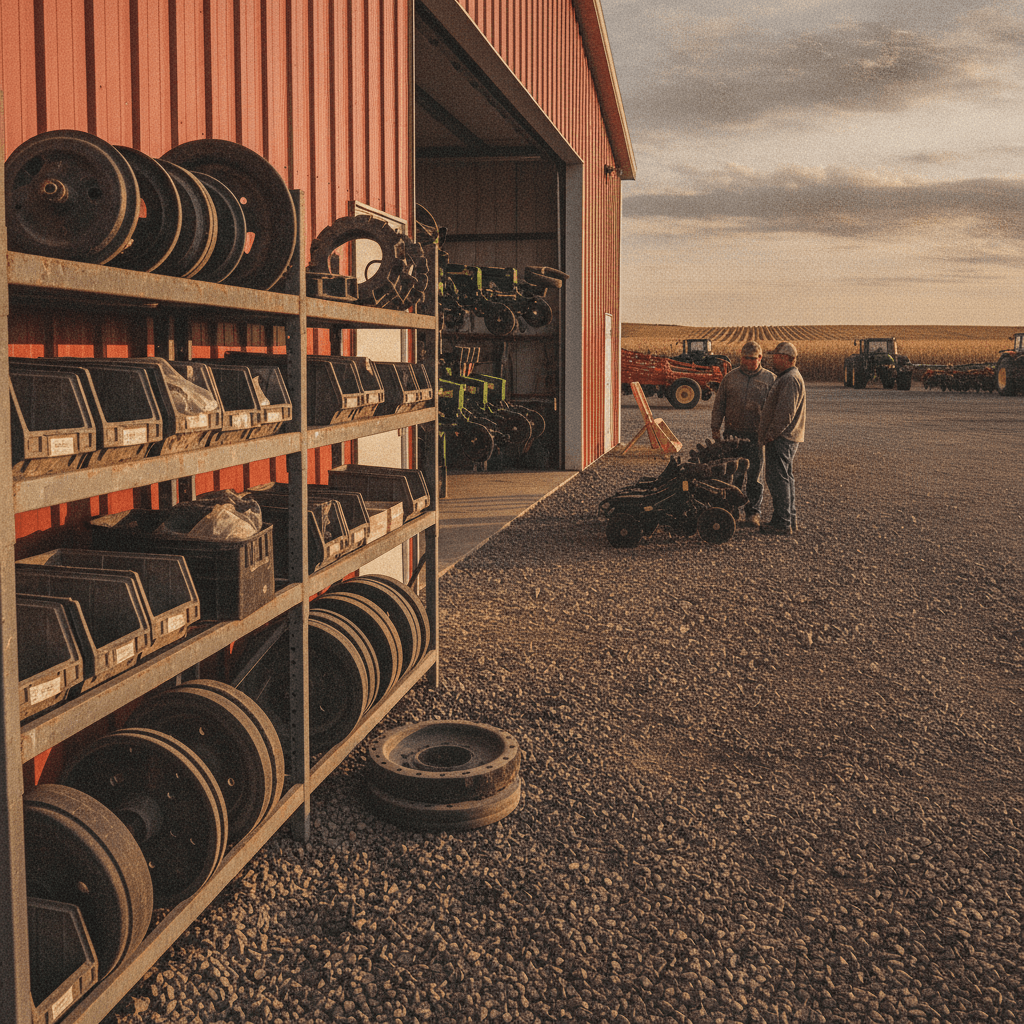
How Do Ag Dealers Near Fargo Know Whether Their Steel Ring Inventory Is Actually Matched to the No-Till Drills Their Customers Are Running — Or Just Stocked for the Planters They See Most?
If you’re an ag dealer near Fargo and your steel ring stock is built around the row-crop planters you see the most — John Deere 1770s, Kinze 3600s, Case IH Early Riser units — you may be stocking right for May corn planting and completely wrong for the no-till drills your wheat and soybean customers start running in April. That’s not a guess. It’s one of the most common inventory mismatches we hear about, and it costs dealers sales precisely when farmers need parts the fastest and are willing to pay for them.
Jung Enterprise is based in Ipswich, South Dakota, and we work with dealers and distributors across the Northern Plains — including operations near Fargo and across eastern North Dakota and western Minnesota. What we’ve found is that the dealers who build inventory strategically for their actual customer mix, not just the loudest demand signal, are the ones who don’t have farmers calling Aberdeen or ordering online two days before they need to seed.
The Problem: No-Till Drill Gauge Wheel Parts Aren’t the Same as Planter Parts
This sounds obvious, but it’s easy to miss in practice. No-till drills run different gauge wheel configurations than row-crop planters. The wheel diameters, tire lip geometry, and hub spacing vary by OEM — and that means the steel rings, curved spoked gauge wheels, and wheel retainers that fit a planter unit may not match what’s on a Great Plains or Horsch or Bourgault drill at all.
If a farmer shows up at your counter with a worn or plugged gauge wheel off a no-till drill and you’re stocked exclusively for row-unit planters, you’ve got a problem. You either send them away empty-handed or you sell them something that won’t fit right — and either outcome hurts your reputation more than a stockout on combine belts ever would. Planting windows near Fargo are short. A farmer who loses two days tracking down the right steel ring remembers that.
What Steel Rings Are Actually Protecting on a No-Till Drill
On a no-till drill running into standing wheat stubble or soybean residue — the kind of conditions you see across North Dakota every spring — the gauge wheel tire lip takes a beating. Residue gets forced between the tire and the gauge wheel rim on every pass. That friction, combined with constant contact with abrasive soil, grinds the tire lip down faster than most operators realize until seeding depth starts going inconsistent.
Jung Enterprise’s patented Steel Ring (US Patent 11,707,013 B2) mounts with six screws directly to the gauge wheel and protects the tire lip from that wear. It also acts as a built-in scraper — so when gumbo or heavy clay starts packing against the wheel, the ring clears it rather than letting it build up into a mud plug that throws off your seeding depth. There’s no separate scraper part to source or install. That’s part of the design.
Field results bear it out: after 13,000 planted acres over three years of use, we measured just 1/16″ of wear on the steel ring itself. For a dealer stocking parts that farmers depend on across a full season, that kind of durability means fewer repeat failures, fewer emergency calls, and a part that actually justifies what you’re charging for it.
How Dealers Near Fargo Should Think About Their Customer Mix Before Ordering
Before you place your pre-season order, ask yourself a few questions about who’s actually buying gauge wheel parts from you:
- What percentage of your customers run no-till drills versus row-crop planters? In the Red River Valley and surrounding areas, no-till drills are common for small grains, canola, and soybeans. Planters dominate for corn. Your stock ratio should reflect that split.
- What OEM brands are in your area? Steel rings and gauge wheel components need to be compatible with the specific wheel diameters your customers are running. Know your local OEM mix before you order.
- Do you have custom planting or custom seeding operations in your territory? Custom operators run high acres fast, which means they’ll burn through parts quicker and they need replacements on short notice. They’re worth stocking for specifically.
- When does your planting season actually start? Near Fargo, no-till spring wheat often goes in before row-crop planting begins further south. That means your no-till drill parts window opens earlier than your corn planter parts window.
None of this is complicated, but most of the competitor literature we’ve seen online — from manufacturers and ag supply companies alike — doesn’t address dealer inventory strategy at all. They’ll tell you what their parts do. They won’t tell you how to think about stocking them relative to your actual customer base. That’s a real gap, and it’s one that costs dealers real money when spring hits.
What to Look for When Evaluating Steel Ring Suppliers for Your Dealership
If you’re considering adding steel rings to your parts inventory — or switching from what you’re currently carrying — here’s what actually matters for a dealer relationship:
- Compatibility documentation. Can the supplier give you a clear fitment guide that maps their parts to specific OEM gauge wheel diameters? If the answer is vague, that’s a return waiting to happen.
- American-made construction. Farmers near Fargo and Aberdeen have seen enough cheap imported parts fail mid-field that they’ve become skeptical. Stocking American-made, patented parts gives you something to sell — not just a part number.
- Durability you can explain at the counter. “13,000 acres, 1/16″ of wear over three years” is a number a farmer can actually understand. Generic claims about “heavy-duty construction” are not.
- Supplier support when you need a question answered fast. During planting season, you don’t have time to wait three days for an email response. A manufacturer that picks up the phone matters.
You can learn more about the full line of products we offer dealers and distributors on our products page, including steel rings, curved spoked gauge wheels, and wheel retainers for planters, air seeders, and no-till drills.
Frequently Asked Questions — Steel Ring Inventory for Ag Dealers
Do Jung Enterprise steel rings fit no-till drill gauge wheels, or just planter gauge wheels?
Jung Enterprise steel rings are designed to fit gauge wheels across multiple OEM platforms, including those used on no-till drills and air seeders, not just row-crop planters. Contact us with your specific wheel diameter and we’ll confirm fitment before you order.
How far in advance should dealers near Fargo be ordering gauge wheel parts for spring?
For the Northern Plains market — North Dakota, South Dakota, western Minnesota — we recommend dealers firm up their pre-season order by February at the latest. No-till spring wheat planting starts early in that region, and the lead time to restock mid-season is a problem you don’t want to be solving in April.
Can one steel ring handle both no-till drill and planter gauge wheels?
Not always — fitment depends on gauge wheel diameter and rim configuration. A dealer stocking for both equipment types needs to carry the correct SKUs for each. We can help you put together a stocking recommendation based on your customer mix.
Why do some dealers stock OEM gauge wheel parts instead of aftermarket options like Jung Enterprise steel rings?
OEM parts are familiar and easy to justify to a farmer who just wants “the original part.” The tradeoff is cost and availability — OEM parts often cost more and can be backordered during peak season. Jung Enterprise’s patented steel ring offers a field-proven alternative with a built-in scraper function that OEM designs typically don’t include.
How do I become a dealer or distributor for Jung Enterprise parts?
Reach out directly through our contact page. We work with dealers and distributors across South Dakota, North Dakota, Minnesota, and the broader Corn Belt. We’ll talk through what a stocking arrangement looks like for your territory and customer base.
If you’re an ag dealer near Fargo — or anywhere across the Northern Plains — and you want to make sure your gauge wheel parts inventory is actually set up for the equipment your customers are running, get in touch with Jung Enterprise. We’re based in Ipswich, we know the region, and we’d rather have that conversation with you now than after you’ve had a farmer drive past your lot to find parts somewhere else come planting time.