
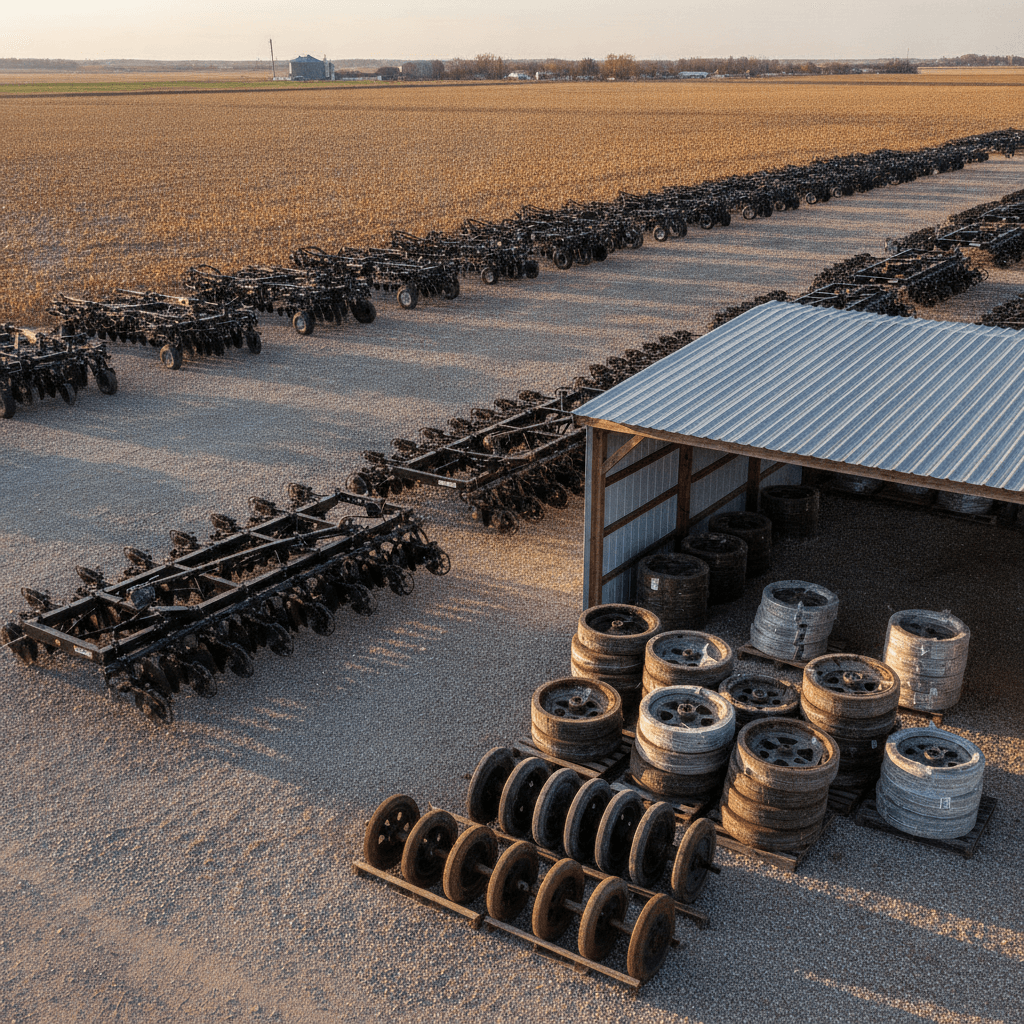
How Do Ag Dealers Near Aberdeen Know Whether Their Steel Ring and Gauge Wheel Parts Are Actually Moving Fast Enough to Justify the Shelf Space — Or Just Sitting Until Farmers Go Elsewhere?
If you’re running an ag dealership near Aberdeen and you’ve got gauge wheel parts on the shelf that haven’t moved since last spring, that’s not a storage issue — that’s a stocking strategy issue. The difference between parts inventory that earns its keep and parts that just collect dust comes down to one question: are you stocked for the machines your customers are actually running this season, or are you carrying what you’ve always carried?
This matters more now than it did five years ago. Planting windows across northern South Dakota and into North Dakota are short and unforgiving. When a farmer comes in mid-May with a plugged gauge wheel or a dislodged wheel retainer, he needs the part today — not in three days from a regional warehouse. If you don’t have it, he’ll find someone who does, or he’ll order direct and remember that next time.
The Inventory Turnover Problem Most Dealer Websites Don’t Talk About
Spend any time on the websites of larger planter parts suppliers and you’ll find product listings, compatibility charts, and spec sheets. What you won’t find is any honest discussion of how a regional dealer — one serving farms around Aberdeen, Ipswich, or Watertown — should actually think about which SKUs to stock and in what quantities. That gap isn’t an accident. National suppliers aren’t in the business of helping your dealership move inventory efficiently. They’re in the business of moving product to you.
The real questions for a dealer serving row-crop farmers across Brown County and the surrounding area are more specific:
- Which planter brands are most common in your trade area — and are your gauge wheel parts actually compatible with those units?
- Are your customers running planters, air seeders, no-till drills, or a mix?
- Are you carrying parts built for tilled ground when half your customers have gone no-till in the last three years?
- Is your steel ring inventory matched to the wheel sizes your customers have, or did you just order what the rep suggested?
These aren’t rhetorical questions. Stocking the wrong gauge wheel sizes or carrying steel rings that don’t fit the tire lips on the equipment your farmers are running means those parts don’t move — and you end up turning them back or sitting on margin you already paid for.
What Fast-Moving Gauge Wheel Inventory Actually Looks Like in the Northern Plains
In wet spring conditions — and northern South Dakota gets its share of them — gauge wheel performance becomes a real pain point fast. When soils are heavy and there’s residue from a corn-on-corn rotation, rubber gauge wheel tires plug up, tire lips wear faster than they should, and wheels can dislodge when operators are moving between fields on rough roads. Farmers know this. They’ve dealt with it.
The parts that move consistently in those conditions are the ones that solve real problems: steel rings that protect the tire lip and scrape mud before it builds up, curved spoked gauge wheels that shed residue instead of packing it, and wheel retainers that keep everything seated under hard use. When those parts are on your shelf in the right sizes, farmers come to you first — and they come back.
Jung Enterprise’s patented steel ring (US Patent 11,707,013 B2) is built specifically for this kind of work. It mounts with six screws, doubles as a built-in scraper, and has been field-tested to show only 1/16″ of wear after 13,000 planted acres across three seasons. That’s the kind of durability proof point that makes a sale in a dealer showroom, because farmers near Aberdeen and out toward Huron can do that math on their own acreage.
How to Audit Your Current Gauge Wheel Parts Lineup
If you haven’t looked at your gauge wheel parts inventory with a critical eye lately, here’s a simple way to start:
- Pull your sales data from the last two planting seasons. Which part numbers actually sold, and which ones are still sitting? If a SKU hasn’t moved in 18 months, ask why. Wrong size, wrong machine, or the wrong product for your customer base.
- Talk to your five busiest customers about what they’re running. Not what they ran four years ago — what they’re running now. Equipment changes. A farm that switched to an air seeder for small grains needs different gauge wheel specs than one running a 16-row corn planter.
- Check compatibility on no-till and strip-till equipment specifically. This is where a lot of dealer inventories come up short. Parts stocked for conventional tillage setups often aren’t the right fit for customers who’ve transitioned to no-till over the last few years, which is a significant portion of the market around Aberdeen and across the Northern Plains.
- Look at whether you’re carrying a wheel retainer. This is a part that gets overlooked until a farmer loses a gauge wheel mid-field. It’s not a high-volume item, but when someone needs one, they need it immediately — and it’s an easy upsell alongside gauge wheel or steel ring purchases.
Dealers who stock Jung Enterprise’s wheel retainer alongside steel rings and gauge wheels report that it rounds out the sale naturally. It’s a small part with a clear job, and the conversation is easy: if you’re replacing the gauge wheel, it makes sense to check the retainer while you’re at it.
Pre-Planting vs. Post-Harvest: When to Stock and How Much
Demand for gauge wheel parts clusters hard around two windows: February through April before planting kicks off, and September through November after harvest when farmers are thinking about what failed and what they want to fix before next season. If you’re not stocked by early February, you’re going to lose sales to dealers in Watertown or direct-to-farmer online orders.
For pre-plant stocking, prioritize the steel rings and curved spoked gauge wheels that work across the most common planter platforms in your area. For post-harvest restocking, pay attention to what you ran out of during the season — that’s your real demand signal. Don’t rely on the rep’s recommendation alone. Your own sell-through data is more accurate than any regional average.
Jung Enterprise works directly with ag dealers and distributors and can help you think through what makes sense for your specific trade area. We’re based in Ipswich, so we know what the market around Aberdeen, across Brown County, and into North Dakota and Minnesota actually looks like — and we’re not going to push you to overstock on sizes that won’t move.
Frequently Asked Questions: Gauge Wheel Parts for Ag Dealers Near Aberdeen
What gauge wheel parts move fastest for dealers in northeastern South Dakota?
Steel rings and curved spoked gauge wheels tend to be the highest-velocity items, especially heading into planting season. Wheel retainers are lower volume but easy to sell alongside the other parts. Focus on the sizes that match the most common planter platforms your customers are running — that varies by area, which is why talking to your top accounts before you place orders matters.
How do I know which steel ring sizes to stock for planters and no-till drills in my area?
Start with your five to ten busiest customers and find out what gauge wheel sizes they’re running. Jung Enterprise’s steel ring fits multiple OEM gauge wheel sizes and is compatible with planters, air seeders, and no-till drills — but you still need to match ring size to tire diameter. Contact us directly and we can help you work through compatibility for the equipment common in your trade area.
Do farmers near Aberdeen care whether planter parts are American-made?
In our experience, yes — especially when they’re comparing a part with a published field-test record against an import with no verifiable durability data. The patented design and the 13,000-acre wear test are things you can point to in a conversation. That matters when a farmer is deciding whether to pay a little more for something he can trust or gamble on a cheaper part that might fail mid-season.
How does carrying a wheel retainer help my overall gauge wheel parts sales?
It rounds out the sale and reduces the chance a customer goes somewhere else for a related part. If a farmer is buying a new gauge wheel or steel ring, asking whether his retainer is still in good shape is a natural conversation — and it’s often a part that gets skipped until it causes a problem. Stocking it means you capture that sale instead of sending him elsewhere.
When should dealers place their gauge wheel parts orders for the upcoming planting season?
Don’t wait until March. By then, demand is already peaking and lead times can stretch. Ordering in December or January gives you time to receive, shelf, and promote parts before farmers are already in the field. Post-harvest is also a good time to reach out to accounts that had problems during the season — those conversations often turn into pre-plant orders.
Talk to Jung Enterprise About Dealer and Distributor Partnerships
If you’re an ag dealer near Aberdeen or anywhere across South Dakota, North Dakota, or Minnesota looking to stock planter parts that actually move, we’re worth a conversation. Jung Enterprise is based in Ipswich, American-made, and built around direct relationships with dealers and farmers who need parts that perform in real field conditions — not just on a spec sheet.
Take a look at our full product lineup and then reach out. We’ll talk through what makes sense for your specific trade area and customer base — no pressure, no generic pitch.
Contact Jung Enterprise to discuss dealer pricing, compatibility questions, or stocking recommendations for your area. You can also call us directly at (605) 281-0497 or email help@jungenterprise.net.