
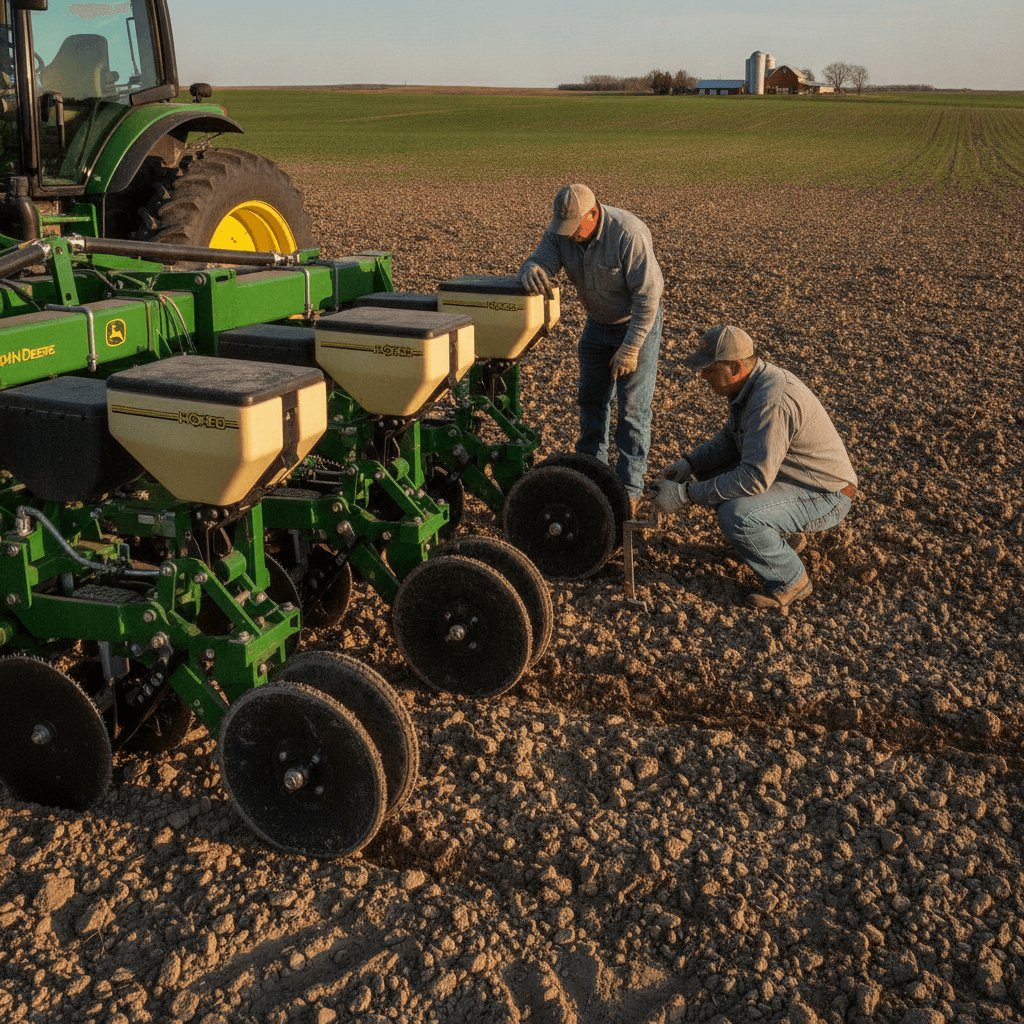
How Do Farmers Near Sioux Falls Know Whether Their Planter’s Gauge Wheel Is Actually Holding Seed Depth Through a Hard Stop and Restart — Or Just Drifting After Every Field Entry?
The honest answer most farmers near Sioux Falls don’t want to hear: you probably don’t know for certain unless you’ve dug seeds at the point of entry after every restart. Most operators check depth in the middle of a pass and assume it’s consistent throughout. But gauge wheel depth drift at field entries — those first 10 to 30 feet after you drop the planter back down — is one of the most underdiagnosed planting problems in row-crop production. And it costs you stand uniformity where the headland meets the field, exactly where every pass starts.
Why Depth Drift at Hard Stops Is a Real Problem — Not Just Operator Anxiety
When you lift the planter at the end of a row and set it back down at the next entry point, several things happen simultaneously. The row units have to re-seat against the soil surface. Downforce has to rebuild from zero. And the gauge wheels have to find purchase and establish their running depth before the disc opener is placing seed at the right level.
In soft or wet spring soils — which farmers across eastern South Dakota and into southwestern Minnesota and northwestern Iowa deal with every planting season — that transition can take longer than you expect. A worn gauge wheel tire that’s lost its original profile can’t seat cleanly. A gauge wheel with packed mud in the spokes can’t make consistent contact with the furrow wall. And a gauge wheel where the tire lip is deteriorated or damaged isn’t giving you the flat, stable reference surface the row unit needs to hold depth.
None of the major competitor product pages address this specific failure mode directly. You’ll find plenty of information about depth control in the middle of the field, but almost nothing about what happens in those critical re-entry moments after every hard stop — which is where the problem often lives.
What’s Actually Causing the Drift: Gauge Wheel Condition First, Downforce Second
Most farmers go straight to adjusting downforce when they see inconsistent depth. That’s not wrong — downforce matters. But before you start moving springs or adjusting pneumatic systems, look at the gauge wheels themselves. Two mechanical issues account for most depth drift at field entries:
- Worn or degraded tire lip: The outer edge of the gauge wheel tire is what rides against the furrow wall and establishes seed depth. If that lip has been ground down by abrasive soil, debris, or corn residue, the wheel is no longer referencing the correct depth plane. It’s seating shallow — and when you lift and reset, it seats shallow again, consistently wrong.
- Mud and debris packed in the spokes: A plugged gauge wheel doesn’t spin freely against the furrow wall. It drags. When the planter drops at re-entry and the wheel hits the soil surface, a plugged wheel doesn’t immediately establish clean contact — it skims across packed residue or mud before finally biting in. By then, you’ve already placed seed at the wrong depth for the first several feet of that pass.
Both of these conditions get worse across a planting season if you don’t address them at the component level. Protecting the tire lip and keeping the spokes clear aren’t just maintenance tasks — they’re directly tied to stand establishment.
How the Steel Ring and Curved Spoked Gauge Wheel Address Both Issues
The Jung Enterprise Steel Ring mounts with six screws directly to the gauge wheel and serves two functions at once. The outer ring protects the tire lip from the abrasive wear that erodes your depth reference over time. The built-in scraper clears mud and debris from the wheel face continuously as it rotates — so by the time you drop the planter at your next field entry, the gauge wheel is already clean and ready to seat immediately.
That’s a different design approach than adding a separate scraper or relying on spoke shape alone to shed mud. The scraper function is integrated into the steel ring itself — no extra hardware, no separate part to install or lose. And it’s built from American-made steel, field-tested to show only 1/16 inch of wear after 13,000 planted acres across three full seasons. That’s not a projection — that’s measured field performance.
Paired with Jung Enterprise Curved Spoked Gauge Wheels, the open-spoke design actively sheds mud and wet residue during field operation rather than trapping it. The curved spoke geometry also maintains consistent contact force against the furrow wall during re-entry — the wheel finds its seat faster after a hard stop because it’s not fighting through packed debris to get there.
What to Check After Every Hard Stop This Planting Season
You don’t need expensive precision planting technology to catch this problem. A few low-tech checks at the start of every day will tell you whether your gauge wheels are performing through re-entry or drifting:
- After the first re-entry of the day, stop and dig seeds at the 5-foot mark, the 15-foot mark, and the 30-foot mark from the field entry. Compare depth across those three points. If depth at 5 feet is consistently shallower than at 30 feet, you have a re-seating problem.
- Inspect gauge wheel faces for mud buildup before the first pass of the day and after the first pass. If mud is already packing in after a single run, your spokes are not shedding material effectively under your soil conditions.
- Look at the tire lip on each gauge wheel. If you can see visible rounding or flattening of the outer edge, that wheel is no longer giving you an accurate depth reference — regardless of what your downforce is set to.
This kind of systematic check takes less than 15 minutes per day during planting. The yield cost of missing it is harder to calculate but easy to observe come grain cart time.
Frequently Asked Questions
Does depth drift at field entry actually affect final yield, or is it a minor issue?
It depends on how many passes you’re making and how long your field entries are. In shorter fields with more frequent re-entries — common in southeastern South Dakota and parts of Iowa and Minnesota — the aggregate effect across a season can be significant. Shallow seeding at re-entry means poor germination at those points, creating irregular emergence that shows up as skipped plants at row ends.
Can I fix depth drift by adjusting downforce without changing gauge wheel components?
Downforce adjustments help manage soil contact pressure, but they can’t compensate for a gauge wheel that’s lost its tire lip profile or one that’s packed with mud at re-entry. You need both — clean, properly shaped gauge wheels and appropriate downforce for your soil conditions. Adjusting downforce on a worn gauge wheel is treating the symptom, not the cause.
Does the Jung Enterprise Steel Ring work on both planters and air seeders?
Yes. The steel ring is designed for compatibility across planters, air seeders, and no-till drills in multiple OEM gauge wheel sizes. If you’re running an air seeder alongside a row-crop planter — a common setup across South Dakota and into North Dakota — you can standardize protection across both without needing different products for each machine.
How hard is it to install the Steel Ring and Curved Spoked Gauge Wheels?
The steel ring mounts with six screws directly to the existing gauge wheel — no special tools, no pulling major components. The curved spoked gauge wheels are a direct replacement for OEM gauge wheels. Most farmers at Ipswich and across the region handle both installations in their shop during pre-season prep or post-harvest inspection without needing a dealer visit.
Where can I get these parts for the upcoming planting season near Sioux Falls?
Jung Enterprise ships direct from Ipswich. Lead time and availability depend on season — demand picks up significantly in February through April. If you’re planning pre-season upgrades, ordering before late winter is the practical move. Contact the team directly to confirm compatibility with your specific row units and gauge wheel sizes before ordering.
Talk to Jung Enterprise Before Planting Season Gets Here
If you’re running row crops near Sioux Falls or anywhere across South Dakota, Minnesota, or Iowa, the time to address gauge wheel condition is before the planter goes in the ground — not during a breakdown at 7 a.m. when you’re trying to hit a narrow planting window. A worn tire lip or plugged gauge wheel doesn’t announce itself. It just quietly costs you stand.
Jung Enterprise builds steel rings, wheel retainers, and curved spoked gauge wheels in Ipswich, South Dakota — American-made, patented, and field-tested across real Northern Plains conditions. See the full product lineup at our products page, or reach out directly to talk through compatibility for your specific setup.
Contact Jung Enterprise at (605) 281-0497, email help@jungenterprise.net, or visit our contact page to ask about your gauge wheel setup before planting season is on top of you.