
How Do Row-Crop Farmers Near Watertown Know Whether Their Planter’s Gauge Wheels Are Actually Performing the Same on a Second Pass as They Did on the First — Or Just Degrading Silently Between Runs?
If your planter ran clean through the first field this spring and you’re wondering why stand counts look inconsistent by field three or four, the answer is probably not your seed, your planter settings, or your hybrid. It’s more likely that your gauge wheels quietly degraded between runs — and nobody noticed because the problem doesn’t announce itself. Near Watertown and across eastern South Dakota, wet spring conditions and heavy soils create exactly the right environment for this kind of silent performance drop. The first pass looks fine. The problems show up later.
Why Gauge Wheel Degradation Happens Between Runs, Not During Them
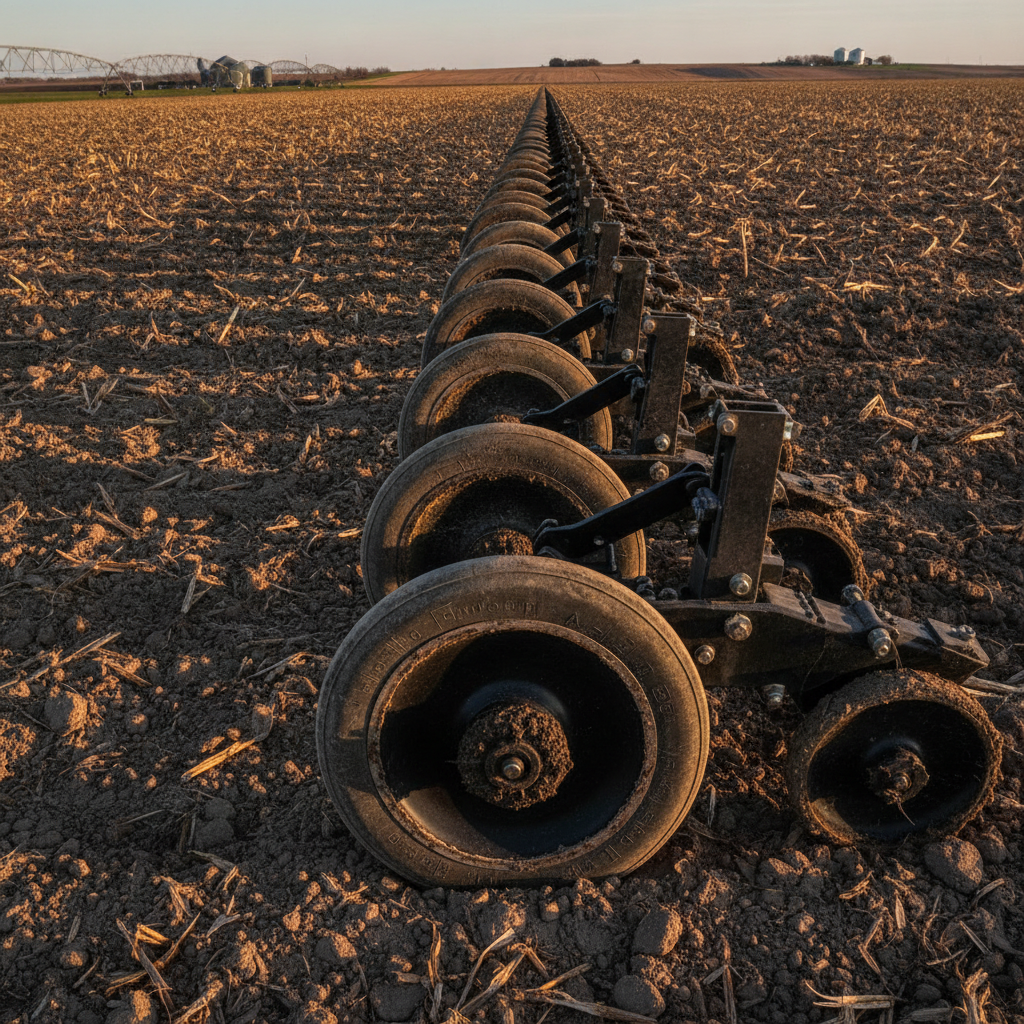
Here’s the part that catches a lot of farmers off guard: gauge wheel wear and mud buildup don’t fail catastrophically. They fail gradually. During a planting run, mud packs into the tire lip area incrementally. Residue gets pushed around the wheel. The tire lip itself starts to round off from abrasion against hard stalks, soil clods, and field debris. By the end of a long day, the wheel that was holding depth at 1.75 inches in the morning may be drifting by the afternoon — but it happens slowly enough that you don’t feel it from the cab.
Then you come back the next morning, or you move to a new field with slightly different soil conditions, and those accumulated small degradations suddenly matter. You’re not starting from the same baseline you started from on day one.
The clay and gumbo soils common between Watertown and Aberdeen are particularly hard on gauge wheel tires. When that soil is wet, it packs into every crevice. When it dries, it hardens there. Over multiple runs, that cycle of packing and drying gradually deforms the tire lip and reduces the wheel’s ability to hold a consistent furrow wall. Standard OEM gauge wheels with solid spoke designs give mud nowhere to go, which makes the problem worse with each successive pass.
What to Check Between Runs — Before You Head Back Out
Most of the farmers who catch this problem early do it the same way: they walk the equipment before the next run, not after. Post-run inspection tells you what happened. Pre-run inspection tells you what’s about to happen.
A few things worth checking between runs:
- Tire lip condition: Run your finger around the inside lip of each gauge wheel tire. If you can feel a groove worn into the rubber where it contacts soil, that tire is no longer controlling furrow wall the way it should. A worn lip means the wheel is sitting lower in the furrow than your depth setting actually calls for.
- Mud and residue buildup: Even after a day of drying, packed clay near the lip area can be harder than it looks. If you can’t clear it easily by hand, it’s already affecting wheel rotation and ground contact.
- Wheel seating: Give each gauge wheel a lateral push. It should have no meaningful side play. If a wheel moves noticeably, your wheel retainer may be worn or improperly seated — and a wheel that’s moving laterally isn’t controlling depth accurately regardless of what the rest of your setup looks like.
- Spoke area on open-spoke designs: If you’re running curved spoked gauge wheels, check that the spoke channels are actually clearing between runs. The curved spoke design is built to shed mud, but in extreme conditions, you should verify it’s doing its job before the next pass.
The Gap Most Competitors Don’t Address: Cumulative Run-to-Run Degradation
If you spend time on competitor sites looking for guidance on this specific problem — how gauge wheel performance changes across multiple runs rather than within a single run — you’ll find very little. Most content covers gauge wheel selection, installation, or single-field performance. The question of how equipment degrades between runs, and how to actively manage that degradation, isn’t something the industry talks about much.
That’s a real gap, because for farmers running 800 to 1,500 acres of corn and soybeans during a tight planting window, the difference between a planter that holds its setup from field one to field ten and one that drifts gradually is measured in bushels per acre across a lot of ground.
The steel ring is one of the most direct answers to this problem. Jung Enterprise’s patented steel ring (US 11,707,013 B2) mounts to the gauge wheel with six screws and protects the tire lip from the abrasion that causes cumulative wear. It also doubles as a built-in scraper, which means mud doesn’t get the chance to pack and harden against the tire between runs in the first place. That’s not a separate scraper kit — it’s built into the ring itself.
The field numbers behind this design are real: 1/16 inch of wear after 13,000 planted acres over three years. That’s the kind of durability that keeps your baseline consistent from the first field of the season to the last, whether you’re farming near Watertown, running custom planting jobs across into Minnesota, or managing a large operation out of Aberdeen.
How Planting Window Pressure Makes This Worse
In a normal year across eastern South Dakota and into North Dakota, your usable planting window for corn and soybeans might be two to three weeks if you’re fortunate. In a wet spring, it could be less. That kind of pressure means farmers are running long days, moving between fields quickly, and doing less inspection between runs than they’d like.
Equipment that holds its setup through that entire window — without requiring constant re-inspection or re-adjustment — is equipment that earns its cost. That’s the practical case for investing in gauge wheel components that are built to resist cumulative degradation rather than just perform well on day one.
Frequently Asked Questions
How can I tell if my gauge wheel is degrading between runs rather than within a single run?
Compare your seed depth at the start of day one against the start of day two. If your depth settings haven’t changed but your actual placement has shifted, you’re seeing between-run degradation. Worn tire lips and packed mud are the most common causes.
Does the steel ring actually reduce mud buildup, or just protect the tire?
It does both. The patented steel ring protects the tire lip from abrasive wear, and its built-in scraper function actively prevents mud from packing against the tire between field passes. You don’t need a separate scraper kit — it’s part of the same design.
Are Jung Enterprise’s gauge wheel products compatible with my current planter setup?
The steel rings, wheel retainers, and curved spoked gauge wheels are built to fit planters, air seeders, and no-till drills across multiple OEM brands and gauge wheel sizes. Check the products page for specifics or contact us directly if you have a compatibility question.
How do curved spoked gauge wheels help across multiple runs in wet conditions?
The open-spoke, curved design gives mud a path out rather than a surface to pack against. In clay soils near Watertown or in gumbo conditions across the Northern Plains, that matters more on run three than it does on run one — because by run three, a solid-spoke wheel is already carrying built-up material that a curved spoke design would have shed on the first pass.
Is this something I should address before planting season or can I upgrade mid-season?
Pre-plant is ideal — you’ll get the full-season benefit. But if you’re mid-season and seeing inconsistent stand emergence that tracks with later-planted fields, it’s worth making a change before you put in the rest of your acres. The installation is straightforward and doesn’t require pulling the planter off the field for days.
Talk to Jung Enterprise Before Your Next Run
We’re based in Ipswich and build these parts for the conditions farmers across South Dakota, North Dakota, and Minnesota are actually dealing with — not for ideal field conditions that don’t exist in a wet spring. If you’re seeing inconsistent stands, watching your gauge wheels closely between fields, or just want to know whether your current setup is holding up the way it should across a full planting season, reach out.
Contact Jung Enterprise here with your planter setup details and we’ll help you figure out what makes sense for your operation. No sales pitch — just straight answers about what’s likely causing your problem and what will actually fix it.