
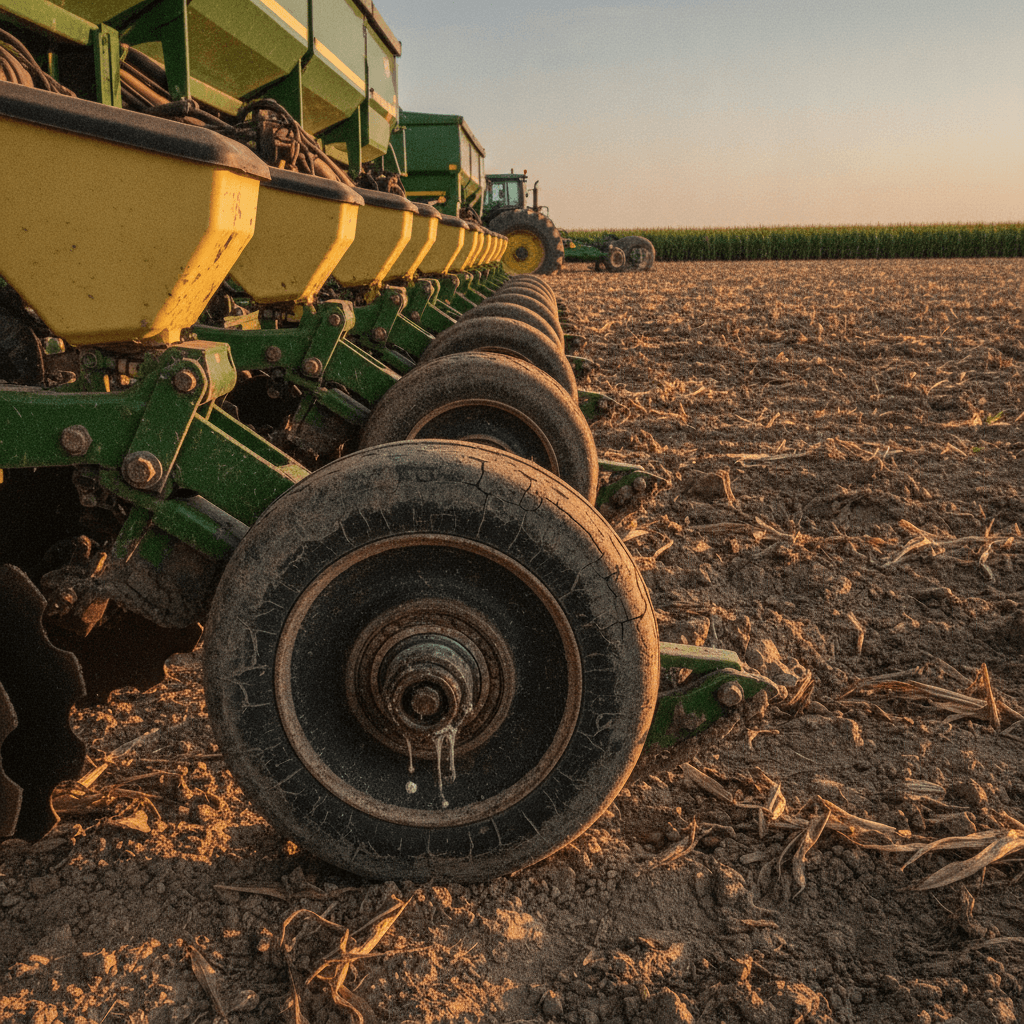
How Do Farmers Near Ipswich Know Whether Their Planter’s Gauge Wheel Bearings Are Actually Failing Early — Or Just Running Dirty From a Single Wet Season?
If your gauge wheel feels rough or sounds wrong after a wet spring, the honest answer is: it might be a bearing that’s done, or it might be a bearing that’s just packed with gumbo and needs a chance to clean itself out. The two feel almost identical if you’re spinning the wheel by hand in the shed. The difference matters a lot, though — one costs you a bearing swap before the season, and the other costs you a row unit sitting on the ground in the middle of a corn field near Ipswich when the planting window is already halfway gone.
This is one of those topics that doesn’t get a lot of direct attention from most gauge wheel parts manufacturers. Most of them focus on selling you the wheel or the tire — not on helping you figure out whether the bearing behind it is the real problem or just a symptom of something else going on with how the wheel is running.
Why Wet Springs in South Dakota Are Hard on Gauge Wheel Bearings Specifically
Gauge wheel bearings on row-crop planters take a specific kind of abuse that most equipment bearings don’t. They run slow — usually under 5 mph — under consistent lateral pressure against the seed trench wall, in direct contact with wet soil, clay, and crop residue. That combination is rough on seals. In a normal dry spring, bearing seals hold up fine. But after a wet planting season like what farmers around Aberdeen, Huron, and Watertown have dealt with more than once in recent years, water and fine clay particles work into the bearing through compromised seals and start breaking down the grease.
The problem is that a bearing running with contaminated grease doesn’t always feel obviously bad right away. It might feel slightly rough, or carry a low grinding sound under load. Then it gets worse fast once planting starts and it heats up under field conditions. By the time it’s obviously failed, you’re usually mid-field.
Three Ways to Tell a Failing Bearing From a Dirty One
Here’s a practical field diagnosis you can do before the season, not after something breaks:
- Spin test under resistance: Put light lateral thumb pressure on the gauge wheel while spinning it by hand. A dirty bearing will feel rough but consistent — same roughness through the whole rotation. A bearing with damaged races will have distinct catches or flat spots in the rotation. If you feel a repeating hard point, the races are likely damaged and the bearing needs to be replaced, not just cleaned.
- Heat check after a short field run: Run the planter one pass across the field, then come back and feel the hub area on each row unit. Some warmth is normal. A bearing running hot — noticeably warmer than surrounding metal — is failing, not just dirty. A dirty bearing running in clean soil usually frees up as it wears in; a damaged bearing gets hotter as load increases.
- Play test: Grab the gauge wheel at 3 and 9 o’clock and try to rock it. Any noticeable side-to-side play that isn’t accounted for by normal hub clearance is bearing wear, not contamination. Contamination doesn’t cause play — it causes roughness. Wear causes play.
What the Bearing Is Telling You About the Wheel Around It
Here’s the part that most suppliers skip: a gauge wheel bearing that fails early — before it should by any reasonable hour or acre count — is usually telling you something about the condition of the wheel itself. Specifically, two things accelerate bearing wear faster than anything else.
First, a gauge wheel tire with a worn or damaged lip puts uneven lateral loads into the bearing. When the tire lip is chewed up from running against abrasive soil and crop residue, the wheel doesn’t seat and track the trench wall cleanly. It wobbles slightly under load, and that wobble gets transferred directly to the bearing as a side load it wasn’t designed to handle repeatedly.
Second, mud packing and plugging behind the wheel — common in the heavy clay and gumbo soils across the Northern Plains — creates drag that the bearing fights on every rotation. A wheel that’s running clean sheds load. A wheel that’s packing mud transfers that load straight into the hub.
This is why protecting the tire lip and keeping the wheel clean aren’t just tire issues. They’re bearing issues too. A steel ring that protects the tire lip and doubles as a built-in scraper isn’t just reducing tire wear — it’s reducing the uneven loading and mud drag that shortens bearing life. Jung Enterprise’s patented steel ring (US 11,707,013 B2) mounts with six screws and handles both jobs without needing a separate scraper attachment.
When the Wheel Itself Is the Problem, Not Just the Bearing
If you’ve replaced a bearing and it failed again within a season or two, stop replacing just the bearing. The bearing is downstream of the real problem. Look at the gauge wheel itself — specifically whether the open-spoke design is actually shedding mud in your field conditions or packing it.
Solid or minimally-spoked gauge wheels pack mud. In the clay soils common around Ipswich and across much of north-central South Dakota, that packed mud creates the drag and imbalance that kills bearings early. Curved spoked gauge wheels are designed specifically to shed that buildup as the wheel rotates, which reduces the load on the bearing and keeps the wheel running balanced through the whole pass.
Field results back this up. Jung Enterprise’s gauge wheels have been tested to only 1/16 inch of wear after 13,000 planted acres over three years. That kind of durability doesn’t happen by accident — it comes from a wheel that’s running clean and balanced, not fighting mud and uneven loading every rotation.
North Dakota and Minnesota Operators: Same Problem, Different Soil
If you’re running a planter or air seeder across the border in North Dakota or Minnesota, the soil profile is different but the bearing problem is similar. Spring thaw conditions and heavy residue from corn-on-corn or soybean acres create wet, dense conditions that challenge gauge wheel bearings just as hard as the gumbo soils in South Dakota. The same diagnostic approach applies — and the same relationship between wheel condition and bearing life holds.
Frequently Asked Questions
How many acres should a gauge wheel bearing last before it needs replacement?
Under normal conditions, gauge wheel bearings should last several seasons — often 3 to 5 years depending on field conditions and how well the wheel itself is maintained. If you’re replacing bearings every season, the bearing is not the root problem. Look at the wheel condition, mud packing, and tire lip wear first.
Can mud packing actually damage a gauge wheel bearing?
Yes. Consistent mud drag on a wheel that isn’t shedding cleanly creates extra rotational resistance and imbalanced loading at the hub. Over time, that load pattern damages bearing races in ways that normal soil pressure wouldn’t. Keeping the wheel clean — through good spoke design and proper tire lip protection — directly extends bearing life.
Does a steel ring affect how the gauge wheel bearing runs?
Indirectly, yes. A steel ring protects the tire lip from the kind of wear that causes the wheel to track unevenly. It also acts as a scraper to prevent mud buildup on the wheel face. Both of those effects reduce uneven and excess loading at the bearing, which extends bearing life.
Should I replace bearings before or after planting season?
Before — always. Post-harvest is the right time to inspect bearings while you still have time to order parts without pressure. Farmers around Watertown and Huron who push bearing inspections until spring frequently end up scrambling for parts during the two or three week planting window when every day matters for yield.
Does Jung Enterprise’s gauge wheel work with my existing row unit setup?
Jung Enterprise’s curved spoked gauge wheels and steel rings are built to fit multiple OEM brands and gauge wheel sizes across planters, air seeders, and no-till drills. Contact Jung Enterprise directly to confirm compatibility for your specific setup before ordering.
Talk to Jung Enterprise Before the Next Season Starts
If you’re not sure whether what you’re feeling in your gauge wheels is a bearing problem, a wheel problem, or something that a steel ring and a spoke design change would actually fix — that’s a conversation worth having now, not in April when the planting window is open and every row unit needs to be running.
Jung Enterprise is based in Ipswich and builds patented, American-made gauge wheel parts that are field-tested for the conditions farmers across South Dakota, North Dakota, and Minnesota actually deal with. Reach out through the contact page and describe what you’re seeing. If it’s a parts question, a compatibility question, or you just want to talk through what’s been failing and why, that’s exactly what we’re here for.