
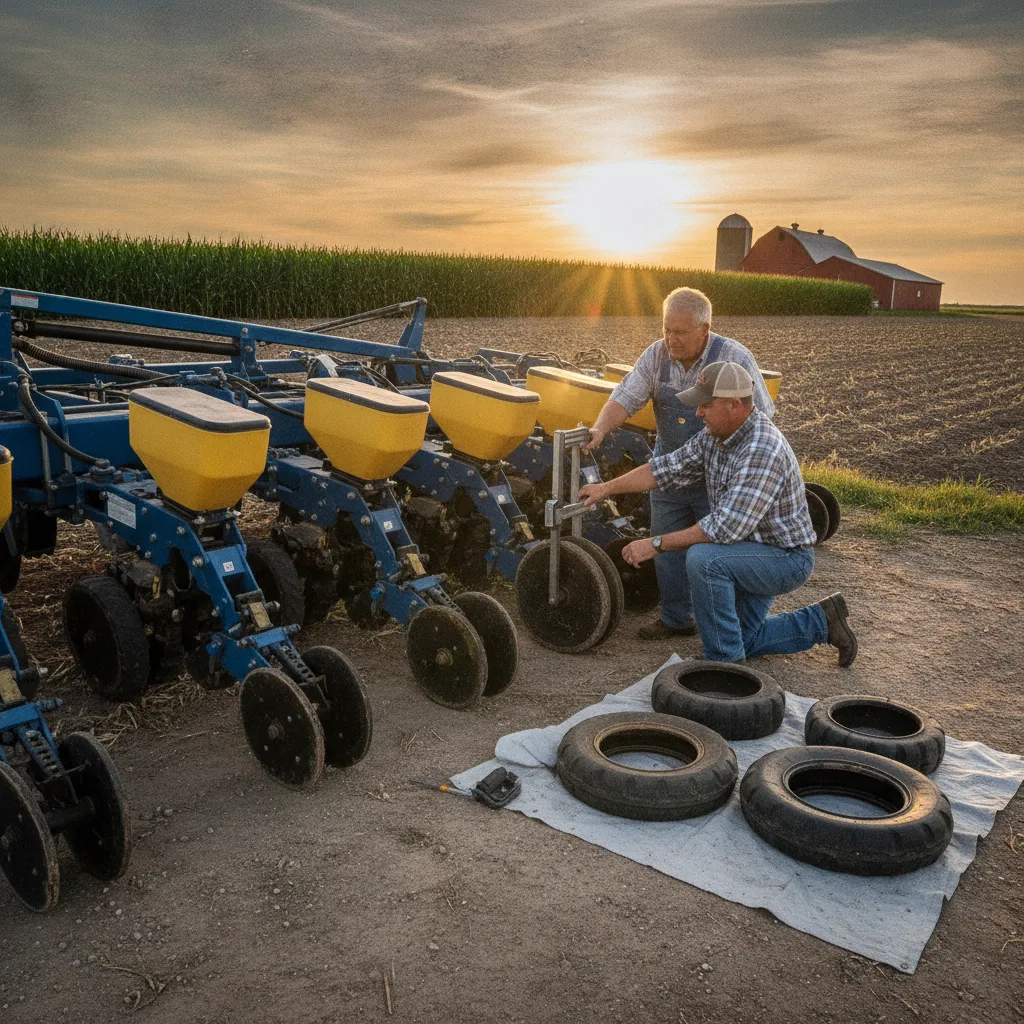
How Do Farmers Near Ipswich Know Whether Their Planter’s Gauge Wheel Is Actually the Right Diameter for Their Row Unit — Or Just Close Enough to Cause Problems?
If the gauge wheel bolted on and the row unit folded up cleanly, most farmers call it good and move on. That’s understandable — planting season in South Dakota doesn’t leave much room for second-guessing parts you already installed. But here’s the problem: gauge wheels that are even slightly off in diameter don’t announce themselves. They just quietly mess with your seeding depth, accelerate wear on the disk opener and the tire itself, and make your planter look like it’s performing fine until a stand count tells you otherwise.
This is one of the most overlooked compatibility questions in the planter parts space — and it’s something that most competitor resources barely touch on.
Why Diameter Matters More Than Most People Think
The gauge wheel’s job is to ride alongside the disk opener and physically set the depth at which seed gets placed. It does that by rolling on the soil surface while the disk cuts below. The geometry between the wheel’s outer diameter and the disk opener’s cut depth is what determines where the seed lands.
When the diameter is right, the wheel rolls level with the soil, holds consistent downforce transfer, and keeps the seed trench at the depth you dialed in. When it’s even a quarter-inch off — say, you’re running a worn-down wheel that started life at the correct size, or you picked up a replacement that was close but not exact — the effective depth shifts. On a corn planter trying to hit 1.75 inches, a quarter-inch error isn’t rounding; it’s a meaningful change in seed-to-soil contact and emergence timing.
In the gumbo soils common across central and northern South Dakota, that kind of depth inconsistency compounds fast. Heavy clay doesn’t forgive a wheel that’s riding too high or digging a channel that’s slightly deeper than intended. You end up chasing emergence problems that look like a planter calibration issue or a seed quality issue — when it’s actually a geometry problem you could’ve caught in the shop.
The Specific Gap Competitors Are Missing on This Topic
Most gauge wheel manufacturers and ag parts suppliers publish compatibility charts that tell you which wheel fits which planter brand and row unit model. What they don’t tell you is what happens when that wheel wears down 10 or 15 percent from its original diameter — and whether that wear threshold matters for depth accuracy on your specific setup.
That’s the gap. Farmers near Ipswich and Aberdeen are running planters that have accumulated real acres. The gauge wheels on those units aren’t new. Whether a worn wheel is still within acceptable diameter range for accurate depth control isn’t something you can answer by looking at a spec sheet for a new part.
Here’s the honest answer: if your gauge wheel has visibly flattened on the contact face, is cracked along the lip, or has worn unevenly side-to-side, diameter consistency is already gone. At that point, you’re not getting accurate depth — you’re getting whatever the worn geometry happens to produce row by row.
How to Actually Check Diameter Compatibility Before You Plant
This doesn’t require special tools. Pull a wheel off the row unit, set it on a flat surface, and measure the outer diameter across the tread face in at least three spots. Compare that against the OEM spec for your row unit. Most standard gauge wheel tires run in the 14- to 15-inch range, but that varies by planter model and row unit style.
If you’re seeing more than about 3/8 inch of variance from spec, or if you measure across multiple wheels on the toolbar and find significant variation from one row to the next, you’ve got a depth consistency problem that no downforce adjustment is going to fix.
Also check the tire lip condition. A cracked or chipped tire lip allows the disk opener to move laterally relative to the wheel, which undermines depth control even when the diameter itself is still close to spec. This is where a steel ring from Jung Enterprise becomes relevant — it protects the tire lip from chipping and wear, keeping the wheel’s contact geometry intact longer. That lip protection isn’t just about the tire surviving; it’s about maintaining the mechanical relationship between the gauge wheel and the disk that makes depth control work.
What to Do When the Diameter Is Wrong
If you’re replacing worn gauge wheels, don’t just match the brand on the wheel you’re pulling off. Match the diameter spec for the row unit — and if you’ve been running aftermarket wheels for several years without checking, verify that spec against your planter’s original documentation or the OEM service manual.
Farmers near Huron and Mitchell running mixed equipment — planters with components sourced from multiple suppliers across different seasons — are especially prone to ending up with mismatched diameters across the toolbar. It happens gradually, one replacement at a time, until row 1 and row 16 are running at meaningfully different effective depths.
Jung Enterprise’s curved spoked gauge wheels are built to precise diameter specs and designed for open-spoke mud shedding — so you’re not just getting a wheel that fits, you’re getting one that holds its geometry through wet South Dakota springs without packing clay into the hub and throwing off your depth control mid-field. After 13,000 planted acres over three years, our gauge wheels showed only 1/16 inch of wear. That kind of dimensional stability means the depth accuracy you set in the shop is the depth you’re getting in the field — not just on day one, but through the full season.
Pre-Season vs. Mid-Season: When to Address Diameter Issues
The best time to catch gauge wheel diameter problems is during your fall or winter shop inspection, not during planting week. By the time you’re in the field near Ipswich in early May, pulling a row unit to swap a gauge wheel costs you time in a window where every day matters for corn yield potential.
If you’re reading this post-harvest, do the diameter check now. Measure every wheel on the toolbar, note which rows are out of spec, and get replacements ordered before pre-season demand hits. Shops and distributors in South Dakota and across the Northern Plains tend to see gauge wheel demand spike in February and March. Getting ahead of that is a straightforward way to avoid the parts availability scramble that catches farmers every spring.
Frequently Asked Questions
Does gauge wheel diameter actually affect seeding depth on a modern planter with active downforce?
Yes. Active downforce systems control the pressure applied to the row unit — they don’t compensate for changes in the gauge wheel’s physical geometry. If the wheel diameter is off, the depth is off regardless of what your downforce monitor reads.
How much diameter variation across the toolbar is too much?
A general rule of thumb is to keep variation within 1/4 inch across all wheels on a single toolbar. Beyond that, you’re introducing meaningful row-to-row depth inconsistency. In corn, that can translate to uneven emergence and yield drag across the field.
Can I mix gauge wheel brands on the same toolbar if they’re the same nominal diameter?
Nominally the same diameter and actually the same diameter aren’t always the same thing. Different manufacturers have different tolerances. If you’re mixing brands, measure the actual diameters rather than trusting the spec labels — especially on aftermarket parts sourced from overseas.
How do Jung Enterprise gauge wheels hold up in the clay soils around Ipswich and Aberdeen?
The curved spoke design sheds clay and wet residue rather than packing it, which keeps the wheel rolling cleanly instead of building up weight and drag. That matters in gumbo conditions where standard wheels can pick up enough material to affect both diameter consistency and row unit downforce transfer.
Do I need to replace the steel ring when I replace the gauge wheel tire?
Not necessarily — inspect the steel ring for cracks, deformation, or loose mounting hardware. If it’s still seated flat with no damage, it can typically transfer to a new tire. If the ring has deformed from impact or shows wear through the lip face, replace it at the same time so the new tire starts with full lip protection.
Ready to Check Your Gauge Wheel Setup Before Spring?
If you’re not sure whether the gauge wheels on your planter are dialed in for this coming season — or if you’re seeing depth inconsistency you haven’t been able to trace — contact Jung Enterprise directly. We’re based in Ipswich and work with row-crop farmers and ag dealers across South Dakota, North Dakota, and Minnesota. We can help you figure out whether what you’ve got is still serviceable or whether it’s time for a replacement that’s actually built to hold its dimensions. Reach out here or call (605) 281-0497.