
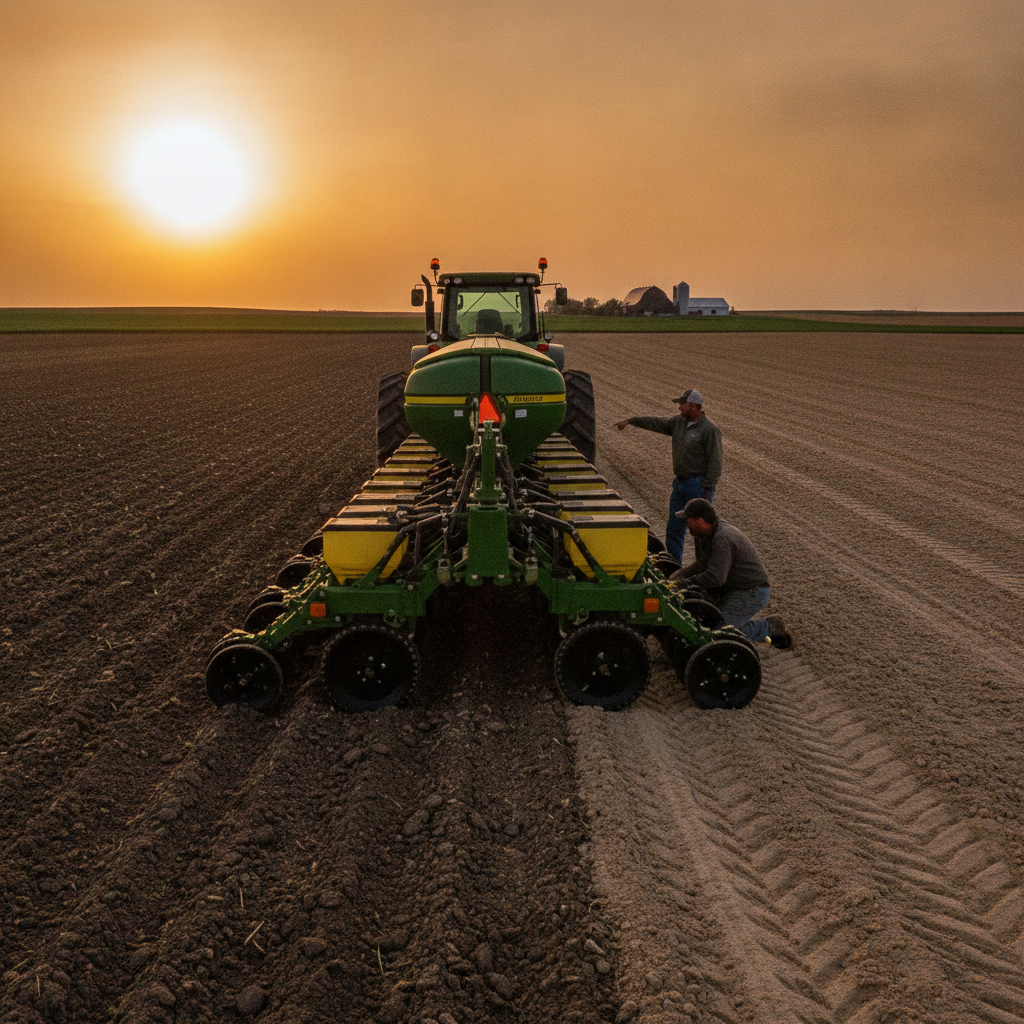
How Do Row-Crop Farmers Near Ipswich Know Whether Their Planter’s Gauge Wheels Are Actually Performing Differently in Gumbo Clay Versus Sandy Loam — Or Just Running the Same Setup Regardless of Soil Type?
If you farm ground near Ipswich, you already know that South Dakota soils don’t pick a lane. You might be planting corn on heavy gumbo clay in one field and rolling into lighter sandy loam two miles down the road — sometimes within the same afternoon. The problem is that most farmers run an identical gauge wheel setup across all of it and never stop to ask whether that setup is actually working or just surviving. Gumbo clay and sandy loam behave completely differently under a gauge wheel, and the wrong configuration costs you seed depth consistency, stand uniformity, and ultimately yield — before you ever know something went wrong.
Why Soil Type Changes What Your Gauge Wheels Actually Have to Do
This is the angle that most equipment content skips entirely. Manufacturers focus on gauge wheel specs — diameter, spoke design, tire material — but they rarely explain how those specs interact with specific soil conditions. That’s a real gap, and it’s one that matters a lot when you’re farming the Northern Plains.
In gumbo clay, especially after a wet spring, the ground near the seed trench has almost no forgiveness. The soil is sticky, dense, and clingy. A gauge wheel with a solid or nearly-solid tire face will start packing clay into the wheel almost immediately. Once it plugs, the wheel stops rolling cleanly and starts dragging. At that point it’s no longer controlling depth — it’s just riding on a mud ball. You lose the one job that wheel was supposed to do.
Sandy loam behaves the opposite way. It sheds moisture fast, doesn’t plug, but it also doesn’t resist well. A gauge wheel running too much downforce on sandy loam will push deeper than your target depth before the soil pushes back. The trench walls are softer, seed placement gets inconsistent, and you end up with variable emergence across a field that looked identical from the cab.
These are two completely different failure modes. One is a mud-plugging problem. The other is a depth-control and soil-firmness problem. The fix for each one is not the same.
What Gumbo Clay Actually Does to a Gauge Wheel Tire — and Why Open Spokes Matter Here
Farmers around Aberdeen and Huron who work with heavier soils know firsthand what a plugged gauge wheel looks like mid-run. The tire accumulates clay between the wheel face and the disk opener, the row unit loses its depth reference, and you’re planting blind. The common response is to stop and clean it out — sometimes multiple times per field. That’s lost time, and in a short planting window on the Northern Plains, lost time is lost yield potential.
An open-spoke gauge wheel design addresses this directly. The curved spoke geometry allows mud and residue to pass through the wheel rather than pack into it. Jung Enterprise’s curved spoked gauge wheels are built specifically around this concept — the spoke angle and spacing are designed to shed material rather than collect it, which keeps the wheel rolling clean and in contact with the soil the way it’s supposed to be.
This matters most in gumbo clay, but it’s also an advantage in soybean stubble and corn residue where wet plant material can wrap around a wheel just as fast as clay can plug it.
The Steel Ring’s Role in Clay Soils Goes Beyond Just Tire Protection
If you’ve ever pulled a gauge wheel off at the end of a wet-soil day and looked at the tire lip, you’ve seen the damage that clay and abrasive soils do. The lip erodes unevenly. Once it’s compromised, the tire no longer seats flush against the disk opener and your depth control starts drifting without any obvious mechanical failure.
The steel ring addresses this at the lip — protecting that contact point where the tire meets the disk. But in clay soils there’s a second function that matters just as much: the steel ring doubles as a built-in scraper. Rather than packing clay between the tire and the disk, it’s actively clearing material from that interface with every rotation. That’s one less thing that builds up, and one less reason to stop and clean the row unit mid-field.
Jung Enterprise’s patented steel ring (US 11,707,013 B2) mounts with six screws and integrates the scraper function into the ring itself — no separate scraper hardware required. Over 13,000 planted acres of field testing showed only 1/16″ of wear after three full years, including seasons with heavy clay conditions. That’s not a lab number. That’s what farmers in these soils actually saw.
Sandy Loam: The Depth-Control Problem That’s Easier to Miss
Sandy loam doesn’t punish you as visibly as gumbo does. The wheel doesn’t plug, the equipment keeps moving, and nothing breaks. That’s exactly why the depth problem in lighter soils goes undetected so often — because from the cab, everything looks fine.
What’s actually happening is that without firm soil resistance, gauge wheel downforce that was calibrated for heavier ground is now pushing seed too deep. Corn that should be at 2 inches is planting at 2.5 or even 3. Soybean emergence gets uneven. You don’t find out until you’re walking the field two weeks later and wondering why you have gaps.
If your operation crosses soil types — and most farms near Pierre and across central South Dakota do — this is worth paying attention to when you’re setting up for planting. Downforce adjustments between fields are part of it, but the gauge wheel itself has to be capable of maintaining precise contact with a less-resistant soil surface. A worn tire, a compromised lip, or a wheel that doesn’t roll clean is going to amplify that variability rather than correct it.
Investing in gauge wheels that hold their geometry over time — and protecting the tire lip from early wear — is what keeps your depth reference honest across every soil type you plant. You can see the full line of options at Jung Enterprise’s product page to find what fits your row units and gauge wheel diameter.
The Setup Question No One Talks About Enough: Are You Running the Same Wheel in Every Field?
Most farmers are. Most of the time, that’s a practical necessity — you’re not going to swap gauge wheels between fields during planting season. But knowing the tradeoffs means you can at least make informed decisions about downforce settings, planting speed in heavier soil, and when it makes sense to invest in a wheel design that performs across a wider range of conditions rather than optimizing for just one.
Farmers in Nebraska and Minnesota running mixed soil types deal with the same question. The answer isn’t always a different wheel in every field. Often it’s a better wheel overall — one that’s durable enough to hold up in clay, open enough to shed mud, and precise enough to control depth when the soil isn’t pushing back hard. That’s what good gauge wheel design is actually solving for.
Frequently Asked Questions
Does gauge wheel design really matter that much between soil types?
Yes — and it’s one of the most underappreciated variables in planting performance. Clay soils cause plugging and smearing that kill depth consistency. Sandy loam soils offer less resistance, which makes depth control harder if the wheel isn’t rolling clean and the downforce isn’t dialed in correctly.
Will an open-spoke gauge wheel actually hold up in sandy loam, or is it only for heavy clay?
Open-spoke gauge wheels perform well across soil types. In lighter soils they still maintain precise ground contact and depth control — the spoke design doesn’t hurt performance in sandy conditions, it just provides extra benefit in clay and residue situations where solid wheels would plug.
How does the steel ring help specifically in gumbo clay conditions?
The steel ring protects the tire lip from abrasive wear that accelerates in clay and heavy soils, and the built-in scraper function clears material from the tire-to-disk interface during operation. That reduces mid-field cleanout stops and keeps the wheel performing consistently throughout a long planting day.
Do Jung Enterprise gauge wheels and steel rings fit my planter if I’m running across multiple soil types in South Dakota or North Dakota?
Jung Enterprise products are compatible with planters, air seeders, and no-till drills across multiple OEM brands and gauge wheel sizes. Contact us directly to confirm fitment for your specific row units before ordering.
Is this something I should address before planting season or can it wait until post-harvest?
If your gauge wheels are showing visible tire lip wear or your depth consistency has been off, pre-planting (February through April) is the right time to address it. Post-harvest (September through November) is the right time to inspect and order so you’re not scrambling when the window opens. Either way, don’t wait until you’re already in the field.
Talk to Jung Enterprise Before Your Soil Gets the Better of Your Equipment
If you’re farming mixed soils across Ipswich, Aberdeen, Huron, Pierre, or anywhere else in South Dakota and the surrounding region, your gauge wheel setup is working against conditions that change field to field. Jung Enterprise builds patented, American-made steel rings, wheel retainers, and curved spoked gauge wheels that are field-tested in exactly these conditions — 13,000 acres, real-world clay and residue, and a proven wear record that holds up to scrutiny.
Reach out to the team at Jung Enterprise with your row unit specs and soil situation. We’ll help you figure out what your equipment actually needs — not just what looks good on a spec sheet. Contact Jung Enterprise here or call us at (605) 281-0497.