
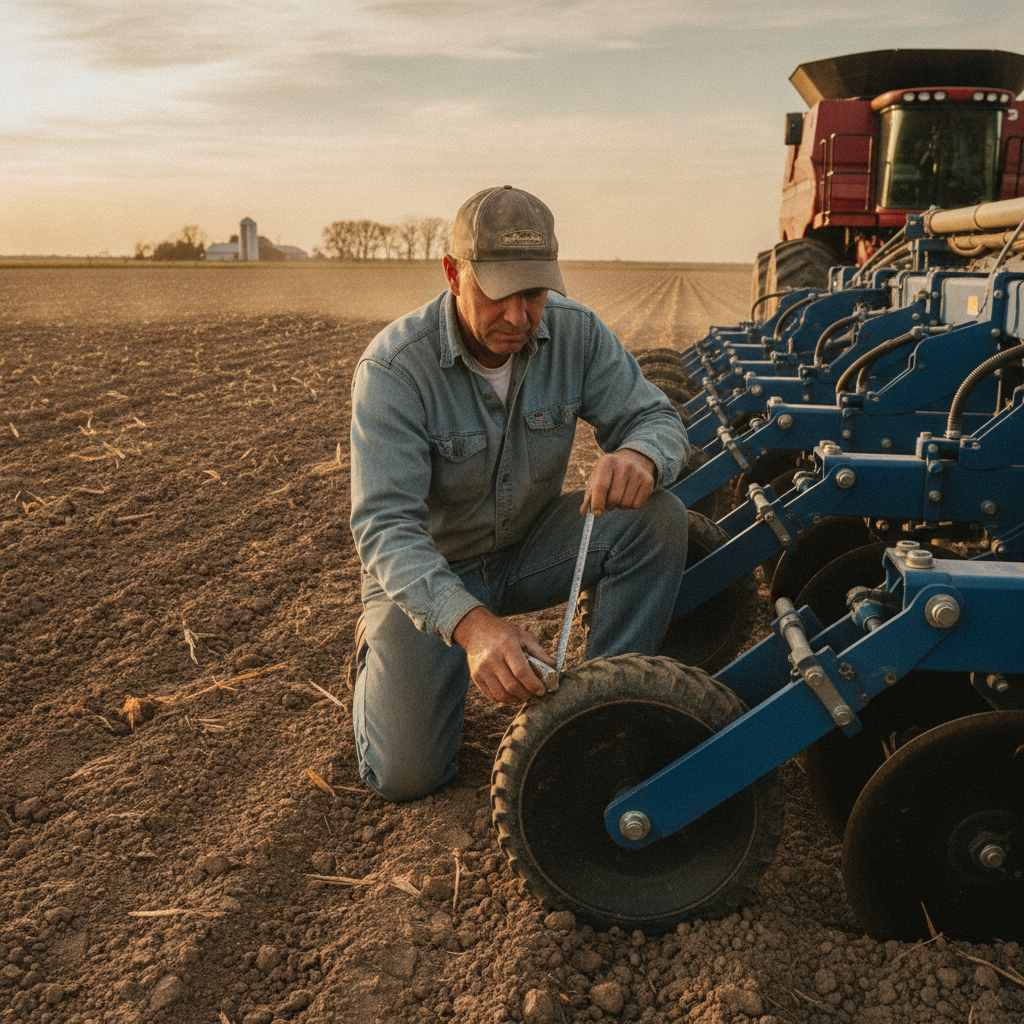
How Do Corn and Soybean Farmers Near Ipswich Know Whether Their Planter’s Gauge Wheel Is Actually Sized Right for Their Row Spacing — Or Just Running Whatever Came Stock on the Machine?
Here’s the short answer: most farmers don’t check. They put the planter in the field with whatever gauge wheels came on the machine, assume the manufacturer got it right, and don’t think about it again until something goes wrong. Near Ipswich and across the Northern Plains, that assumption is costing people stands they’ll never get back — not because the wheel is broken, but because it was never the right size to begin with.
Gauge wheel diameter and width aren’t interchangeable across row spacings and row unit designs. A wheel that works fine on a 30-inch corn setup may not give you the same seed trench control on a narrower row or a different row unit configuration. This is a surprisingly underexplored topic — one that most competitor content glosses over entirely in favor of discussing wear rates and mud shedding. The sizing question deserves a straight answer.
Why Gauge Wheel Sizing Matters More Than Most Farmers Realize
The gauge wheel does one primary job: it rides on the soil surface alongside the disc opener and sets the planting depth by limiting how far the disc can drop. That relationship — between wheel diameter, the disc blade, and your target seeding depth — is a mechanical geometry problem. Change any one variable without accounting for the others, and your depth control drifts.
On a standard 30-inch corn planter, most OEM gauge wheels are sized to work within a known range of disc blade diameters and row unit geometry. But planters get modified. Disc blades wear down and get replaced with a slightly different diameter. Row units get swapped between machines. Farmers convert 30-inch equipment to 15-inch twin rows or add a new crop to the rotation. Every one of those changes can throw off the sizing equation without anyone noticing until emergence maps start showing irregular depth or poor stand counts in scattered areas of the field.
In the heavy clay soils common around Ipswich, Huron, and south into central South Dakota, the consequences compound fast. A gauge wheel running slightly undersized for the disc geometry will allow the opener to cut deeper than intended in soft spots — especially after a wet spring when gumbo clay lets the disc drop freely. Oversized wheels do the opposite: they skim the top and leave you with inconsistent trench depth across variable soil conditions.
What the Spec Sheet Doesn’t Always Tell You
Gauge wheel sizing comes down to two measurements that actually matter in the field: outside diameter and width. Outside diameter controls depth — it determines how high the axle rides relative to the disc. Width affects trench wall contact and whether the wheel is physically clearing adjacent row unit hardware without interference.
Most OEM manuals list a nominal wheel size, but they don’t always account for aftermarket disc blade swaps, regional tillage practice differences, or the fact that a used planter may have had its disc blades replaced once or twice before you bought it. If you picked up a used planter near Aberdeen or traded into one at a dealer in Fargo, there’s a real chance the gauge wheels on it were swapped at some point — and not necessarily back to spec.
Before you run a field, you should physically verify:
- The outside diameter of the gauge wheel currently on the machine, measured with a tape — not assumed from the label
- The diameter of your current disc blades (new blades run true to size; worn blades are smaller and change the geometry)
- Whether the wheel width is clearing the row unit frame without rubbing under load
- Whether the wheel is riding flush with the soil surface on both sides of the trench at your target seeding depth
That last point — whether the wheel is actually riding level and consistent — is where curved spoked gauge wheels show their value. An open-spoke design lets you see what’s happening at the trench wall during a pass without having to stop and dig. Solid rubber wheels hide the contact zone. That visibility matters when you’re troubleshooting a sizing fit, not just wear.
The Row Spacing Variable Most Farmers Skip Over
Switching row spacings — even from 30-inch to 20-inch, or adding a twin-row conversion — changes the physical space available between row units. That matters for gauge wheel width. On narrow-row setups, a wheel that’s slightly wide can contact adjacent hardware or crowd the trench on one side, creating the kind of uneven sidewall pressure that looks like a compaction problem when it’s really a sizing problem.
Custom planters running multiple row spacings across different farm accounts near Ipswich or out toward the Minnesota border deal with this regularly. They may be planting corn at 30 inches for one operation and running the same toolbar at 20 inches for another. Gauge wheel width compatibility across those configurations is something worth confirming with a supplier who actually knows the spec — not just ordering based on what’s in stock.
Jung Enterprise builds gauge wheels and steel rings to fit multiple OEM row unit configurations across planters, air seeders, and no-till drills. If you’re not sure which size applies to your specific setup, that’s a direct question we can answer before you pull the equipment into the field.
What Happens When You Get the Size Right
When gauge wheel diameter is properly matched to your disc blade size and row unit geometry, depth control becomes consistent and repeatable. You stop chasing the reason your stand varies by three to four plants per hundred feet between field entries. You stop second-guessing whether the soil conditions caused it or the equipment did.
The Jung Enterprise curved spoked gauge wheels are field-tested to show only 1/16 inch of wear after 13,000 planted acres across three years of operation. That durability number means something specific: when you get the size right and install a wheel that holds its geometry over time, you’re not chasing a moving target season after season as the wheel wears down and the effective diameter quietly changes on you. A wheel that wears fast is also a wheel whose size is drifting — which means the depth control problem comes back even after you solve it the first time.
Frequently Asked Questions
Does gauge wheel diameter really change my planting depth that much?
Yes. Even a quarter-inch difference in effective wheel diameter can shift your seeding depth by a measurable amount when the disc blade diameter is held constant. In variable soil conditions across the Northern Plains, that shift shows up in stand counts and emergence timing — especially in wet springs when gumbo soils let the opener ride more aggressively than normal.
How do I know what gauge wheel size my row unit actually requires?
Start with your current disc blade diameter and your OEM row unit spec. Then measure the wheel currently on the machine — don’t assume the label is correct, especially on used equipment. If you’ve replaced disc blades since the machine was new, recalculate from the new blade diameter. Jung Enterprise can help you confirm the right fit for your specific row unit.
Can I run the same gauge wheel size across different row spacings on the same planter?
Diameter can often stay consistent if the disc geometry is the same. Width is the variable to watch — narrower row spacings may require a narrower wheel to avoid interference with adjacent row unit hardware. This is especially relevant on twin-row conversions and 15-inch setups.
Does gauge wheel wear affect the effective diameter over time?
It does. As the tire lip and outer edge wear down, the effective diameter decreases — which means your depth control drifts shallower over the life of the wheel if you’re not monitoring it. This is one reason durability matters: a wheel that holds its size longer holds your depth control longer. Jung Enterprise’s steel ring design protects the tire lip specifically to slow that wear process.
I farm near Ipswich in heavier clay soils. Does soil type affect which gauge wheel size I should run?
Soil type affects downforce requirements more than gauge wheel size directly, but it does influence how aggressively the disc drops in soft conditions. In the heavier gumbo soils common around Ipswich and south toward Huron, running a wheel that’s even slightly undersized can allow the disc to cut deeper than intended in wet, soft areas of the field. Getting the size right — and keeping the wheel in good shape — is especially important when your soil conditions swing hard between dry and saturated across the same field.
Talk to Jung Enterprise Before Planting Season
If you’re not confident that your gauge wheels are sized right for your row unit and current disc blades, the best time to find out is before you’re already in the field. Jung Enterprise is based in Ipswich and works with row-crop farmers, custom planters, and ag dealers across South Dakota, North Dakota, Minnesota, and Iowa. We build American-made, patented gauge wheels, steel rings, and wheel retainers designed to fit real-world planting setups — not just catalog specs.
Contact Jung Enterprise to talk through your row unit configuration and confirm you have the right gauge wheel size going into planting season. We’d rather sort it out now than hear about it after emergence.