
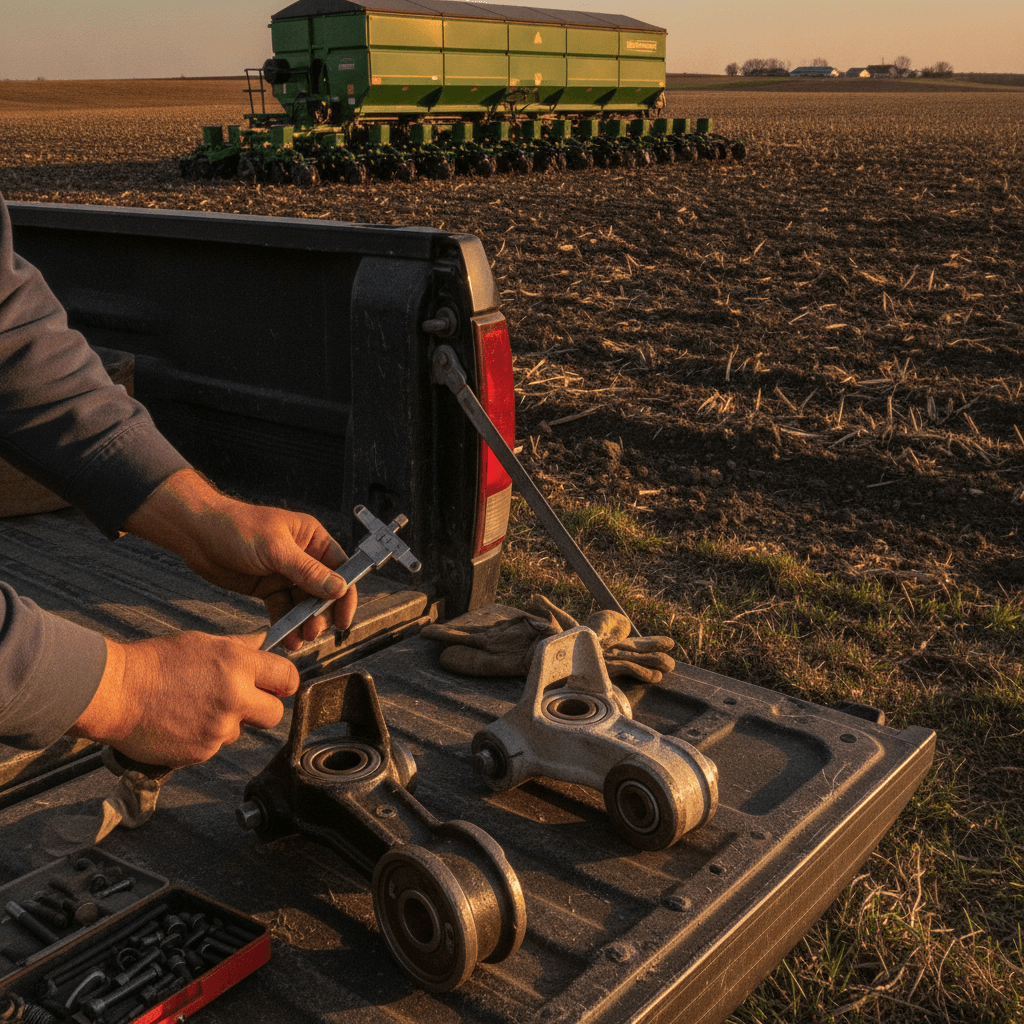
How Do Row-Crop Farmers Near Ipswich Know Whether Their Planter’s Gauge Wheel Parts Are Actually Made in America — Or Just Labeled That Way?
If you’re farming near Ipswich or anywhere across South Dakota, you’ve probably seen gauge wheel parts and steel rings marketed with American flags, patriotic language, and bold durability claims. Some of it is legitimate. A lot of it isn’t. The hard truth is that “American quality” and “made in America” are two different things, and the difference shows up fast once you’re 80 acres into a wet spring field and a part gives out on you. Here’s how to actually verify what you’re buying before planting season puts the pressure on.
Why “American-Made” Claims Are Worth Scrutinizing on Planting Parts
Walk through any farm show or browse a few ag e-commerce sites and you’ll find gauge wheels, steel rings, and wheel retainers with similar-looking specs listed at significantly different price points. The cheaper options often originate from overseas factories where tolerances are looser, steel grades are softer, and there’s no domestic accountability if the part fails in the field.
The issue isn’t just patriotic preference. It’s practical. Parts machined to inconsistent tolerances don’t seat correctly on the row unit. A steel ring that’s slightly out of round won’t scrape mud evenly, which means plugging, uneven seeding depth, and downtime — all during the 10 to 14 days you actually have to get corn or soybeans in the ground across the Northern Plains.
Farmers near Aberdeen and Watertown who run no-till into heavy clay soils know exactly how fast a poorly manufactured part can go from marginal to useless. When the ground is wet and you’re pushing through residue, there’s no grace period for a part that was built to a lower standard.
What Competitors Don’t Tell You About Their Manufacturing Origins
Here’s a gap you won’t find addressed directly on most competitor websites: none of them clearly document where their parts are manufactured at the component level. You’ll find brand names, product photos, and feature lists, but you won’t find a straight answer about which specific components are machined domestically versus sourced offshore and assembled stateside. That distinction matters legally and practically.
Under FTC guidelines, a product can only be labeled “Made in USA” if all or virtually all of its components originated and were manufactured in the United States. “Assembled in USA” is a legally different — and weaker — claim. If a company isn’t stating exactly which is true, that’s worth asking directly before you place an order.
At Jung Enterprise, based right here in Ipswich, the answer is straightforward: the steel rings, wheel retainers, and curved spoked gauge wheels are designed and manufactured domestically, and they carry United States patents — US 11,707,013 B2 and related patents — that document the engineering behind the design. You can’t patent a knockoff. The patents are public record and verifiable.
How to Actually Verify a Part’s Origin Before You Buy
You don’t have to take any manufacturer’s word for it. Here are four things you can do before committing to a gauge wheel part or steel ring supplier:
- Ask for the country of origin documentation. Any legitimate domestic manufacturer can provide this. If the answer is vague or you get redirected to a FAQ page, that tells you something.
- Check for U.S. patents. A genuine domestic design innovation will be patented. Look up the patent number on the USPTO database at patents.google.com. If a company is claiming a patented design but can’t produce a patent number, the claim is marketing language, not fact.
- Request field test data. Real-world durability data is hard to fake. Jung Enterprise’s steel rings have been tested across 13,000 planted acres over three years and showed only 1/16″ of measurable wear. That’s the kind of data point that comes from actual field use, not a product brochure.
- Talk to your local dealer. Ag dealers near Huron and Sioux Falls who stock multiple brands can often tell you which ones they’ve had to warranty and which ones hold up. Dealers who’ve been burned by failed parts know the difference.
If a supplier can’t satisfy at least three of those four points, it’s worth looking harder before you commit inventory budget or install the parts on your row units.
Why Domestic Manufacturing Matters Specifically for Planting Equipment Parts
Gauge wheel parts aren’t bolts. They operate under repeated stress — lateral pressure from row unit downforce, abrasion from soil and residue, impact from rocks and hard ground. The steel grade, heat treatment, and dimensional tolerances all matter in ways that only show up after sustained field use.
A steel ring that’s made from inferior-grade steel might look identical to a domestically manufactured one out of the box. After 2,000 acres through gumbo clay in a wet South Dakota spring, the wear rate diverges fast. That’s money — in replacement parts, in installation labor, and in downtime when you can least afford it.
The same logic applies to curved spoked gauge wheels. An open-spoke design that sheds mud reliably in Iowa loam may not perform the same in the heavy gumbo soils you see across the Northern Plains if the spoke geometry and material strength aren’t built to handle that kind of soil loading. That design and material engineering comes from domestic field testing, not catalog specs.
What a Patented Design Actually Means for the Farmer
The patents on Jung Enterprise’s products aren’t just legal protection — they represent genuine engineering solutions to real problems. The steel ring’s patented design functions as both a tire lip protector and a built-in scraper, which means you’re not sourcing and installing two separate parts to get mud-clearing function and tire wear protection. One part, one installation, documented performance.
That kind of integration is the result of domestic engineering with input from farmers who actually run planters and air seeders in the field. It’s not designed by committee in an offshore factory working from a parts catalog photo.
Frequently Asked Questions
How can I tell if a gauge wheel part is actually made in America and not just assembled here?
Ask the manufacturer for country-of-origin documentation and check whether a U.S. patent number is publicly registered. Assembly in the USA does not qualify as Made in USA under FTC standards unless substantially all components are also domestic.
Does it matter whether gauge wheel parts are patented if they look the same as the competitor’s version?
Yes. A patent documents a specific engineering design and requires that the design be novel and functional. Knockoffs that look similar often cut corners on materials, tolerances, or design geometry — differences that only become visible after field hours accumulate.
Are Jung Enterprise’s parts compatible with my planter brand and row spacing?
Jung Enterprise’s steel rings, wheel retainers, and curved spoked gauge wheels are designed to fit multiple OEM brands and gauge wheel sizes across planters, air seeders, and no-till drills. Contact the team directly to confirm fitment for your specific setup before ordering.
I farm near Watertown in heavy clay soils. Will an American-made steel ring actually perform better than an imported one in those conditions?
Field data suggests yes. The 13,000-acre, three-year test showing only 1/16″ of wear was conducted in demanding field conditions. Imported parts with softer steel grades tend to show significantly higher wear rates in abrasive or wet soil environments — exactly what you see across much of eastern South Dakota in a normal spring.
Can I buy Jung Enterprise parts through a local ag dealer near Aberdeen or Huron?
Yes. Jung Enterprise works with ag dealers and distributors across the region in addition to direct sales. If your local dealer doesn’t currently stock Jung Enterprise products, they can inquire about becoming a distributor.
The Bottom Line
If a supplier can hand you a U.S. patent number, show you 13,000 acres of field test data, and tell you straight where the part was made, that’s a supplier worth doing business with. If the answer to any of those questions is evasive, you’re probably looking at a product that will underperform when it counts — which in the Northern Plains means a two-week planting window in a wet April with gumbo sticking to everything.
Jung Enterprise is a family-owned manufacturer based in Ipswich, South Dakota. The products are patented, American-made, and field-proven. If you want to know whether they’re the right fit for your planter, air seeder, or no-till drill, reach out directly. Contact Jung Enterprise here and get a straight answer before planting season is on top of you.