
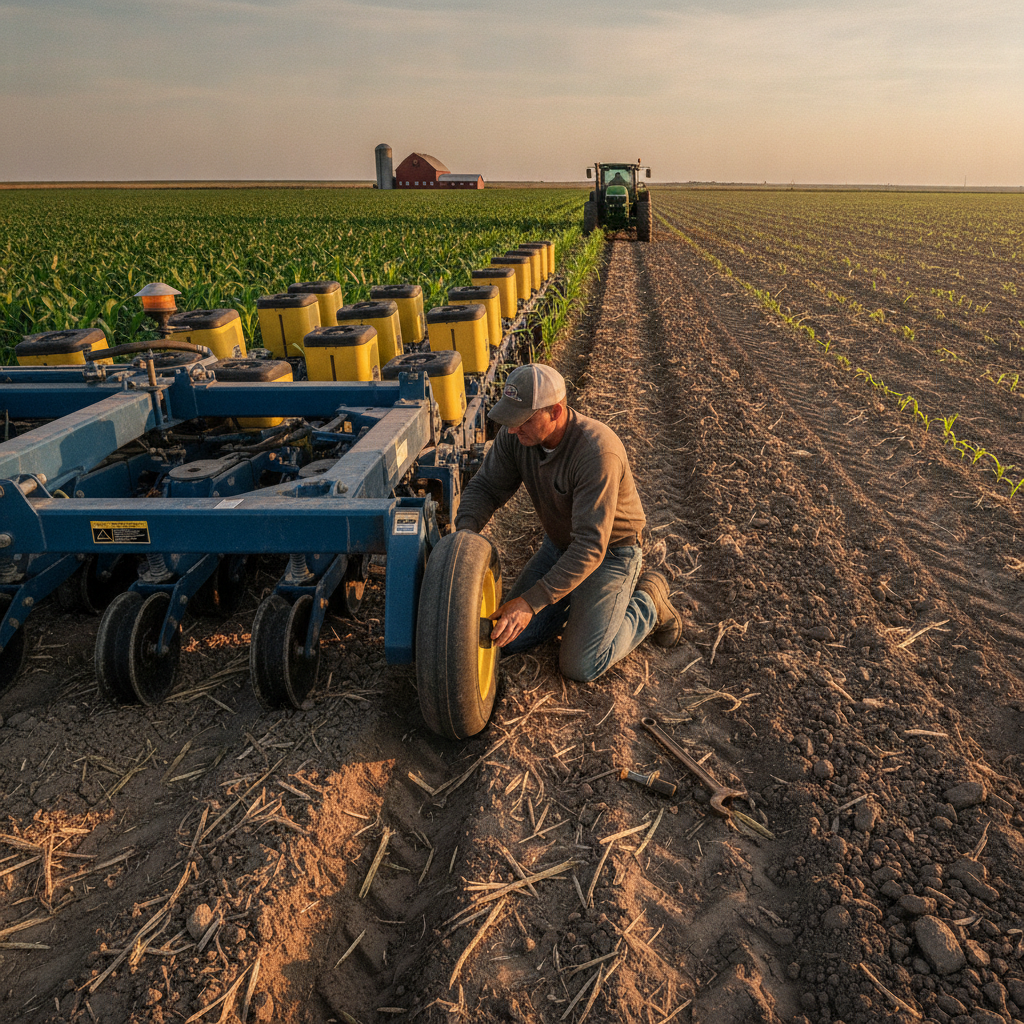
How Do Farmers Near Ipswich Know Whether Their Planter’s Gauge Wheel Is Actually Performing the Same After a Mid-Season Tire Swap — Or Just Assumed to Be Back to Normal?
A mid-season gauge wheel tire swap can fix an obvious problem — a blown sidewall, a cracked bead, a tire that’s been chewed down by a steel ring that wasn’t doing its job. But the swap itself doesn’t automatically restore your planting depth consistency. There are at least three things that can go wrong between pulling the old tire and running the next field, and farmers near Ipswich who skip the post-swap checks often don’t find out until their stand counts come back light or uneven. Here’s what to actually verify before you trust that row unit again.
Why a Tire Swap Isn’t a Complete Reset
The tire is one piece of the gauge wheel system. When you swap it, you’re not just changing rubber — you’re also disturbing the relationship between the tire, the rim, the steel ring if one is mounted, and the wheel retainer holding everything on the row unit. Any one of those connections, if it was marginal before the swap, can come loose faster or seat worse on the replacement tire.
In wet spring conditions across South Dakota — the kind of heavy clay and gumbo soil that runs from the Ipswich area south through Huron and across much of the Northern Plains — a gauge wheel that’s even slightly out of position will collect mud differently on every pass. That means your depth control drifts, your seed trench closes inconsistently, and by the time you’re two or three fields in, you’ve got depth variation you didn’t have before the swap. The tire fix was real. The depth problem is too.
Three Things to Check After a Mid-Season Tire Swap
1. Verify the Wheel Retainer Is Seated Correctly
This one gets skipped more than it should. When you pull a gauge wheel to change the tire, the wheel retainer comes off with it. Reinstalling it correctly — fully seated, no twist in the clip, retaining the wheel securely against the row unit arm — takes an extra minute that’s easy to skip when you’re trying to get back in the field before the window closes.
A retainer that’s not fully seated will let the gauge wheel shift laterally under load. In firm, dry ground that might not matter much. In the wet, variable soils common across north-central South Dakota and into North Dakota and Minnesota, a wheel that’s moving around on the arm is going to give you inconsistent depth on every pass. Jung Enterprise’s wheel retainer is designed to be straightforward to reinstall correctly and stay put through the full season — but only if you take the time to seat it right after the swap.
2. Check Whether Your Steel Ring Still Fits the Replacement Tire
If you’re running a steel ring on your gauge wheel — and if you’re not, you probably should be — a tire swap is the moment to confirm the ring still fits properly on the new tire’s lip. Not all replacement tires sit exactly the same on the rim, and a steel ring that was snug on the original tire may sit loose, crooked, or not fully contact the bead on a replacement with slightly different molding.
A loose steel ring won’t protect the tire lip the way it’s supposed to. More importantly, it won’t scrape mud cleanly. You’ll start seeing the same plugging problems that likely contributed to the original tire wearing out in the first place. The six-screw mount on Jung Enterprise’s patented steel ring (US 11,707,013 B2) gives you a way to verify fit and torque after every swap — if the screws won’t draw down evenly, the ring isn’t sitting right and you need to find out why before you go back to the field.
3. Walk the Row and Physically Confirm Depth
Once the tire is swapped, the retainer is seated, and the steel ring is confirmed, do a short test pass and dig a few seeds. Don’t trust that the depth setting didn’t shift during reassembly. On a 24-row planter working through 200-acre fields near Aberdeen or across the larger operations common in north-central South Dakota, a quarter-inch of depth variation on one row unit you assumed was fixed can cost you in stand uniformity by the time you figure it out.
This sounds basic, but competitor product sites and OEM documentation almost universally skip the post-swap verification step. They cover installation. They don’t cover what happens when you do a tire swap in the middle of a planting run and need to confirm the full system is working together again.
The Angle Competitors Miss: Mid-Season Swap Protocols
Most gauge wheel and steel ring product pages — from the major players to the smaller regional brands — describe their products in terms of initial installation and seasonal durability. What they don’t address is the mid-season repair scenario: the farmer who blows a tire on day three of a 10-day planting window, swaps it roadside or in a shop, and needs to know whether his full gauge wheel system is back to performing the way it should.
That’s a real situation. It happens every spring across South Dakota, North Dakota, and Minnesota, and the consequences of getting it wrong — uneven depth, inconsistent seed-to-soil contact, stand gaps — compound across the rest of the planting run. The right parts make the verification faster and the swap more reliable. A steel ring that mounts with six screws and doubles as a built-in scraper gives you a clear way to confirm fit after a swap. A wheel retainer that seats positively and holds under load gives you one less thing to question when you’re back in the field under pressure.
Jung Enterprise’s gauge wheel components have been field-tested across 13,000 planted acres with only 1/16″ of wear over three years. That durability is built on consistent fit and positive retention — both of which depend on correct reinstallation after any mid-season swap, not just on the parts themselves.
Frequently Asked Questions
Does swapping a gauge wheel tire affect my planting depth setting?
It can. If the replacement tire sits slightly differently on the rim, or if the wheel retainer doesn’t seat fully during reassembly, your effective depth can shift. Always walk a short test pass and verify depth manually after a mid-season swap.
Do I need to re-torque my steel ring screws after a tire swap near Ipswich?
Yes. Any time the gauge wheel comes off the row unit, confirm that the steel ring screws are drawing down evenly on the replacement tire’s lip. Uneven torque is a sign the ring isn’t seated correctly on the new tire.
Can I reuse my wheel retainer after pulling the gauge wheel for a tire swap?
Yes, as long as it’s not bent, cracked, or visibly distorted. Inspect it during the swap. If there’s any doubt about its condition, replace it — a retainer failure mid-field is a much bigger problem than the cost of a new one.
How do I know if my replacement gauge wheel tire is compatible with my existing steel ring?
Mount the ring on the new tire’s lip and run the screws down. If they draw evenly and the ring sits flush around the full circumference without rocking, you’re in good shape. If the fit is inconsistent, the tire profile may be different enough to require a ring check or adjustment before running.
Are Jung Enterprise steel rings and wheel retainers sold through dealers near Huron or Aberdeen?
Jung Enterprise works with ag dealers and distributors across South Dakota and the surrounding region. Contact us directly for dealer availability near your area, or order through our website for direct fulfillment.
Get Back in the Field With Confidence
A mid-season tire swap doesn’t have to cost you depth consistency for the rest of your planting run — but it takes more than just bolting on a new tire to make sure it doesn’t. If you’re running into repeated gauge wheel tire wear, mud plugging between swaps, or wheel retention issues that slow you down at the worst possible time, Jung Enterprise builds the parts that address all three in one system.
Reach out to us directly to talk through your setup, confirm compatibility, or get parts on the way before your next planting window. Contact Jung Enterprise here — we’re in Ipswich, and we answer the phone.