
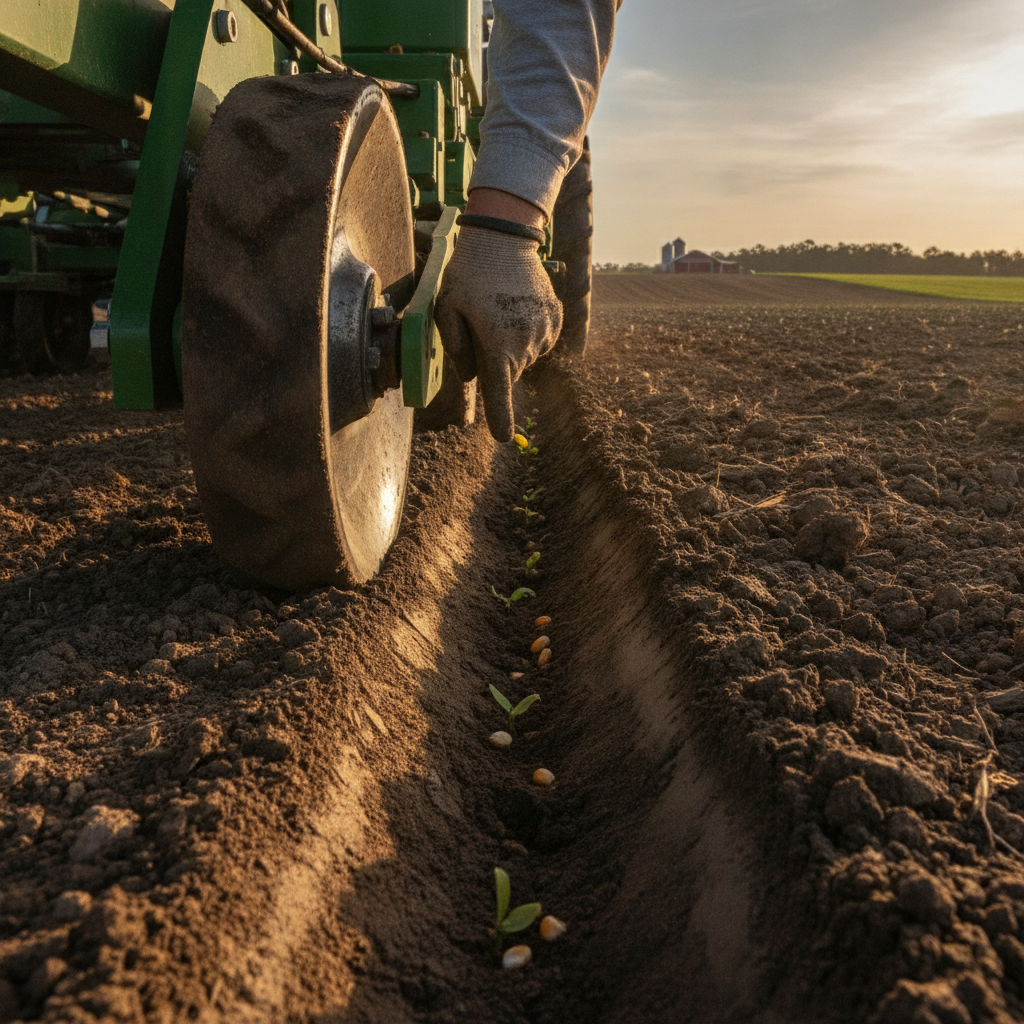
How Do Row-Crop Farmers Near Ipswich Know Whether Their Planter’s Gauge Wheel Is Actually Contributing to Sidewall Smearing in Wet Soils — Or Just Getting Blamed for a Problem That Starts Somewhere Else?
Sidewall smearing is one of the more damaging things that can happen in a corn or soybean furrow — and it’s also one of the most misdiagnosed. If you’re planting into wet conditions near Ipswich and pulling up seed trench cross-sections that show a glazed, slick wall instead of a clean, crumbly one, the gauge wheel is often the first thing that gets accused. Sometimes that’s right. Sometimes it’s not. Knowing the difference matters a lot before you start swapping parts.
What Sidewall Smearing Actually Is — And Why It Costs You
When a planter disk cuts through soil that’s too wet, it doesn’t slice cleanly. Instead, the disk face smears the cut surface and seals it — creating what amounts to a glazed wall on each side of the seed trench. That glazed layer resists root penetration, restricts water movement, and in heavy gumbo clay soils common across central South Dakota and into North Dakota, it can bake nearly solid once conditions dry out. Roots hit that wall and deflect instead of growing through it. Stand counts look okay early, but yield potential is already compromised underground.
Most discussions about sidewall smearing in the ag equipment space stop at the disk opener — and they’re not wrong to start there. But the gauge wheel plays a specific secondary role that gets overlooked: it determines how much downward pressure the disk opener is applying and how consistently the row unit tracks depth. If the gauge wheel is worn, plugged with mud, or running with a degraded tire lip, it stops doing its job of limiting penetration depth. That means the disk can push deeper than intended in soft spots, forcing more soil disturbance in marginal conditions and making smearing worse.
The Gauge Wheel’s Actual Role in a Wet-Soil Furrow
A gauge wheel running correctly rolls beside the disk opener and physically limits how far the opener can sink. It’s your depth stop. The moment that wheel starts slipping, floating on mud buildup, or running with a worn tire lip that’s lost its defined contact edge, your depth control degrades — and the disk opener gets inconsistent in exactly the soil conditions where consistency matters most.
There’s a second issue that doesn’t get talked about much: gauge wheel tire mud plugging. In the heavy clay soils around Huron, Aberdeen, and across the Northern Plains, wet clay doesn’t just stick to equipment — it packs into the tire cavity between the gauge wheel and the disk, locks the wheel rotation, and turns a rolling depth-control tool into a skid. A wheel that’s skidding instead of rolling isn’t controlling depth. It’s dragging, and that drag is smearing the furrow wall just as surely as a wet disk is.
This is a gap in the content you’ll find on most competitor sites. They cover gauge wheel diameter, bearing wear, and downforce settings — but they rarely address the direct relationship between gauge wheel mud plugging and sidewall smear formation in real field conditions. It’s a practical problem that farmers in wet-spring regions deal with every year.
How to Tell Whether Your Gauge Wheel Is the Source — Or Just a Bystander
Here’s a simple field diagnostic. Pull up four or five furrow cross-sections from different parts of the field — ideally in areas where you know conditions varied. Look at the degree of sidewall smear relative to how wet each zone was. Then check your gauge wheels for these specific things:
- Mud packed between the gauge wheel and the disk. If you can’t turn the gauge wheel freely by hand after a run, it was dragging, not rolling. That’s a plugging problem and a direct smearing contributor.
- Tire lip wear or deformation. A worn tire lip means the wheel’s contact geometry with the soil is off. You lose the defined rolling edge that limits penetration, and depth becomes a guess.
- Smear depth relative to soil moisture zones. If smearing is uniform across wet and drier zones, the disk angle or ground speed is more likely the cause. If smearing tracks closely with areas where you know your gauge wheels were plugging, that’s your answer.
- Row-to-row variation in smear severity. If some rows are worse than others on the same pass, individual row unit issues — including gauge wheels that are worn unevenly — are the more likely culprit than a field-wide soil condition.
What the Right Gauge Wheel Parts Actually Fix
If your diagnostic points back to the gauge wheel — either because of plugging or because of a worn tire lip — there are two specific things worth addressing.
First, a gauge wheel with an open-spoke design sheds mud instead of letting it pack in. Jung Enterprise’s curved spoked gauge wheels are built specifically for this. The curved spoke geometry creates a self-cleaning rotation that keeps the wheel turning freely through heavy, sticky clay rather than letting it lock up into a skid. In conditions around Watertown or anywhere across the Northern Plains where spring planting means wet soils and tight windows, a wheel that stays clear is one that keeps doing its depth-control job.
Second, the tire lip itself needs protection. Once that edge wears down or gets notched up from debris, you’ve lost your precise depth stop. Jung Enterprise’s Steel Ring — patented under US 11,707,013 B2 — mounts to the gauge wheel with six screws and serves two functions at once: it protects the tire lip from wear, and its built-in scraper geometry actively clears mud and debris from the wheel face as it rotates. That means you’re not adding a separate scraper part and hoping it stays put — the scraper is part of the ring itself. After 13,000 planted acres over three years of field testing, wear measured at just 1/16 inch. That’s a part that holds up through the kind of high-acre spring runs that farmers across South Dakota and into Minnesota put on their equipment.
Neither of these fixes changes the fact that you should not be planting into soil that’s genuinely too wet. That’s an agronomic call, not a parts call. But they do mean that when you’re operating in marginal conditions — which happens every spring in this part of the country when the window is closing — your gauge wheels are actually doing their job rather than making the furrow problem worse.
FAQ: Gauge Wheels, Wet Soils, and Sidewall Smearing
Does slowing down ground speed help with sidewall smearing?
Yes, reducing speed lowers disk aggressiveness and gives the opener a cleaner cut in wet conditions. But if the gauge wheel is plugged and dragging, slower speed alone won’t fix the smearing that’s happening because of lost depth control. Address the plugging issue and then adjust speed accordingly.
How often do gauge wheel tires on planters actually cause smearing versus the disk itself?
The disk opener is the primary driver of sidewall smear in wet soils. But a plugged or worn gauge wheel amplifies the problem by removing depth control. Think of it as the disk creates the smear risk, and a compromised gauge wheel removes the one thing limiting how bad it gets.
Will Jung Enterprise’s curved spoked gauge wheels fit my planter if I’m running a non-standard row unit?
Jung Enterprise’s gauge wheels are designed to fit multiple OEM configurations across planters, air seeders, and no-till drills. Check the products page or call directly at (605) 281-0497 to confirm compatibility with your specific setup before ordering.
Is sidewall smearing worse in no-till fields compared to tilled ground?
It can be, particularly because no-till soils in the Northern Plains often have higher moisture retention near the surface in spring. The disk is cutting through undisturbed soil that hasn’t been loosened, which means any smearing is harder for roots to break through. No-till operators near Ipswich and across central South Dakota generally need to be more conservative about planting conditions — and more attentive to gauge wheel performance.
Can a worn steel ring on the gauge wheel actually make sidewall smearing worse?
Yes. A degraded or missing tire lip protection means the tire edge loses its defined geometry. That loss of geometry means the wheel no longer holds depth consistently — it floats or sinks depending on soil conditions. In wet ground, that inconsistency translates directly into the disk running deeper than intended in soft spots, which is exactly when smearing is worst.
Talk to Jung Enterprise Before Next Planting Season
If you pulled cross-sections this spring near Ipswich or anywhere across the Northern Plains and didn’t like what you saw in the furrow wall, now is the time to figure out whether your gauge wheel setup is part of the problem. Jung Enterprise builds patented, American-made gauge wheels and steel rings specifically for the conditions row-crop farmers here actually deal with — heavy clay, wet springs, short windows, and equipment that needs to perform across thousands of acres without swapping parts mid-season.
Get in touch before next planting season. Contact Jung Enterprise here or call (605) 281-0497. Tell us what you’re running and what you’re seeing in the field — we’ll tell you straight whether a parts change will actually help.