
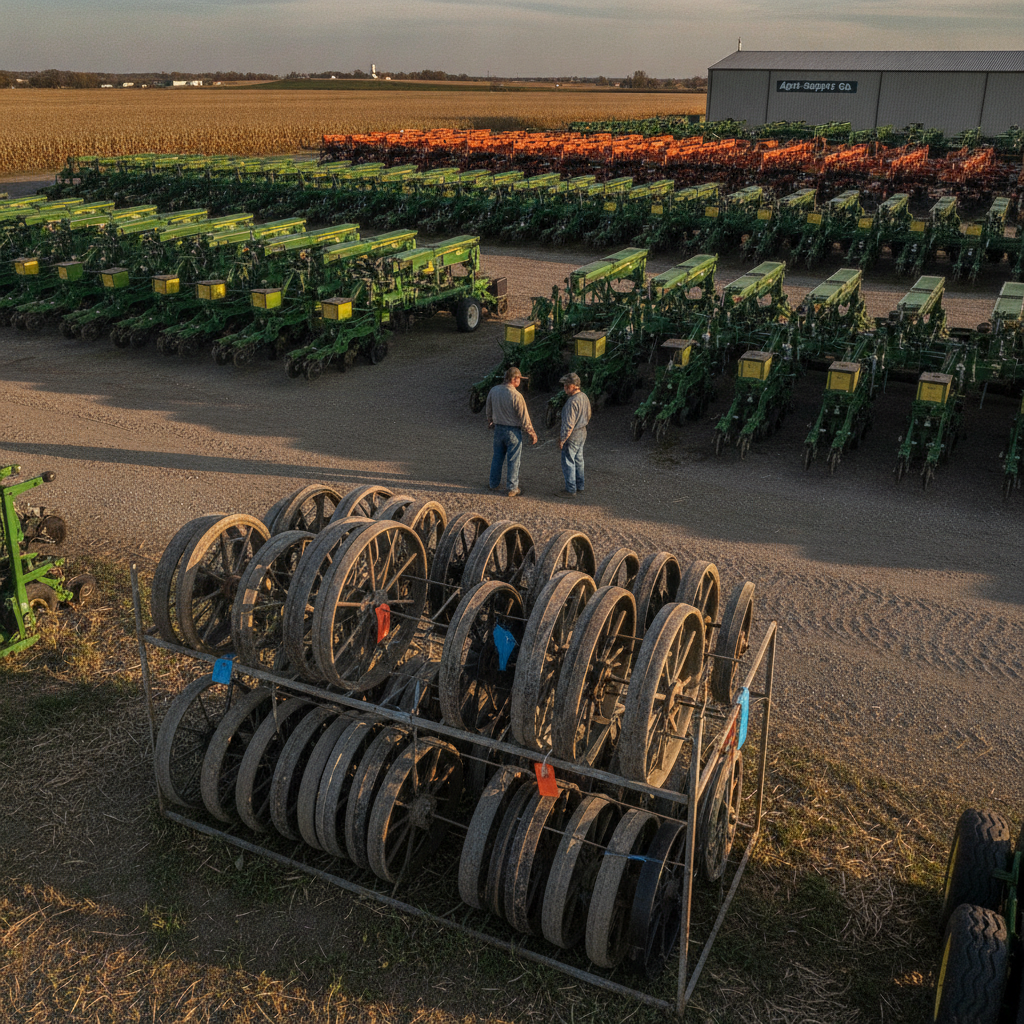
How Do Ag Dealers Near Ipswich Know Whether Their Curved Spoked Gauge Wheel Stock Is Actually Turning Over Fast Enough to Justify a Standing Order — Or Just Tying Up Cash Between Seasons?
If you’re running an ag dealership near Ipswich and you’ve got curved spoked gauge wheels sitting on the shelf from last February, that’s not a neutral situation — that’s tied-up working capital that could have funded something else. The real question isn’t whether gauge wheels are a good product. They are. The question is whether your current stock mix, your reorder timing, and your supplier relationship are actually set up to move product during the windows when farmers need it — or whether you’re just guessing and hoping spring sorts it out.
This article is aimed at dealers — not farmers. It’s about inventory strategy, demand timing, and how to tell the difference between a gauge wheel line that earns its shelf space and one that just looks good in a product catalog.
The Demand Window Is Narrower Than It Looks
Planting season across South Dakota and the Northern Plains doesn’t give you much room. Corn and soybean farmers in the region are typically putting planters in the ground from late April through mid-May, and that window can compress fast if conditions cooperate — or drag out into a muddy grind if they don’t. Either way, a farmer who needs a gauge wheel on April 28th is not waiting until May 10th for a backorder to clear. He’s calling whoever has it in stock, or he’s pulling an old worn part off a spare unit and running with it.
That’s where dealers near Ipswich, Aberdeen, and Watertown who are actually stocked for the season win business — and where dealers who ordered light because last fall’s cash flow was tight lose it. Gauge wheel demand isn’t spread evenly across the year. It spikes in the 6-to-8 weeks before planting, picks up again in fall for farmers doing pre-season maintenance, and goes quiet in between. If your turns data doesn’t reflect that pattern, you’re either understocked when it matters or overstocked when it doesn’t.
What the Competitor Sites Don’t Tell You About Stocking Decisions
Most gauge wheel manufacturers — and there are several out there — publish product pages and spec sheets. What they generally don’t do is give dealers actionable guidance on how to stock their line relative to local planter populations, soil conditions, or the mix of planters versus air seeders in their territory. That’s a real gap, and it leaves dealers making gut-feel decisions instead of informed ones.
Here’s what actually matters for a dealership in the Northern Plains when deciding how many curved spoked gauge wheels to carry and in what sizes:
- What planters are your customers actually running? A dealer near Huron serving mostly 16-row John Deere operators has a different stocking need than a dealer near Fargo with a large air seeder customer base. Gauge wheel compatibility varies, and stocking for the wrong machine type is as bad as not stocking at all.
- What’s the soil type in your primary service area? Heavy gumbo clay soils — common across much of central and northeastern South Dakota — chew through gauge wheel tires faster and create more plugging problems than lighter soils. Dealers in those areas should be carrying more stock, not less, because their customers are replacing parts more often.
- Are your customers running no-till or strip-till? No-till and strip-till operations put more stress on gauge wheels than conventional tillage. If a significant portion of your customer base is no-till, you can expect higher replacement frequency and pre-season demand for upgraded parts that handle residue and wet conditions better.
- How fast does your supplier ship? If you’re relying on a vendor who takes 10 business days to ship, you need more buffer stock than a dealer working with a manufacturer who can turn an order in 2 to 3 days. That lead time math directly affects how much cash you need tied up in inventory at any given time.
Open-Spoke Design and Why It Matters for Turnover
Not all gauge wheels perform the same in the field, and that affects how dealers should think about their product mix. Jung Enterprise’s curved spoked gauge wheels are built with an open-spoke design specifically to shed mud — a real-world problem for farmers running wet clay soils across the Northern Plains. When a gauge wheel plugs with mud, it stops doing its job. The farmer either cleans it out mid-field or accepts inconsistent seeding depth for the rest of the run. Neither option is acceptable during a tight planting window.
From a dealer’s perspective, this matters for one practical reason: a gauge wheel that performs well in the conditions your customers actually face generates fewer warranty headaches, fewer returns, and more repeat purchases. Farmers talk to each other. If a product works in the mud around Ipswich, word travels fast. If it doesn’t, that travels faster.
The durability data backs this up — Jung’s gauge wheels have been field-tested to just 1/16 inch of wear after 13,000 planted acres over three years. That’s the kind of number that turns a first-time sale into a long-term stocking relationship, because the farmer who buys them once doesn’t need to replace them every season.
How to Evaluate Whether Your Current Stock Is Actually Earning Its Place
Pull your sales data from the last two full planting cycles. For each gauge wheel SKU you carry, look at three things:
- How many units moved in the 60 days before planting started each year?
- How many units were still on the shelf 30 days after planting ended?
- How many times did you turn away a customer or back-order because you were out of a specific size?
If the answer to question two is “more than a few” and the answer to question three is “regularly,” your stock mix is off — either you’re carrying too many of the wrong sizes, not enough of the right ones, or both. Adjusting that mix before next February costs you nothing. Not adjusting it costs you sales during the one window that counts.
Dealers near Watertown and Aberdeen who serve a broad footprint of row-crop farmers should also be thinking about whether they’re stocked for the full system, not just individual parts. A farmer who needs a curved spoked gauge wheel often also needs a steel ring for tire lip protection or a wheel retainer to prevent the gauge wheel from dislodging. Stocking complementary parts increases your average transaction value and makes you the one-stop answer instead of the partial answer.
Frequently Asked Questions
How many curved spoked gauge wheels should a dealer near Ipswich carry heading into spring?
That depends on your customer base size and soil types served, but a practical starting point is to look at what you sold in your two busiest weeks last spring and use that as your minimum opening stock. In heavy clay areas around central South Dakota, err toward carrying more — plugging problems drive faster replacement cycles.
Are Jung Enterprise’s curved spoked gauge wheels compatible with the most common planter and air seeder brands in the area?
Yes. They’re designed to fit multiple OEM brands and gauge wheel sizes used on planters, air seeders, and no-till drills common across the Midwest and Northern Plains. Contact Jung Enterprise directly to confirm fitment for specific models in your territory.
What’s the lead time from Jung Enterprise for a dealer restock order?
Jung Enterprise is based in Ipswich, South Dakota, which means shorter lead times for dealers across the Northern Plains than what you’d get from a distributor shipping from the coasts or from overseas inventory. Reach out directly to discuss reorder timelines and volume arrangements.
Should dealers stock gauge wheels differently for no-till customers versus conventional tillage customers?
Yes. No-till and strip-till operators put more wear on gauge wheel components and deal with more residue plugging. If a meaningful share of your customers are no-till, plan for higher unit velocity and consider stocking the open-spoke design specifically — it handles residue conditions better than solid designs.
Is there a dealer or distributor program with Jung Enterprise?
Jung Enterprise works with ag dealers and distributors across the region. The best way to start that conversation is to reach out directly and talk through what your customer base looks like and what products make sense to carry.
Ready to Talk About a Stocking Arrangement That Actually Works for Your Territory?
Jung Enterprise is a family-owned, American-made manufacturer based right here in Ipswich. If you’re an ag dealer or distributor across South Dakota, North Dakota, or Minnesota and you want to carry gauge wheels that actually move — and that your customers will come back for — let’s talk. No boilerplate distributor pitch. Just a conversation about what you’re serving and what makes sense to stock.
Reach out to Jung Enterprise here or call (605) 281-0497. We’d rather get you the right stock at the right time than have you sitting on parts that aren’t moving when it matters.