
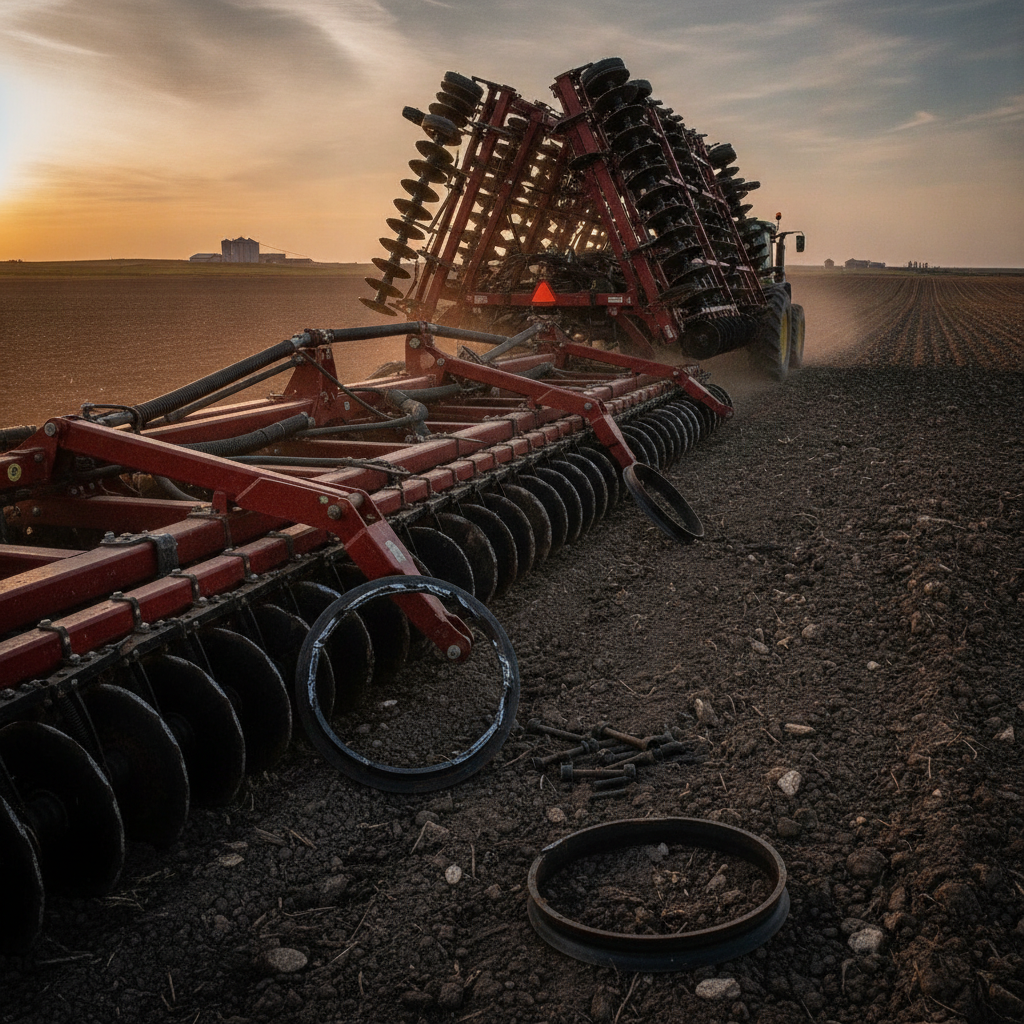
How Do No-Till Farmers Near Pierre Know Whether Their Steel Ring Is Actually Rated for the Axle Load Their Air Seeder Puts On It — Or Just Assumed to Handle Whatever the Machine Weighs?
If you’re running a heavy air seeder through Pierre-area no-till ground and your steel ring was spec’d for a lighter row-crop planter, you may already have a problem you haven’t seen yet. Most farmers assume that if a ring fits the hub, it’ll hold up under load. That assumption gets tested in a hurry once you start dragging a full commodity cart across heavy clay soils at planting pressure. Here’s what you actually need to know.
Why Axle Load Matters More on Air Seeders Than on Standard Planters
A 24-row corn planter and a large-frame air seeder are not the same animal when it comes to downforce. Air seeders — especially those paired with large commodity carts — put considerably more static and dynamic load through each gauge wheel than most row-crop planters do. That extra weight gets transferred through the gauge wheel assembly, including the steel ring if one is mounted. If the ring’s construction isn’t up to that load, you’re going to see it in one of a few ways: accelerated wear at the mounting points, cracking near the screw holes, or in worse cases, the ring deforming and failing to scrape mud correctly — which defeats the whole purpose of having it there.
Farmers running no-till across the Pierre and Huron areas deal with this more than most. Heavy gumbo soils combined with a wet spring mean you’re not just fighting weight — you’re fighting packed clay that builds up and acts as a load multiplier on the ring assembly. When a ring fails under that combination, you’re not just looking at a replacement part cost. You’re looking at stopped equipment, lost acres, and a planting window that doesn’t wait for anyone in central South Dakota.
What Competitors Don’t Tell You About Steel Ring Load Specs
Here’s a gap worth naming directly: most competitors selling steel rings — whether it’s a national brand or a regional distributor — don’t publish load rating data for their rings at all. You can browse through product listings from several well-known planter parts suppliers and find plenty of information about fit and diameter, but almost nothing about what axle load the ring is designed to handle or what the mounting hardware is rated for. That’s a problem when you’re making a buying decision for a machine that’s pushing significantly more weight per row unit than a standard planter.
When you’re shopping for a steel ring to run on an air seeder, you need to know how it’s built — not just what it fits. That means asking about the steel gauge used in the ring body, the grade and size of the mounting hardware, and whether the ring has been tested under conditions similar to what you’re running. A ring that’s been field-tested to only 1/16″ of wear over 13,000 planted acres is a different product from one that’s listed at a similar price with no performance data behind it.
Construction Details That Actually Predict Durability Under Load
When you’re evaluating whether a steel ring will hold up on an air seeder, here are the things worth looking at before you buy:
- Steel thickness and grade: Thinner stamped rings flex under heavy load. A ring built from heavier stock is going to resist deformation at the mounting points far better over a long season.
- Mounting hardware count and grade: Six-screw mounting patterns distribute load more evenly around the hub than fewer attachment points. The screw grade matters too — standard hardware loosens under vibration; higher-grade fasteners hold position.
- Scraper integration: A ring with a built-in scraper function (rather than a separate scraper bolt-on) has fewer potential failure points. If the scraper is part of the ring’s profile, there’s one less component to come loose when you’re running heavy ground.
- Patent-backed design: A patented design (US 11,707,013 B2 and related patents) means the geometry has been engineered and protected — not reverse-engineered from a cheaper original or assembled from off-the-shelf steel without engineering review.
Jung Enterprise’s steel ring mounts with six screws, incorporates the scraper function into the ring itself, and has been field-tested across thousands of acres of real no-till and strip-till conditions. That’s the kind of data point that matters when you’re deciding what goes on a machine that costs several hundred thousand dollars to own and operate.
The Air Seeder Compatibility Question Farmers Often Skip
Compatibility with air seeders is not automatic, even if a ring lists your gauge wheel diameter. Air seeders run different hub configurations, different gauge wheel widths, and in many cases, different tire profiles than standard planters. Before ordering, you need to confirm that the ring is designed to seat correctly on your specific gauge wheel — not just that the outer diameter is close.
This is especially relevant for farmers near Aberdeen and across North Dakota who run large-format air seeders as their primary seeding platform. The gauge wheel geometry on these machines differs enough from a standard John Deere or Case IH row-crop planter that a ring sized for the planter market may not seat flush or scrape cleanly on the air seeder application. A flush seat matters because a ring that rocks or sits proud at any point around the hub will wear unevenly and lose its scraping function within a season.
If you’re uncertain about fit for your specific machine, reach out to Jung Enterprise directly before ordering. Getting the right ring for your setup the first time is faster and cheaper than figuring it out after the ring arrives.
What to Do Before Planting Season If You’re Running an Air Seeder
If you’re planning to run a steel ring on your air seeder this spring, here’s the practical checklist worth going through before the ground opens up in Pierre or anywhere across central South Dakota:
- Confirm gauge wheel diameter and hub configuration — don’t assume it matches your planter setup
- Check the current condition of your gauge wheel tire lip — if it’s already showing wear, the ring is overdue
- Verify that the ring you’re ordering has been tested in no-till conditions, not just conventional tillage
- Ask whether the ring includes scraper function or whether that’s a separate component (separate = more to install, more to fail)
- Order ahead of February — demand for proven rings picks up fast once the pre-planting window hits, and lead times can stretch
Frequently Asked Questions
Can a steel ring rated for a row-crop planter handle an air seeder’s axle load?
Not always. Air seeders — especially those with large commodity carts — put more load per gauge wheel than most row-crop planters. Confirm that the ring you’re buying has been tested under real-field conditions, not just sized to fit a certain diameter.
Does Jung Enterprise’s steel ring work on air seeders, not just planters?
Yes. Jung Enterprise’s steel ring is compatible with planters, air seeders, and no-till drills across multiple OEM configurations. Contact Jung Enterprise to confirm fit for your specific gauge wheel.
Why does a six-screw mounting pattern matter for heavy-load applications?
More mounting points distribute axle load more evenly around the hub, reducing stress concentration at any single screw hole. In heavy no-till applications — especially in gumbo clay near Pierre or Huron — this directly affects how long the ring stays seated and functional.
How long does a properly installed steel ring last on an air seeder in no-till conditions?
Field testing on Jung Enterprise rings shows only 1/16″ of wear after 13,000 planted acres over three years. Real-world longevity will vary depending on soil conditions and machine load, but that figure gives you a credible baseline for budgeting replacements.
Does the built-in scraper function on the Jung Enterprise steel ring work on air seeder gauge wheels?
Yes. The scraper is integrated into the ring’s profile, not a separate bolt-on component. This keeps mud from building up under the ring on the tire lip — which is exactly the failure mode that shuts down no-till operations in wet spring conditions across South Dakota and North Dakota.
Ready to Get the Right Steel Ring for Your Air Seeder?
Don’t spend another planting season guessing whether your ring is up to the job. Jung Enterprise builds patented, American-made steel rings field-tested in the same kind of heavy no-till conditions you’re running near Pierre, Aberdeen, and across the Northern Plains. If you want to confirm fit for your air seeder or get a direct answer on compatibility before you order, contact Jung Enterprise here. We’re based in Ipswich and we talk to farmers and dealers directly — no sales funnel, no runaround.