
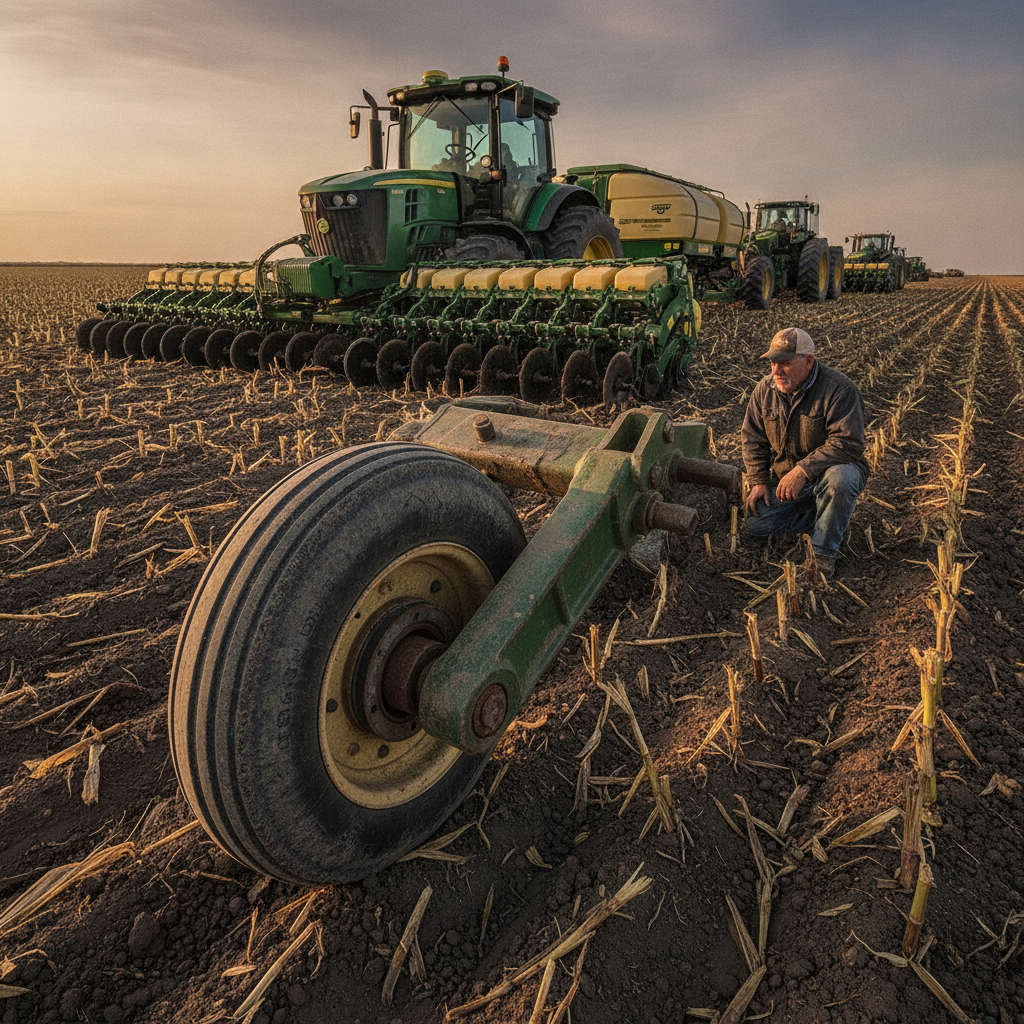
How Do No-Till Farmers Near Watertown Know Whether Their Air Seeder’s Wheel Retainer Is Actually Holding Up Through a Full Spring Run — Or Just Getting By Until Something Pops Off in the Field?
If you’re farming no-till ground near Watertown and running an air seeder through a typical eastern South Dakota spring, your wheel retainer isn’t a part you think about — right up until a gauge wheel pops off mid-row and you’re down in a wet field trying to figure out what happened. The honest answer to the question in this title is: most farmers don’t know until it fails. That’s a problem when you’re working inside a planting window that might give you ten good days before the forecast turns.
This isn’t a part failure that announces itself early. A wheel retainer that’s worn, undersized, or just not built for the loads an air seeder puts on it will usually hold together through the first few hundred acres. Then something gives — a hard-packed headland, a rough field entry, a piece of residue that catches wrong — and the gauge wheel dislodges. Now you’re losing time you don’t have, in a season that doesn’t wait.
Why the Wheel Retainer Gets Ignored Until It Fails
Most pre-season equipment checks focus on the obvious stuff — tires, seed meters, disc openers, closing wheels. The wheel retainer is easy to overlook because it doesn’t show obvious wear the way a tire does. It’s not something most operators pull off and inspect unless they’re already chasing a problem.
The issue is that wheel retainers on air seeders take more stress than most people account for. Air seeders are heavier machines. They cover ground fast. No-till residue creates uneven loading across the row unit, and in wet spring conditions near Watertown and across the Codington County area, you’re running through soils that can shift from firm to soft within a single pass. That variability puts real lateral and vertical stress on the retainer every time the gauge wheel flexes against the disc.
If your retainer isn’t designed to handle that load consistently across a full planting run — not just the first field — you’re running on borrowed time.
What Competitors Don’t Tell You About Wheel Retainer Specs
Here’s something worth noting: if you look at how most equipment manufacturers and aftermarket suppliers talk about wheel retainers, they tend to focus on fitment and installation. Does it fit your planter brand? Does it go on easy? Those questions matter, but they’re not the whole story.
What rarely gets addressed — and what no-till operators running air seeders in the Northern Plains specifically need to know — is how a wheel retainer performs under sustained load across high-acre spring runs. Corn Belt row-crop farmers putting in 500 acres on a planter have a different set of demands than a no-till operator running an air seeder through 3,000 acres of heavy residue across Codington and Clark counties. The retainer needs to hold position under variable loading, in wet and abrasive conditions, without backing off or fatiguing over the course of a full run.
That’s the gap most product pages don’t fill. Fitment is table stakes. Durability under real operating conditions is the question that actually matters.
What to Look for in a Wheel Retainer Built for Air Seeder Work
Not every wheel retainer is the same. Before you assume the one on your machine — or the replacement you ordered — is adequate for a full no-till spring run, here’s what to evaluate:
- Retention force under lateral load: Does the retainer hold the gauge wheel firmly against side-to-side movement when the row unit flexes through residue or rough ground? A retainer that only prevents axial pullout isn’t doing the full job.
- Material and construction: Cheap stamped retainers can fatigue and deform over time. You want a retainer that maintains its grip geometry across thousands of acres, not just a few hundred.
- Compatibility with your specific gauge wheel and axle: A retainer that’s sized for a planter may not be the right fit for an air seeder axle. Confirm the cross-reference before you install it and assume it’s correct.
- Ease of field inspection: If you can’t quickly check the retainer between fields without pulling the whole row unit apart, you’re less likely to catch a problem before it becomes a breakdown.
Jung Enterprise’s Wheel Retainer is designed specifically to prevent gauge wheel dislodgement under the kind of variable loading you see in no-till air seeder applications. It’s built to hold the gauge wheel securely in place through a full season — not just pass inspection on the workbench.
The Real Cost of a Dislodged Gauge Wheel During Spring Planting
Let’s be direct about what gauge wheel dislodgement actually costs. It’s not just the part. In a normal year, a no-till farmer near Watertown or Aberdeen might have a planting window that opens and closes inside of two weeks, depending on spring moisture and soil temps. Losing a day to a dislodged gauge wheel — tracking down the failure, sourcing a replacement, getting the machine back in the field — can mean acres you simply don’t get planted at optimal timing.
In corn and soybeans, that timing window directly affects yield. The research on planting date and yield drag is well-documented. A day or two of delay during the optimal window costs real bushels. The wheel retainer that failed didn’t cost you $30 — it potentially cost you a meaningful yield penalty across a significant number of acres.
That’s the calculation worth making before planting season, not after. Replacing a worn or undersized wheel retainer in March costs you an hour. Replacing it in May costs you a day you can’t get back.
Pre-Season Inspection: What to Do Before You Leave the Shed
If you’re prepping an air seeder for a no-till spring run in South Dakota or western Minnesota, add wheel retainer inspection to your pre-season checklist. Specifically:
- Pull each gauge wheel and check the retainer for deformation, fatigue cracking, or loss of grip force
- Verify the retainer seats fully and doesn’t rock or flex when the gauge wheel is mounted and loaded
- Check for any axle wear that might cause a correctly-sized retainer to lose its hold over the course of a run
- If you replaced gauge wheels at any point last season, confirm the retainer you reinstalled is the right spec — not just the one that was nearby on the bench
This takes maybe 30 minutes across a full toolbar. It’s the kind of check that pays off in not having to make it in a wet field in early May.
You can see all of Jung Enterprise’s products — including the Wheel Retainer, Steel Ring, and Curved Spoked Gauge Wheels — on the products page. Everything is American-made and patented, built from a shop in Ipswich, South Dakota that understands what Northern Plains planting conditions actually look like.
Frequently Asked Questions
Does a wheel retainer designed for a planter also work on an air seeder?
Not always. Air seeders run at higher weights and often through heavier residue than row-crop planters. Always confirm the retainer is spec’d for your specific machine and axle size — don’t assume a planter retainer crosses over without checking.
How often should I replace the wheel retainer on my air seeder?
Inspect it every pre-season and after any significant impact or rough-ground incident. If it shows deformation or no longer grips the gauge wheel firmly, replace it before the season starts. There’s no fixed mileage interval — condition is what matters.
Can a worn wheel retainer cause seed depth problems even if the gauge wheel doesn’t fully dislodge?
Yes. A retainer that’s lost grip force can let the gauge wheel shift laterally under load, which affects depth consistency even when the wheel stays on the axle. This is one reason depth problems sometimes get blamed on other components when the retainer is the actual issue.
Does Jung Enterprise’s Wheel Retainer fit air seeders or just planters?
Jung Enterprise’s Wheel Retainer is designed to fit across multiple OEM gauge wheel configurations, including air seeder applications. Contact Jung Enterprise directly to confirm fitment for your specific machine.
Where can I get wheel retainers shipped to the Watertown area before planting season?
Jung Enterprise ships direct from Ipswich, South Dakota. If you’re in the Watertown, Aberdeen, or eastern South Dakota area, reach out early — pre-season demand runs high and lead times matter when you’re counting down to field-ready.
Get Your Air Seeder Ready Before the Window Opens
If you’re running no-till ground near Watertown and you’re not sure whether your wheel retainer is actually up to a full spring run, now is the time to find out — not when you’re in the field with a dislodged gauge wheel and a weather forecast closing in.
Jung Enterprise builds patented, American-made wheel retainers, steel rings, and curved spoked gauge wheels out of Ipswich, South Dakota, specifically for the conditions farmers in this region deal with. Reach out to Jung Enterprise to confirm fitment, ask about availability, or talk through what your air seeder needs before planting season starts. We’re here to help you stay in the field.