
How Do No-Till Farmers Near Huron Know Whether Their Steel Ring Is Actually Preventing Mud Plugging Between Rows — Or Just Sitting There While the Gauge Wheel Clogs Solid?
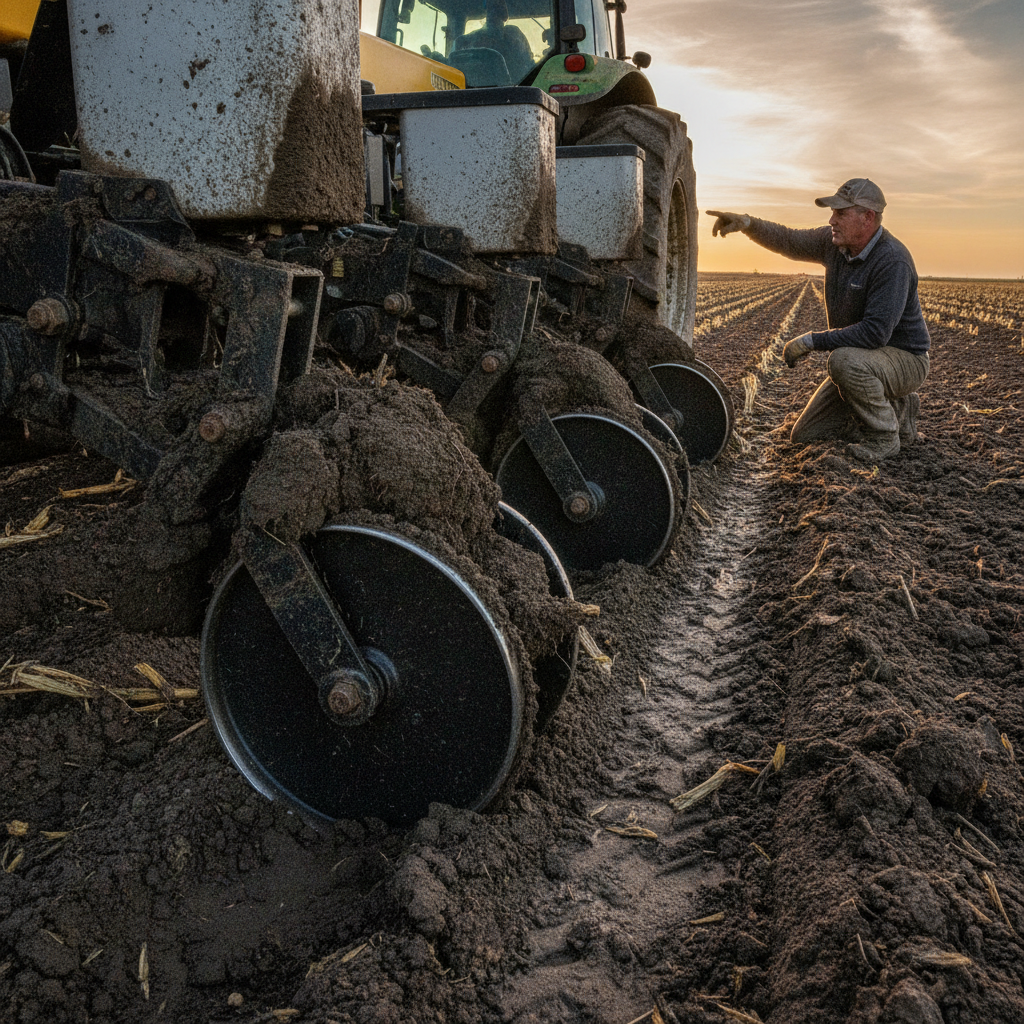
If you’re running no-till ground near Huron in a wet spring, you already know what gumbo mud does to a gauge wheel. It packs in tight, builds up fast, and before long you’ve got a wheel that’s not rolling clean — it’s dragging a ball of wet clay that throws off your seed depth and kills your stand uniformity. The question isn’t whether mud plugging happens. It’s whether your steel ring is actually doing anything to stop it, or just along for the ride.
That distinction matters a lot when your planting window is measured in days, not weeks. A ring that only protects the tire lip isn’t enough on no-till ground in Beadle County. You need one that actively scrapes debris away from the wheel face between every pass.
What Mud Plugging Actually Costs You in a No-Till System
Mud plugging isn’t just a nuisance — it’s a yield problem. When a gauge wheel clogs solid, it stops rolling at the correct depth. You may be running your planter at the right setting, but if the wheel is packed with clay, it’s effectively riding higher than it should. That pushes seed shallower than intended, inconsistently row to row, sometimes field to field.
In no-till systems across South Dakota, where you’re already managing heavy residue and variable soil moisture, that depth inconsistency compounds fast. Corn that germinates at 1.5 inches instead of 2 inches in a cold, wet April soil is behind from the start. Soybeans aren’t any more forgiving.
Add to that the time you lose stopping mid-field to clear packed mud by hand — or worse, not stopping and not realizing there’s a problem until you check emergence two weeks later — and the cost adds up well beyond the price of a replacement part.
What a Steel Ring Is Supposed to Do in Muddy Conditions
Most farmers understand that a steel ring protects the tire lip from wear. That’s the baseline. But the scraper function is where a lot of rings — and a lot of competitor products — fall short.
A ring that only sits flush against the tire face isn’t going to clear mud from the wheel’s inner edge as it rotates. Mud doesn’t self-clear on a smooth surface in wet conditions. It sticks, packs, and hardens between passes. If the ring design doesn’t account for active debris shedding — through geometry, clearance, or a built-in scraper edge — you’re relying on centrifugal force alone, and that’s not enough in heavy clay.
Jung Enterprise’s patented Steel Ring (US Patent 11,707,013 B2) is designed with a built-in scraper function as part of the ring itself — not as a separate bolt-on accessory. That means as the gauge wheel rotates, the ring is actively working to prevent mud and debris from packing between the tire and the row unit frame. No separate scraper plate to source, install, or replace.
What Competitor Products Aren’t Telling You About Scraper Design
This is where most competitor product pages go quiet. Browse through Yetter, Schaffert, Copperhead Ag, or MudSmith’s content and you’ll find plenty of talk about mud management in a general sense — residue managers, row cleaners, closing wheel solutions. What you won’t find is a detailed, honest explanation of how their gauge wheel protection products handle the specific problem of mud packing at the tire-to-ring interface on no-till ground.
That gap matters if you’re trying to make a purchasing decision before planting. You want to know: does this ring scrape, or does it just protect? Because on a wet May morning outside Huron when you’ve got 500 acres to cover and the forecast turns on you, the difference is the difference between finishing and stopping.
Jung’s design integrates scraping into the ring function from the start. The six-screw mount keeps the ring seated flush and secure, and the patented geometry means you’re not adding complexity to your row unit — you’re simplifying it. One part doing two jobs, made in America, field-tested across 13,000 planted acres with only 1/16 inch of measurable wear over three years.
How to Check Whether Your Current Ring Is Actually Scraping
You can do a basic field check without pulling the row unit apart:
- After a muddy pass, stop the planter and walk the row units. Look at the gap between the steel ring (or tire edge) and the inner frame rail. Is there packed clay in that gap, or is it reasonably clear?
- Spin the gauge wheel by hand. Does it rotate freely, or does it feel like it’s dragging against built-up material?
- Check the ring face itself. If mud is caking on the outward face of the ring, that’s normal. If it’s packing at the junction between ring and tire sidewall, your ring isn’t clearing it.
- Look at seed depth variability in emergence. Inconsistent depth row-to-row in wet conditions is often a gauge wheel clogging issue before it’s a population or hybrid issue.
If you’re seeing packed mud in the ring-to-tire interface after every pass on no-till ground near Aberdeen or Huron, your ring isn’t doing its full job — regardless of what the product page says about mud management.
No-Till Ground Near Huron Is Not Forgiving of Partial Solutions
Farmers running continuous no-till systems in Beadle County and across central South Dakota are dealing with surface residue, variable soil moisture from snowmelt, and clay content that makes mud adhesion worse than most regions in the Corn Belt. A steel ring that handles average conditions adequately may fail completely in a wet spring on heavy no-till ground.
That’s not an argument against no-till — it’s an argument for components that are actually engineered for the conditions you’re running in, not just rated for general use. Jung Enterprise builds out of Ipswich for exactly these kinds of regional conditions. The company was founded on field problems like this one, not on catalog specs.
Frequently Asked Questions
Does the Jung Steel Ring work as a scraper without adding a separate scraper plate?
Yes. The built-in scraper function is part of the patented ring design itself. You don’t need to source or install a separate scraper accessory — the ring handles both tire lip protection and debris clearing as a single component.
How does mud plugging in no-till differ from conventional-till conditions?
No-till ground typically has more surface residue and slower soil drying, which keeps the seed trench zone wetter longer. That means gauge wheels stay in contact with wet, sticky material for more of the pass, increasing the rate at which mud packs. Conventional-till ground dries faster and has less residue to hold moisture near the surface.
How many screws does the Jung Steel Ring mount with, and does the mount stay secure in heavy clay?
The ring mounts with six screws. The six-point mount distributes load evenly around the ring and keeps it seated against the tire lip even in heavy, sticky gumbo conditions that would work a loosely mounted ring free over time.
Is the Jung Steel Ring compatible with both planters and air seeders used near Huron?
Yes. The Steel Ring fits multiple gauge wheel sizes and is compatible across planters, air seeders, and no-till drills from multiple OEM brands. Check the product page or contact Jung directly if you need to confirm fitment for a specific row unit configuration.
After 13,000 acres, how much wear does the Jung Steel Ring actually show?
Field testing showed only 1/16 inch of wear across 13,000 planted acres over three seasons. That’s the kind of number that tells you something real about longevity — not a warranty period, but actual measured wear under working conditions.
Ready to Stop Pulling Mud Balls Off Your Row Units Mid-Field?
If you’re heading into another spring run on no-till ground near Huron and you’re not confident your current steel ring is actually clearing mud the way it should, it’s worth looking at a design that was built to handle exactly that problem. Reach out to Jung Enterprise and tell us what you’re running — we’ll help you figure out what fits your row units and whether the Steel Ring is the right solution for your conditions. American-made, patented, and built for the kind of spring planting this part of South Dakota actually throws at you.