
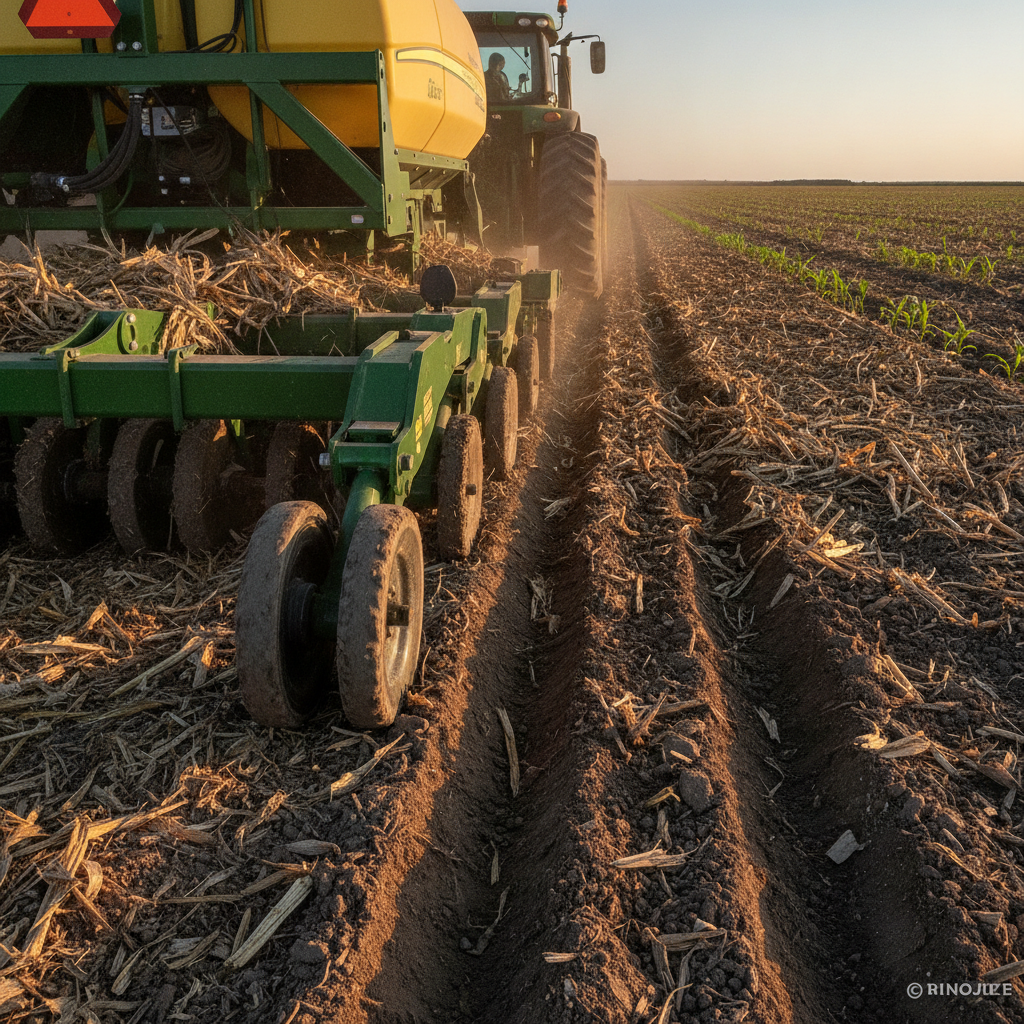
How Do Row-Crop Farmers Near Mitchell Know Whether Their No-Till Drill’s Gauge Wheel Is Actually Maintaining Consistent Furrow Width Across Variable Residue Loads — Or Just Opening a Ragged Trench That Varies Row to Row?
If you’re running a no-till drill near Mitchell, South Dakota and you’re seeing patchy emergence that doesn’t track back to seed quality or population settings, there’s a good chance the culprit is furrow consistency — specifically, what your gauge wheel is doing when it hits a heavy mat of corn stover on one pass and near-bare ground on the next. The furrow your drill opens isn’t always the same furrow your seed lands in. When gauge wheel performance degrades through residue, the width and shape of that trench changes row to row, and you end up with seeds placed at different depths, different moisture zones, and different contact angles. That shows up as uneven emergence, and uneven emergence costs you yield before you even put the first kernel in the ground.
Why Furrow Width Variability Is a No-Till Problem Specifically
In a tilled field, the seed bed is relatively uniform. The disk opener does most of the work, and the gauge wheel is mostly there to control depth. But in a no-till or minimum-till situation — which is exactly what a lot of farmers between Mitchell and Sioux Falls are running — the gauge wheel is doing something more complicated. It’s riding on top of residue in some spots, pressing through it in others, and occasionally rolling through a thick mat of flattened stalks that deflects it sideways just enough to widen or distort the trench.
That deflection is subtle. You won’t see it from the cab. But when you walk emerged rows in June and notice that some sections look like a solid stand and others look like every third plant skipped, that inconsistency often starts with what the gauge wheel was doing at the moment of seeding.
The issue compounds when residue loads vary across the field — which they always do. Rows that tracked through heavy stover piles open differently than rows that passed through light residue or bare ground. If your gauge wheel can’t self-correct through that variability, every pass introduces depth and width error that accumulates across the field.
What Most Gauge Wheel Designs Don’t Handle Well
The core problem with many OEM and aftermarket gauge wheels is that they were designed around consistent soil contact, not variable residue loads. A solid or lightly-vented wheel face is fine in a tilled seedbed. In no-till, that same wheel face catches residue, carries it into the trench, and either packs debris into the furrow bottom or holds the wheel off the soil surface just enough to let depth drift.
Mud loading makes this worse. In the wet spring conditions that are common across south-central South Dakota — heavy clay soils, standing water from snowmelt, fields that haven’t fully dried between passes — a solid-face gauge wheel picks up soil and straw, packs them together on the wheel face, and then carries that packed mass into the next furrow. At that point, the wheel isn’t controlling depth anymore. It’s dragging a dirty compacted plug through your seed trench.
This is an angle that most competitor product pages don’t address head-on. They’ll talk about mud shedding in general terms, but very few walk through what happens specifically when residue variability — not just mud — causes furrow width to drift across a field.
How Open-Spoke Design Addresses the Residue Problem
The curved spoked gauge wheels from Jung Enterprise — built and shipped out of Ipswich — use an open-spoke design that handles residue differently than a solid or semi-solid wheel. Because the spoke openings allow material to pass through rather than accumulate on the wheel face, the wheel maintains consistent contact with the soil surface even when it’s rolling through a heavy stover mat. That means the depth-controlling function of the wheel stays intact across variable residue conditions rather than degrading as residue loads increase.
It’s not a complicated concept, but it matters a lot when you’re running 1,500 acres of no-till corn ground south of Mitchell where your residue load varies from 3 tons per acre to nearly nothing depending on what field you’re in and how well the combine spread last fall.
These wheels have been field-tested to show just 1/16 inch of wear after 13,000 planted acres over three years. That’s not a lab number — that’s field measurement across real working conditions. See the full specs on the curved spoked gauge wheel page if you want to compare dimensions to what you’re currently running.
What to Actually Check in the Field Before You Blame Seed or Population
Before you call your seed dealer or start adjusting singulation settings, walk a few of your problem rows and look for these signs that your gauge wheel is the actual issue:
- Furrow width variation row to row: Dig up a few spots in your stand gaps and in your solid stands. If the trench looks different in shape or width between the two, your gauge wheel contact is inconsistent.
- Seed depth variation within a single row: If you find seeds at 1.5 inches in one spot and 2.5 inches twenty feet away, that’s not a population problem — that’s a depth control problem.
- Residue packed into the furrow bottom: If you’re seeing pressed-in straw or leaf material at seed depth, the wheel is carrying residue into the trench rather than shedding it.
- Mud buildup on the wheel face: Check the gauge wheel face after a wet pass. If you’re pulling packed mud and debris off the wheel by hand, that buildup was riding against your furrow wall during planting.
If you’re seeing two or more of these signs, the issue is mechanical — not agronomic. And spending money on seed treatments or population adjustments won’t fix a gauge wheel that’s failing to do its job through residue.
No-Till Drills Versus Planters: The Gap Nobody Talks About
Most of the discussion around gauge wheel performance — including the content on competitor sites — centers on row-crop planters. That’s understandable. But a significant share of acres in Iowa, Nebraska, and south-central South Dakota are planted with no-till drills, and those machines put gauge wheels through a different set of conditions than a standard planter row unit does. The residue loads are higher, the row spacing is tighter, and the ground speed is often faster. A gauge wheel that performs adequately on a planter at 5 mph may not hold furrow consistency on a no-till drill running 7 mph through standing stover.
That’s an honest tradeoff to understand before you buy. Wheel diameter, spoke geometry, and material hardness all matter differently at higher speeds and heavier residue loads. Jung Enterprise’s product lineup is built with those conditions in mind, with compatibility across multiple OEM drill configurations and gauge wheel sizes.
Frequently Asked Questions
Can a gauge wheel really affect furrow width, or does that come from the disk opener?
Both matter. The disk opener cuts the initial furrow, but the gauge wheel controls depth and rides the furrow wall during cutting. If the wheel deflects laterally due to residue or mud loading, it can widen or distort the furrow shape — especially in softer soils common near Mitchell and Huron after snowmelt.
How do I know if my no-till drill gauge wheels are compatible with Jung Enterprise’s curved spoked design?
Jung Enterprise’s gauge wheels are built to fit multiple OEM configurations across planters and no-till drills. Contact them directly at help@jungenterprise.net or (605) 281-0497 to confirm fit before ordering.
Is furrow width consistency more of a problem in clay soils or sandy soils?
Clay soils — the kind common across south-central South Dakota and parts of Iowa and Nebraska — tend to amplify the problem because wet clay smears rather than crumbles. That smearing changes furrow wall integrity and makes depth variability worse. Sandy or loamy soils are more forgiving, but residue deflection still causes real variability in no-till conditions regardless of soil type.
How often should I inspect gauge wheels on a no-till drill?
At minimum, inspect before each planting season and after every 300 to 400 acres during the season. Check for mud buildup on the wheel face, any visible deformation of the spokes or tire lip, and lateral play in the wheel bearing. Catching wear early saves you from a mid-season failure during your narrowest planting window.
Does Jung Enterprise ship direct to farmers near Mitchell, or do I need to go through a dealer?
Jung Enterprise ships direct and also works through ag dealers and distributors across the region. If you’re in the Mitchell or Huron area, reach out directly and they can get you squared away on fit, quantity, and lead time before planting season hits.
Get the Right Gauge Wheel Before the Season Opens
If you’re heading into another spring with the same no-till drill setup and you’ve been living with uneven emergence, it’s worth taking a hard look at what your gauge wheels are actually doing through variable residue loads. The fix is often simpler — and less expensive — than the yield loss you’re absorbing every year by running equipment that’s marginal in those conditions.
Jung Enterprise is based in Ipswich and builds patented, American-made gauge wheels, steel rings, and wheel retainers that are field-tested to hold up across the Northern Plains. Reach out through the contact page to talk through your specific drill setup and get a straight answer on fit and availability before the spring rush.