
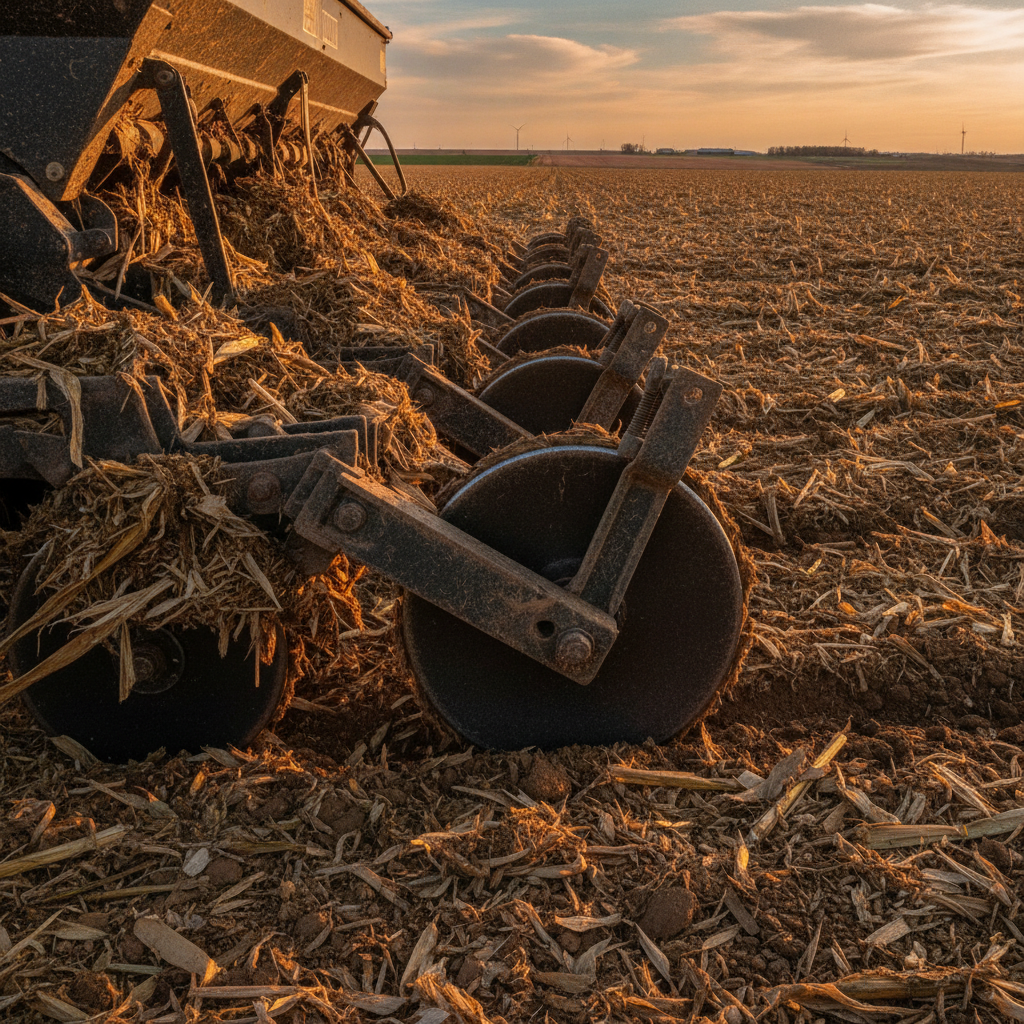
How Do Corn and Soybean Farmers Near Sioux Falls Know Whether Their No-Till Drill’s Wheel Retainer Is Actually Keeping Gauge Wheels Mounted Through Heavy Residue Passes — Or Just Waiting to Fail When It Matters Most?
If you’re no-tilling into heavy corn stalks or matted soybean stubble near Sioux Falls and you’ve had a gauge wheel walk off mid-field, you already know what that costs you — lost time, a half-planted field, and a scramble for parts during the tightest window of the year. The wheel retainer is what’s supposed to prevent that. But a lot of operators don’t actually know whether theirs is holding up under real load, or whether it’s just sitting there until the moment it finally lets go. Here’s how to think through it honestly.
What Heavy Residue Actually Does to a Wheel Retainer
Running a no-till drill through standing corn residue is different from planting into worked ground. The lateral forces on each row unit change constantly — residue bunches up, hangs on the gauge wheel, and pulls sideways. If your wheel retainer isn’t designed to handle that kind of repeated lateral stress, it doesn’t fail dramatically. It fails gradually. The gauge wheel starts to wobble slightly, then it seats inconsistently, then one pass it’s on the ground beside the drill and you’re pulling the machine out of the field.
Farmers in eastern South Dakota and across southern Minnesota and Iowa deal with this every spring. Fields that grew 180-bushel corn leave behind a lot of residue, and no-till operators who don’t cut residue ahead of time are asking their row units to work through material that creates real mechanical stress on every fastened component. The wheel retainer takes more of that abuse than most people account for.
The Gap That Most Competitor Products Don’t Address Directly
If you’ve searched around for information on wheel retainer performance in heavy residue specifically — not just gauge wheel depth control or closing wheel setup — you’ve probably noticed that most manufacturers don’t say much about it. They’ll tell you the retainer keeps the gauge wheel from dislodging, full stop. What they don’t tell you is how it performs when residue is wrapping around the wheel repeatedly for 10-hour days, or what happens when the drill bounces off a buried stalk and the gauge wheel takes a lateral hit.
That’s a real gap in how this product category gets explained, and it matters for no-till operators who are running more acres through heavier residue than they were five or ten years ago. The question isn’t just whether a wheel retainer works under ideal conditions. It’s whether it holds through a full spring run in the kind of fields you’re actually farming.
Jung Enterprise’s Wheel Retainer is designed with that kind of sustained field stress in mind — not just to meet a spec, but to stay mounted and functional from the first pass to the last.
Signs Your Current Wheel Retainer Is Underperforming
You don’t always get a dramatic failure. More often, wheel retainer problems show up as smaller signals that are easy to dismiss during a busy planting push:
- Gauge wheel wobble that wasn’t there at the start of the season
- Uneven furrow depth across different rows, especially on the ends where residue tends to pile
- Visible wear or deformation on the retainer itself after a single spring run
- Having to reseat the gauge wheel more than once during the season
- A gauge wheel that sits slightly cocked rather than running straight and true
Any one of these by itself might be a minor issue. All of them together, or any of them repeating season after season, points to a retainer that’s not built for the load your operation is putting on it.
What to Actually Look for in a Replacement
When you’re evaluating a replacement wheel retainer — whether you’re shopping out of Sioux Falls or ordering direct from a manufacturer like Jung Enterprise up in Ipswich — there are a few things worth asking before you buy:
- Is it field-tested under real residue conditions, or just bench-tested? Ask for specifics. At Jung Enterprise, our parts have been run through 13,000 planted acres over three years, with only 1/16″ of wear to show for it. That’s the kind of data point that actually means something.
- Does it fit your specific drill or planter gauge wheel size? Wheel retainers are not universal. A retainer sized for one OEM may not seat correctly on another, and a loose fit will fail faster under lateral load.
- Is it easy to install correctly? A retainer that requires special tooling or complicated fitment is one that’s more likely to get installed wrong in the field, which is how a lot of premature failures happen.
- Is it made domestically? This matters for quality consistency and for lead time when you need a replacement fast in the middle of May.
No-Till and Heavy Residue Are Not Going Away
Across South Dakota, Minnesota, and Iowa, no-till adoption has been growing steadily, and that means more operators are running drills into more residue than ever before. If your wheel retainer strategy is still based on whatever came stock on your machine, it may have made sense when you were tilling. It’s worth reconsidering now that you’re not.
The other factor is planting window pressure. Around Sioux Falls and across the eastern part of the state, spring planting windows can be short and unpredictable. Equipment that fails mid-season doesn’t just cost you repair time — it costs you planting days you can’t get back. A wheel retainer that holds through the full run is cheaper than the yield drag from delayed planting on even a few hundred acres.
See all Jung Enterprise products designed for no-till and row-crop planting operations.
Frequently Asked Questions
Can a wheel retainer really cause planting depth problems if it’s failing?
Yes, indirectly. If the gauge wheel isn’t seated and running true, it can’t maintain consistent furrow depth. Even minor wobble in the wheel translates to variability in how the disk opener tracks, which shows up as uneven emergence across the row.
How do I know if the wheel retainer is specific to my drill make and model?
It depends on the gauge wheel size and axle configuration on your row units. Jung Enterprise can help you match the right retainer to your machine — contact us directly with your drill make, model, and gauge wheel diameter before ordering.
Is a wheel retainer something I can replace myself, or does it need a shop?
Most farmers can handle the swap themselves. Jung Enterprise’s wheel retainer is designed for straightforward installation without specialty tools. If you’re unsure, your local ag dealer can confirm fit and walk you through it quickly.
Does the wheel retainer work on air seeders as well as no-till drills?
Yes. Jung Enterprise’s wheel retainer is compatible with both no-till drills and air seeders across multiple OEM gauge wheel sizes. The same lateral-load issues that show up in drill applications are present in air seeder row units running through residue.
How often should I replace a wheel retainer if it’s working correctly?
A properly matched and installed retainer shouldn’t need frequent replacement. Jung Enterprise’s parts are field-tested to hold up over multiple seasons under real working conditions. If you’re replacing yours every year, that’s a signal the part isn’t sized or built right for your application.
Ready to Stop Guessing and Start Planting With Confidence?
If your wheel retainer situation isn’t something you’ve looked at closely, now — before spring — is the right time. Jung Enterprise is based in Ipswich, South Dakota, and ships to farmers and dealers across the Northern Plains. We build patented, American-made gauge wheel components that are field-tested under real conditions, not just rated on paper.
Reach out before the season gets away from you. Contact Jung Enterprise here to ask about wheel retainer fit for your specific drill or air seeder, or to place an order ahead of spring planting.