
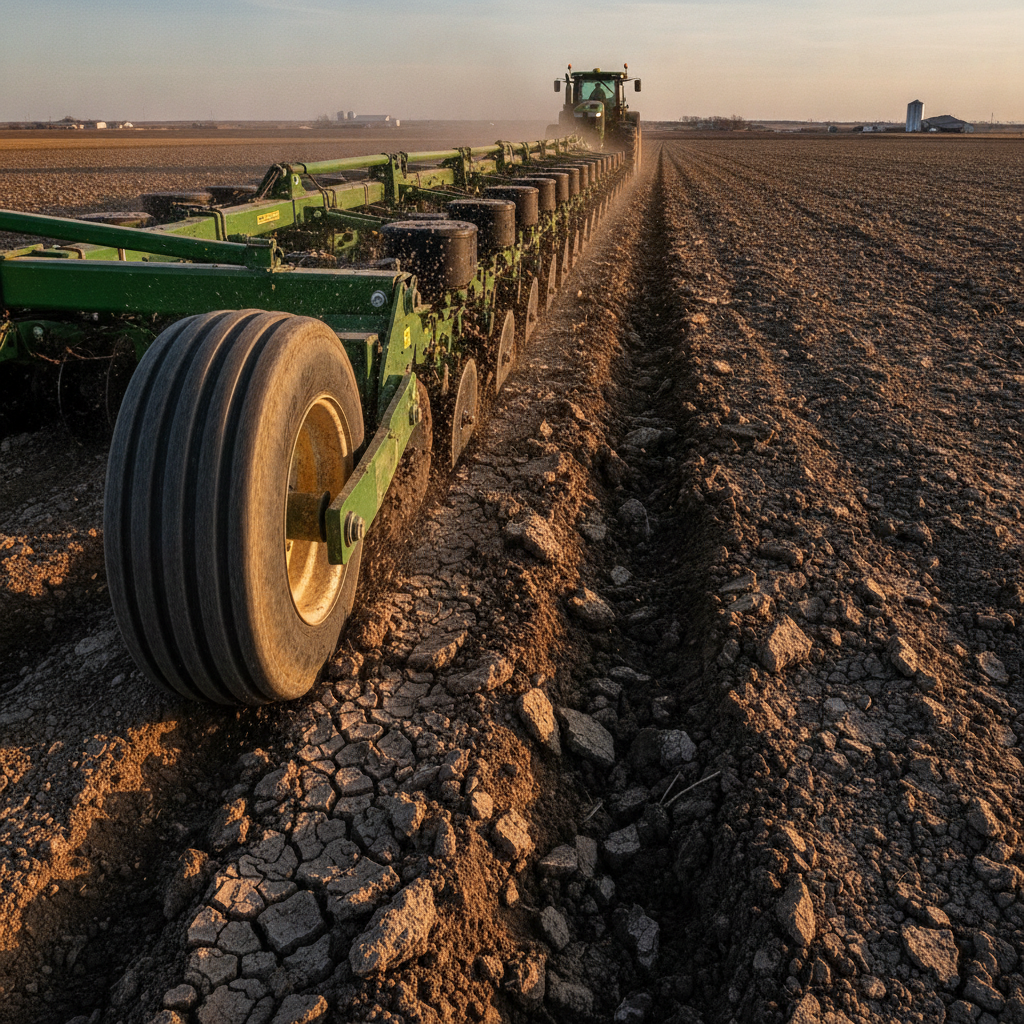
How Do Corn and Soybean Farmers Near Pierre Know Whether Their Planter’s Gauge Wheel Is Actually Engineered to Handle the Transition From Frozen Crust to Saturated Subsoil — Or Just Forcing Seed Depth Before the Ground Is Ready?
Near Pierre, the spring planting window opens under conditions that aren’t just wet — they’re layered. You’ll get out there and the top inch or two is still crusted from an overnight freeze, but underneath that crust the soil is saturated and soft. A gauge wheel that isn’t built to handle that transition doesn’t ride through it cleanly. It either skips across the crust and runs shallow, or punches through and sinks into the soft layer underneath, throwing your seed depth off row by row before you’ve finished your first field. If you’re not checking for this specifically, you might not catch it until you’re pulling poor emergence across half your stand.
Why the Frozen-Crust-to-Soft-Subsoil Transition Is a Real Engineering Problem
This isn’t just a “wait for better conditions” situation. Planting windows in central South Dakota are short. You can’t always wait for the soil profile to thaw and drain uniformly. Farmers near Pierre are often pushing into fields that are ready on the surface but not fully ready underneath, because if you wait for perfect conditions you lose days you don’t have.
The problem is that most stock gauge wheels aren’t designed with that transition in mind. A solid or semi-open gauge wheel packs saturated subsoil into the spoke pockets the moment it punches through the crust layer. Once that happens, the wheel stops rolling freely and starts riding on a packed mud mass. At that point it’s not measuring depth — it’s just dragging. Your disk opener keeps going down while the wheel is effectively floating on debris, and you lose the depth control you thought you had.
The other failure mode is riding the crust without punching through. If the gauge wheel’s contact geometry isn’t aggressive enough, it can skim across a frozen surface instead of seating into consistent soil. The result looks fine from the cab, but your furrow depth is inconsistent across every pass where the crust thickness varies.
What an Open-Spoke Design Actually Does in These Conditions
The curved spoked gauge wheels from Jung Enterprise are designed with an open-spoke geometry specifically to prevent mud and debris from packing into the wheel. When you punch through a frozen crust layer into saturated soil, the mud that gets picked up has somewhere to go. It moves through the open spokes and clears with each rotation instead of building up and altering the effective diameter of the wheel.
That matters because effective diameter is what controls seed depth. A wheel that’s carrying a mud pack around its perimeter is functionally larger than it’s supposed to be, which means your opener runs shallower than your setting. You won’t see it. You won’t feel it from the cab. You’ll see it in emergence, and by then it’s too late to do anything about that field.
The open-spoke design keeps the wheel’s contact diameter consistent from the first row to the last. That’s the whole point of using a precision gauge wheel — if the mud is defeating the geometry, you’ve lost the precision you paid for. Jung Enterprise’s curved spoked gauge wheels are field-tested for exactly this kind of real-world Northern Plains condition, not just for dry or ideal soil.
How to Actually Check Whether Your Current Wheel Is Handling This Transition
You don’t need a lab to figure this out. At the end of a field pass where you’ve run through that frozen-crust-over-wet-subsoil condition, pull the planter and look at your gauge wheels before they dry off. If you’re seeing significant mud accumulation between spokes or around the spoke pockets, that mud was affecting your depth while you were running. If the wheels are relatively clean and clear, the design is shedding like it should.
The second check is emergence consistency. Pull emergence counts at the same depth setting across rows that ran through variable surface conditions. Wide variance in emergence depth — where some seedlings are right at target and others are shallow — is a strong indicator that the gauge wheel was not maintaining consistent contact with the soil surface during the crust transition.
If you’re running a no-till drill or air seeder into this same soil type, the same logic applies. The gauge wheel still controls depth, and mud packing on a solid or poorly designed wheel creates the same drift problem in a drill row unit that it does on a row crop planter.
Durability Through a Full Spring Run
It’s also worth talking about wear. Central South Dakota soils are abrasive, and the freeze-thaw cycle works soil particles in ways that accelerate wear on gauge wheel components. Jung Enterprise’s curved spoked gauge wheels have been field-tested to show only 1/16 inch of wear after 13,000 planted acres over three years. That’s a number that matters if you’re running a lot of acres or doing custom work — you’re not replacing these every season, and you’re not watching the wheel geometry slowly drift toward inaccuracy because the material can’t hold up to your ground.
That kind of durability is built in from the start, not marketed as a feature after the fact. The goal is a wheel that holds its geometry long enough to actually pay for itself in yield consistency, not just one that looks like it will. Jung Enterprise is a family-owned, American-made manufacturer based in Ipswich, South Dakota, and these parts are designed by people who understand what Northern Plains soils do to equipment season after season.
Frequently Asked Questions From Farmers Near Pierre
Can a curved spoked gauge wheel actually punch through a frozen crust layer, or does it just ride over it?
It depends on crust thickness and the weight of your row unit, but the curved spoke geometry is designed to seat into uneven surfaces more consistently than a flat-faced solid wheel. It’s not a tillage tool — if the crust is several inches thick and unbroken, nothing’s going through it cleanly. But in the typical spring crust condition near Pierre, where the top inch is firm and the rest is soft, the wheel will seat and track correctly.
Will mud still pack into curved spokes the way it does in solid wheels?
No — the open-spoke design is specifically built to prevent that. Mud picks up and exits through the spoke openings rather than accumulating and riding around with the wheel. This is the core functional difference in wet or transitional soil conditions.
Do I need to change anything else on my planter if I switch to curved spoked gauge wheels?
In most cases, no. Jung Enterprise’s curved spoked gauge wheels are built to fit multiple OEM planter and air seeder platforms across common gauge wheel sizes. Check compatibility for your specific machine before ordering — if you have questions about fit, reach out directly.
How do I know if my gauge wheel is the reason for inconsistent emergence, versus a seed meter or closing wheel problem?
Gauge wheel issues typically show up as depth variation — some seeds at the right depth, others too shallow. Meter problems tend to produce skip patterns or spacing issues at consistent depth. If your emergence count is reasonable but depth is variable row to row or pass to pass, start with the gauge wheel before diagnosing the meter.
Is this the same wheel that works for no-till drills, or is it a different product?
Jung Enterprise’s curved spoked gauge wheels are designed to work across planters, air seeders, and no-till drills. If you’re running a no-till drill into the same frozen-crust-over-saturated-subsoil conditions, the same open-spoke mud-shedding advantage applies.
Get the Right Gauge Wheel Before the Next Planting Season
If you’re farming near Pierre and you’ve seen inconsistent emergence after pushing into early spring ground, it’s worth taking a hard look at whether your gauge wheel is actually maintaining depth through that crust-to-wet-subsoil transition — or just getting by well enough that you haven’t connected the dots yet. The fix is straightforward and the parts are built to last. Contact Jung Enterprise in Ipswich to talk through what you’re running and what will fit your machine. Reach out through the contact page and get a straight answer before planting season puts you back on the clock.