
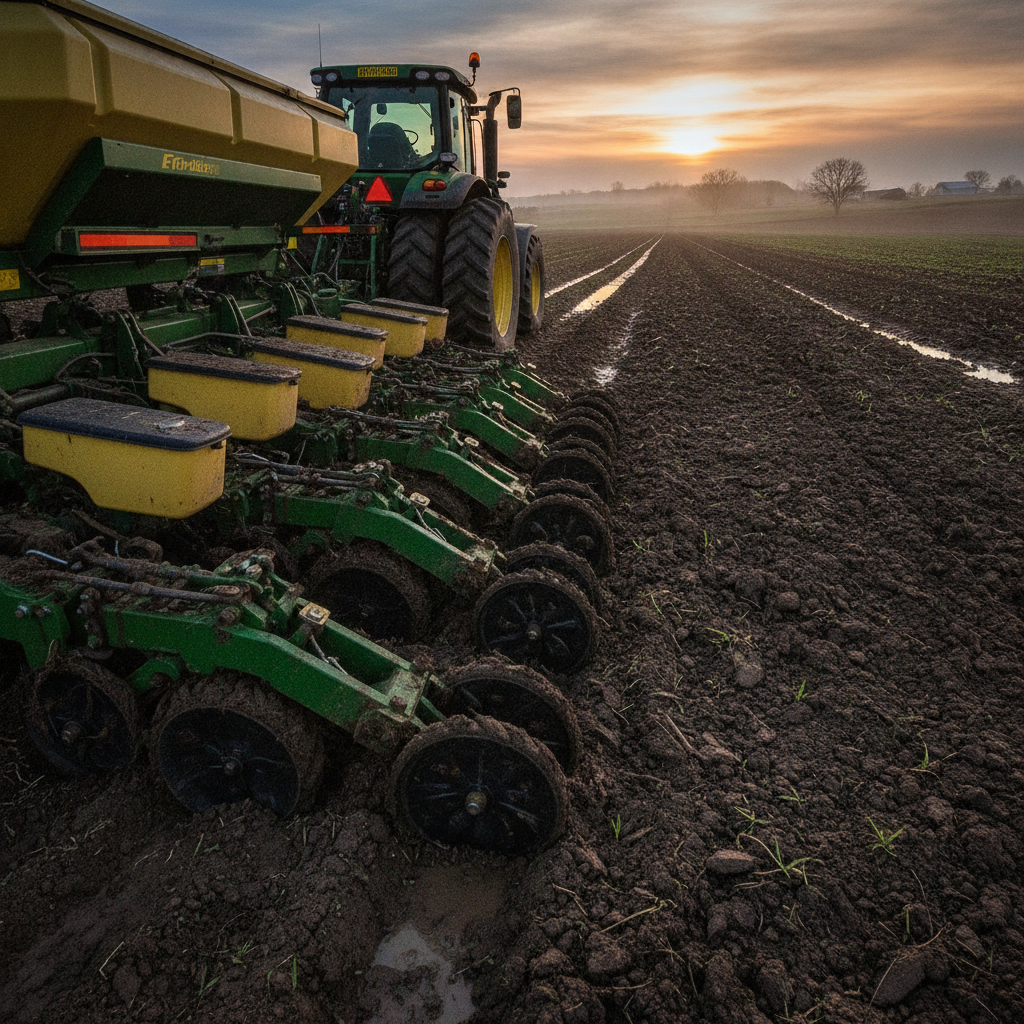
How Do Corn and Soybean Farmers Near Sioux Falls Know Whether Their Planter’s Gauge Wheel Is Actually Set Up for Early-Season Cold Soil Planting — Or Just Running the Same Configuration They Used Last Fall?
If your planter is sitting in the shed right now configured the same way it finished last season, you may already be setting yourself up for depth problems the moment you hit a cold, wet field in April. Farmers near Sioux Falls know the spring window is tight — sometimes only a handful of workable days before soils either stay too wet to plant or dry out fast and crust hard. What a lot of operators don’t stop to consider is that early-season cold soils behave completely differently from warm, settled soils, and your gauge wheel setup needs to match those conditions or you’ll be fighting seed depth inconsistency from the first pass.
What Cold Soil Actually Does to Your Gauge Wheel Setup
Cold soil — especially in the heavy clay and silty loam ground common across eastern South Dakota and into southwestern Minnesota and northwestern Iowa — is denser, more plastic, and far less forgiving than the same field in June. When a gauge wheel rolls through a cold, wet furrow, a couple of things happen that don’t get talked about enough.
First, smearing. Cold clay soil doesn’t crumble and flow past a gauge wheel — it smears. A solid or nearly-closed spoke design pushes wet soil to the side of the furrow wall instead of letting it pass through. That smeared sidewall actually reduces water infiltration into the seed trench and can limit root penetration in the first weeks after germination. Research from land-grant university extension programs in the Corn Belt has consistently shown that sidewall compaction in cold, wet soils is one of the more underappreciated causes of uneven emergence and early-season yield drag in corn and soybeans.
Second, mud packing. If your gauge wheel can’t shed the soil it picks up between spokes — or if it has no spoke clearance to speak of — it starts carrying a mud plug. That plug changes the effective diameter of the wheel, which means your planting depth is drifting shallower with every rotation. By the time you notice uneven emergence, you’ve already planted a hundred acres at the wrong depth.
Open-Spoke Design Isn’t Just a Marketing Feature — It’s a Soil Physics Solution
The curved spoked gauge wheel design that Jung Enterprise manufactures out of Ipswich was built specifically to address these conditions. The curved spoke geometry creates natural clearance channels that allow wet soil to exit the wheel during rotation rather than packing in. It’s not a complicated concept — it’s just engineering that matches how cold, saturated soil actually behaves in the field.
The same design that sheds mud in a cold April field near Sioux Falls also maintains consistent rolling contact with the furrow wall, which is what keeps your seed depth stable across variable soil conditions. When you’re planting 50,000 seeds per acre, a quarter-inch of depth variation row to row compounds into a yield problem fast. The curved spoked gauge wheels from Jung Enterprise have been field-tested across 13,000 planted acres over three years and showed only 1/16″ of wear. That’s not a spec sheet claim — that’s a real farm, real conditions, real measurement.
What to Actually Check Before the Season Starts Near Sioux Falls
Before the planter rolls this spring, work through these checks with your early-season soil conditions in mind — not last fall’s conditions:
- Spoke clearance and design: Can the wheel actually shed wet clay, or are the spoke pockets tight enough that mud will pack and stay? If you’re running a solid-face or narrow-spoke design on heavy soils, you’re accepting depth drift as a tradeoff.
- Gauge wheel wear: A worn gauge wheel doesn’t hold the furrow wall cleanly. Even modest wear changes the contact geometry and starts introducing depth variability you won’t see until emergence tells the story.
- Tire lip condition and steel ring status: The gauge wheel tire lip is exposed to constant abrasion and debris impact. A damaged tire lip changes how the wheel contacts the soil and directly affects depth consistency. A steel ring protects that lip and doubles as a built-in scraper — one part doing two jobs instead of two parts you have to source, install, and maintain separately.
- Wheel retainer integrity: Cold-soil planting creates more lateral force variation as the gauge wheel tracks through uneven frozen and thawed patches. A wheel retainer that’s worn or not properly secured is a mid-field failure waiting to happen.
The Setup Decision You Make in February Affects Your Yield in October
Planting season in eastern South Dakota moves fast. When conditions are right near Sioux Falls — or anywhere from the Missouri River east into Minnesota and Iowa — you don’t have time to troubleshoot gauge wheel problems in the field. The decisions you make during the off-season, when the planter is in the shed and you have time to actually think, are the ones that determine whether your setup is ready for cold, wet, early-season soils or just adequate for ideal conditions.
If you’re planning to push into fields early to capture the top of the planting window — which every farmer with corn ground in the Northern Plains is thinking about — then your gauge wheel setup needs to be matched to those early conditions, not to the warm dry soils of late May. Jung Enterprise builds parts specifically for the conditions farmers in this region face: cold springs, heavy clay, tight planting windows, and no tolerance for downtime.
Frequently Asked Questions
Does gauge wheel spoke design actually matter in cold soils, or is any wheel fine as long as it’s the right diameter?
Spoke design matters a lot in cold, wet conditions. A wheel that can’t shed soil between spokes will carry a mud pack that changes its effective diameter and drifts your planting depth. Curved or open-spoke designs are engineered to let wet soil clear the wheel during rotation — that’s not a minor difference in heavy clay soils near Sioux Falls or similar ground across eastern South Dakota.
How do I know if my gauge wheel is worn enough to affect seed depth?
Put a straight edge across the face of the gauge wheel where it contacts the furrow wall. If you can see visible rounding or cupping at the contact surface, the wheel isn’t tracking the furrow wall cleanly anymore. Even modest wear introduces depth variability — particularly in variable soils where the wheel already has to work to maintain contact.
Can I run the same gauge wheel setup in no-till as I do in conventional-till ground?
Not without accepting tradeoffs. No-till ground near Sioux Falls and across the Northern Plains typically has more surface residue, variable soil density at the surface, and in cold springs, more moisture retention near the seed zone. An open-spoke gauge wheel designed to shed residue and wet soil will perform more consistently in those conditions than a design carried over from conventional-till work.
What does the steel ring have to do with gauge wheel depth performance?
The steel ring protects the tire lip from wear and debris damage, but it also functions as a built-in scraper that keeps mud from building up against the tire. If mud builds at the tire lip, it changes the effective rolling diameter of the gauge wheel — same result as spoke plugging. The Jung Enterprise steel ring (US Patent 11,707,013 B2) mounts with six screws and handles both functions in one part, which means less to manage and fewer failure points going into a cold, wet planting season.
When should I order replacement gauge wheels and steel rings to make sure they arrive before planting?
Order in February at the latest if you’re planting corn in eastern South Dakota or neighboring states. Pre-planting demand hits hard in March and April, and lead times compress. If you’re waiting until the week the soil is ready, you’re taking a risk on availability that you don’t need to take.
Get Your Planter Ready Before the Window Opens
Don’t wait until April to find out your gauge wheel setup isn’t matched to cold-soil conditions. If you’re farming near Sioux Falls, in the Northern Plains, or across the Corn Belt and you want to know whether your current gauge wheel, steel ring, and wheel retainer setup is actually built for early-season work — reach out to Jung Enterprise now, while there’s still time to get the right parts installed before the planter rolls.
Contact the team in Ipswich directly at (605) 281-0497 or email help@jungenterprise.net, or submit a question through the contact page and we’ll get back to you with straight answers about fitment, availability, and what setup makes sense for your operation.