
What’s the Difference Between Steel Gauge Wheels and Rubber Gauge Wheels Near Sioux Falls?
If you’re farming corn or soybeans in South Dakota and you’re shopping for gauge wheels, the material question comes up fast: steel or rubber? Near Sioux Falls and across the rest of the state, most farmers have used rubber at some point — it’s what comes stock on most planters and no-till drills. But rubber has real limitations, especially in the wet, heavy soils that show up every spring in this part of the country. Steel gauge wheels solve some of those problems. They also come with tradeoffs worth understanding before you buy. Here’s a plain comparison so you can decide what actually fits your operation.
- Why Gauge Wheel Material Matters More Than Most People Think
- Rubber Gauge Wheels: Where They Work and Where They Don't
- Steel Gauge Wheels: What They Actually Fix
- The Angle Most Competitors Don't Talk About: Tire Lip Protection
- When Rubber Still Makes Sense
- FAQ: Steel vs. Rubber Gauge Wheels
- Ready to Make the Switch Before Next Planting Season?
Why Gauge Wheel Material Matters More Than Most People Think
A gauge wheel has one job: control planting depth. That’s it. If your gauge wheel isn’t running clean and sitting consistently against the furrow wall, your seed depth wanders, and variable emergence is one of the fastest ways to leave bushels in the field. The material your gauge wheel is made of directly affects how well it holds depth in real conditions — not ideal conditions, real ones. That means wet springs, clay soils, and the kind of sticky gumbo that builds up on every spinning surface it touches.
Most equipment comes from the factory with rubber gauge wheels. They’re relatively inexpensive to manufacture, they have decent grip, and they’ve been the default for decades. But rubber isn’t the end of the story.
Rubber Gauge Wheels: Where They Work and Where They Don’t
Standard rubber gauge wheels do a reasonable job in dry-to-moderate conditions. The tire profile rolls cleanly, they handle well on firm ground, and replacement costs are predictable. If you’re farming in Iowa or Nebraska in a drier spring on lighter soils, rubber can get you through a season without major issues.
The problems show up when soils get wet and heavy:
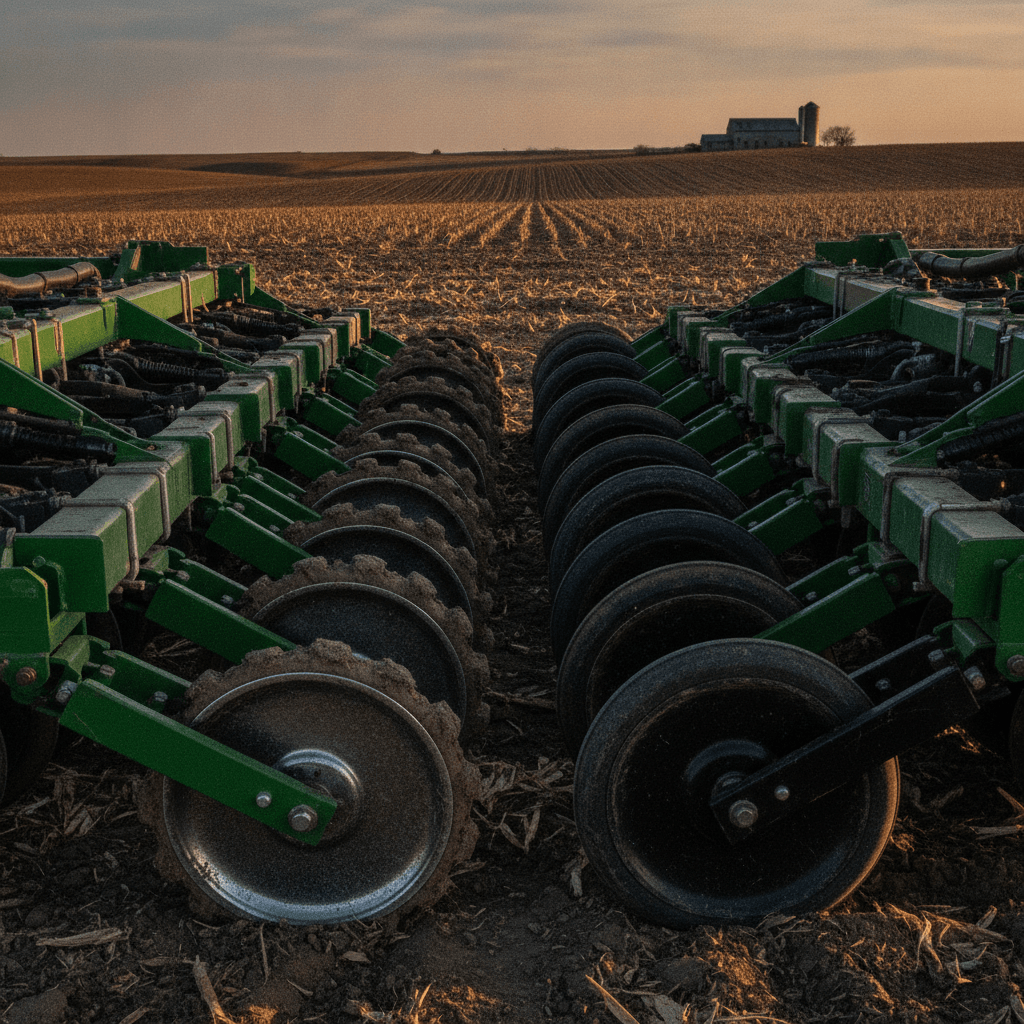
- Mud plugging. Rubber gauge wheels pack soil into the space between the tire and the frame. Once mud bridges across that gap, the wheel stops shedding and starts carrying a ball of soil around with it. Depth control goes out the window.
- Tire lip wear. The edge of a rubber gauge wheel takes a beating from abrasive soil, especially in heavy clay. Once the lip rounds off or deforms, the wheel no longer sits true against the furrow wall — and you lose the depth reference you were counting on.
- Replacement frequency. Rubber wears faster than steel. In high-acreage operations — especially custom planters running thousands of acres across South Dakota, Minnesota, or neighboring states — that adds up fast in parts cost and labor.
Steel Gauge Wheels: What They Actually Fix
Steel gauge wheels are built for exactly the conditions that cause rubber to fail. The open-spoke design — used in Jung Enterprise’s Curved Spoked Gauge Wheels — sheds mud instead of packing it. When soil can’t build up and bridge across the wheel, depth control stays consistent through wet ground that would otherwise force a shutdown or a constant manual cleanup.
Steel also holds its shape. Rubber deforms under pressure and over time. Steel doesn’t. That matters for depth accuracy, especially in no-till and strip-till situations where you’re working through residue and variable soil conditions in the same pass. When the wheel is consistent, your seed placement is consistent — and that translates directly to more uniform emergence.
Durability is another honest advantage. Jung Enterprise’s curved spoked steel gauge wheels have been field-tested to just 1/16″ of wear after 13,000 planted acres across three seasons. That’s a number worth comparing to whatever rubber wheel you’re currently buying on an annual or semi-annual basis.
The Angle Most Competitors Don’t Talk About: Tire Lip Protection
Here’s something that gets very little attention on competitor websites: the gauge wheel tire lip is a wear point on its own, separate from the wheel body. Even if you’re running steel gauge wheels, the contact edge where the wheel rolls against the furrow can take damage from abrasive soil and debris. Jung Enterprise’s Steel Ring (patented under US 11,707,013 B2 and related patents) addresses this directly. It mounts to the gauge wheel with six screws, protects the tire lip, and doubles as a built-in scraper — so you’re not buying a separate scraper part to manage buildup.
That combination — steel construction, open-spoke mud shedding, and built-in scraper protection — is what makes the full system from Jung Enterprise different from just swapping rubber for generic steel. It’s a purpose-built solution for the actual conditions farmers deal with in this part of the country.
When Rubber Still Makes Sense
Being honest: rubber gauge wheels aren’t always the wrong call. If you’re running limited acres on well-drained ground, your existing rubber wheels are in decent shape, and you’re not dealing with serious plugging issues, replacing them with steel is a capital expense that may not pay back quickly. Rubber is also easier to source through most local dealers on short notice during planting season.
The crossover point is when you’re losing time to plugging, losing depth consistency in wet conditions, or burning through replacement rubber faster than you’d like. At that point, the math on steel gauge wheels changes.
FAQ: Steel vs. Rubber Gauge Wheels
Do steel gauge wheels fit my existing planter?
Jung Enterprise’s curved spoked gauge wheels are built to fit multiple OEM brands and gauge wheel sizes across planters, air seeders, and no-till drills. Check the product page or contact the team directly to confirm fitment for your specific row units.
Will steel gauge wheels damage my furrow or seed trench?
No. Steel gauge wheels control depth against the sidewall of the furrow — they don’t create a different cut or disturb the seed trench. The contact mechanics are the same as rubber; the material just holds its shape and sheds mud better.
How do steel gauge wheels handle heavy residue in no-till situations?
The open-spoke design helps here too. Residue that might wrap or pack against a solid rubber wheel face tends to clear through the spokes rather than build up. It’s one of the reasons steel gauge wheels see strong adoption in no-till and strip-till operations across South Dakota and Minnesota.
How long will steel gauge wheels actually last compared to rubber?
Field-tested numbers from Jung Enterprise show 1/16″ of wear after 13,000 planted acres over three seasons. That’s considerably longer than most rubber gauge wheels hold up under comparable conditions. Your results will vary with soil type and abrasiveness, but the durability gap is real.
Where are Jung Enterprise gauge wheels made?
Designed and manufactured in the United States, out of Ipswich, South Dakota. Not an import. Not a commodity part sourced overseas and re-labeled.
Ready to Make the Switch Before Next Planting Season?
If you’re tired of fighting mud buildup, watching depth consistency suffer in wet springs, or replacing rubber gauge wheels more often than you should be, steel is worth a serious look. Jung Enterprise builds these parts in Ipswich for the conditions farmers across South Dakota, Minnesota, Iowa, and Nebraska actually face — not for ideal test plots.
Take a look at the full line of gauge wheels, steel rings, and wheel retainers, or reach out directly with questions about fitment, quantities, or dealer pricing. The team at Jung Enterprise will give you a straight answer — no runaround, no upsell pitch.
Contact Jung Enterprise to ask about gauge wheel compatibility for your planter or drill, or to get set up before the next planting window opens.