
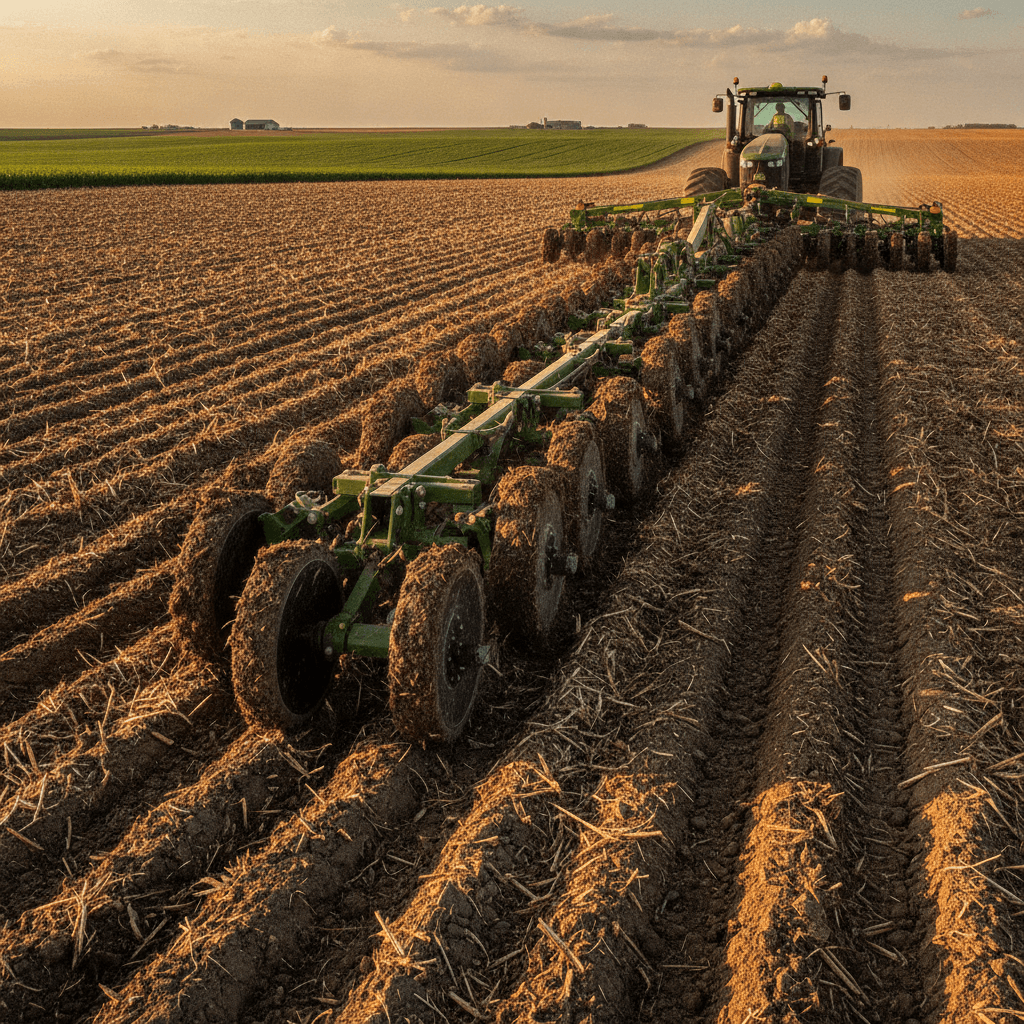
How Do Strip-Till Farmers Near Huron Keep Gauge Wheels Running Clean Through the Entire Planting Pass?
Strip-till farmers near Huron face a gauge wheel problem that most equipment manufacturers gloss over: the strip itself. You’re running a planter into a raised, worked seedbed that’s surrounded by undisturbed residue and compacted inter-row soil. That transition — soft strip, hard shoulder — puts uneven lateral pressure on your gauge wheels all day long. Add a wet April to the mix, and you’ve got conditions that will plug a standard solid gauge wheel fast and throw your planting depth off before you’re two passes into the field. The short answer to keeping gauge wheels running clean through a strip-till pass is choosing the right wheel design for the job and making sure your tires and hardware are up to the punishment. Here’s what actually matters out there.
- Why Strip-Till Is Harder on Gauge Wheels Than Conventional Tillage
- What an Open-Spoke Design Actually Does in Strip-Till Conditions
- The Part of Strip-Till Wear Nobody Talks About: Tire Lip Damage from Strip Shoulders
- Keeping the Wheel on the Planter: Why Strip-Till Operators Need Wheel Retainers
- Practical Checklist Before Your First Strip-Till Pass
- Frequently Asked Questions
- Talk to Jung Enterprise Before Your Next Strip-Till Season
Why Strip-Till Is Harder on Gauge Wheels Than Conventional Tillage
In a conventional-till field, your gauge wheels are riding on a relatively uniform surface. Strip-till is different. The tilled strip is mellow and can be a couple of inches higher than the inter-row. That crown effect means your gauge wheels are under constant side-load as the planter unit tracks into the strip. Over the course of a long field, that lateral pressure accelerates tire lip wear on the outside edge of the wheel — the side taking the most contact against the strip shoulder.
On top of that, the inter-row residue and soil don’t just sit there. Mud and crop material get pushed into the wheel cavity. In the gumbo soils common across central South Dakota — especially after a wet spring that delays planting into May — that debris packs in and doesn’t shed. Once a gauge wheel is packed with mud, it stops floating on the soil surface and starts dragging. Your depth control goes out the window.
Most competitor products address mud shedding on flat, conventional ground. Very few are designed specifically with the strip-till environment in mind — the uneven surface loading, the residue concentration between rows, and the abrasive shoulder contact that chews through tire lips faster than you’d expect.
What an Open-Spoke Design Actually Does in Strip-Till Conditions
The biggest single upgrade strip-till operators can make is switching from a solid gauge wheel to a curved open-spoke design. On solid wheels, mud has nowhere to go. It fills the cavity and stays. On an open-spoke wheel, the spokes flex slightly as the wheel rotates and mud is thrown clear by centrifugal force and the curved spoke geometry.
Jung Enterprise’s Curved Spoked Gauge Wheels are built specifically for this. The open-spoke pattern sheds mud and debris on every rotation, which matters in strip-till because you’re constantly picking up material from the residue mat between the strips. Less packing means your wheel stays in ground contact, your depth stays where you set it, and your seed spacing doesn’t suffer. That’s not a marketing claim — in a short planting window like the ones farmers near Huron deal with, consistent depth across the whole pass is the difference between a uniform stand and a patchy one.
The Part of Strip-Till Wear Nobody Talks About: Tire Lip Damage from Strip Shoulders
Here’s a gap that most gauge wheel suppliers — including the major names farmers near Aberdeen and Mitchell tend to compare — don’t address directly: what happens to the tire lip when the gauge wheel is riding the edge of a strip all day.
The shoulder of the strip acts like a low-grade scraper against the outside tire lip. It’s not dramatic wear — you won’t notice it mid-season. But after one or two full seasons of strip-till planting, that tire lip starts to thin out, crack, or deform. Once the lip goes, the wheel no longer sits properly in the planter arm, your depth control suffers, and you’re looking at a replacement that costs real money and real time during a window when neither is available.
The fix is protecting that tire lip before it starts to wear. Jung Enterprise’s Steel Ring mounts with six screws directly to the gauge wheel and covers the tire lip. It doubles as a built-in scraper — so you’re getting debris protection and lip protection from a single part, with no separate scraper add-on needed. The patent (US 11,707,013 B2) covers that integrated design specifically. After 13,000 planted acres over three years in field testing, wear measured at only 1/16 of an inch. In strip-till conditions near Huron, that durability matters because the sidewall abuse is ongoing, not occasional.
You can see the full spec on the Steel Ring product page if you want to compare it against what you’re running now.
Keeping the Wheel on the Planter: Why Strip-Till Operators Need Wheel Retainers
Strip-till planting is harder on planter hardware across the board. The lateral forces from tracking into the strip, plus the occasional hard impact when the planter hits a ridge or a rock, can work a gauge wheel loose from its mount over the course of a long day. Farmers running in North Dakota and Minnesota where strip-till is common on heavy soils report this more than they do on flat, conventional ground.
A wheel retainer keeps the gauge wheel seated on the planter arm under those lateral and impact loads. It’s a straightforward part — easy to install — but if you’re not running one and a wheel dislodges mid-field, you’ve lost a pass and possibly damaged the planter unit. It’s worth checking your current setup before the season starts, not after it happens.
Practical Checklist Before Your First Strip-Till Pass
- Inspect tire lips on every gauge wheel before planting. If you see cracking, thinning, or deformation from last season’s strip shoulder contact, address it now — not mid-season.
- Check that gauge wheels shed mud cleanly with a slow hand-spin. Solid wheels that hold debris should be replaced with an open-spoke design before you’re in wet field conditions.
- Verify wheel retainers are seated and haven’t worked loose over winter storage. A quick check takes two minutes per row unit.
- Match your wheel to your strip width and soil type. Central South Dakota gumbo behaves differently than the sandier soils you might find further west. If your current wheel design was spec’d for lighter soils, it may not shed clay the same way.
- Order backup parts before planting season starts. Lead times from Ipswich are short, but don’t count on next-day availability during peak demand in April when everyone in the region is calling at once.
Frequently Asked Questions
Do curved spoked gauge wheels work on air seeders as well as planters?
Yes. Jung Enterprise’s curved spoked gauge wheels are compatible with planters, air seeders, and no-till drills across multiple OEM configurations. If you’re running an air seeder in strip-till or no-till conditions near Huron or across central South Dakota, the mud-shedding benefit applies the same way.
Will a steel ring fit my existing gauge wheel, or do I need to buy a new wheel?
The Steel Ring mounts to your existing gauge wheel with six screws. You don’t need to replace the whole wheel to get lip protection and scraper function. That’s part of what makes it cost-effective compared to a full wheel swap.
How long does it take to install a wheel retainer on a planter row unit?
Most operators have it done in under ten minutes per unit. There’s no specialized tooling required. It’s the kind of job you can run through a full planter in a half day during pre-season prep.
Are these parts made in the U.S.?
Yes. Jung Enterprise is based in Ipswich, South Dakota, and manufactures domestically. For farmers who’ve dealt with import parts that don’t hold tolerances or fail in the first season, that matters — especially when you need a replacement fast and can’t wait on overseas shipping.
Does the steel ring scraper function hold up in heavy residue from corn-on-corn strip-till ground?
Field testing shows 1/16 inch of wear after 13,000 acres across three seasons — including high-residue conditions. The integrated scraper is part of the patented design, not a bolt-on afterthought, so it maintains contact geometry over time rather than getting knocked out of position by residue impact.
Talk to Jung Enterprise Before Your Next Strip-Till Season
If you’re running strip-till near Huron, Aberdeen, or anywhere across central South Dakota and you’re not fully satisfied with how your gauge wheels handled last season — the mud plugging, the tire lip wear, the depth inconsistency — it’s worth a conversation before you put the planter in the ground again. Jung Enterprise is a short drive from most of the region and builds parts specifically for the conditions Northern Plains farmers deal with every spring.
Reach out to Jung Enterprise here or call (605) 281-0497 to ask about fitment for your specific planter setup, availability, and whether the Steel Ring, Curved Spoked Gauge Wheels, or Wheel Retainer make sense for what you’re running. No obligation — just a straight answer from people who build this stuff and know the ground you’re farming.