
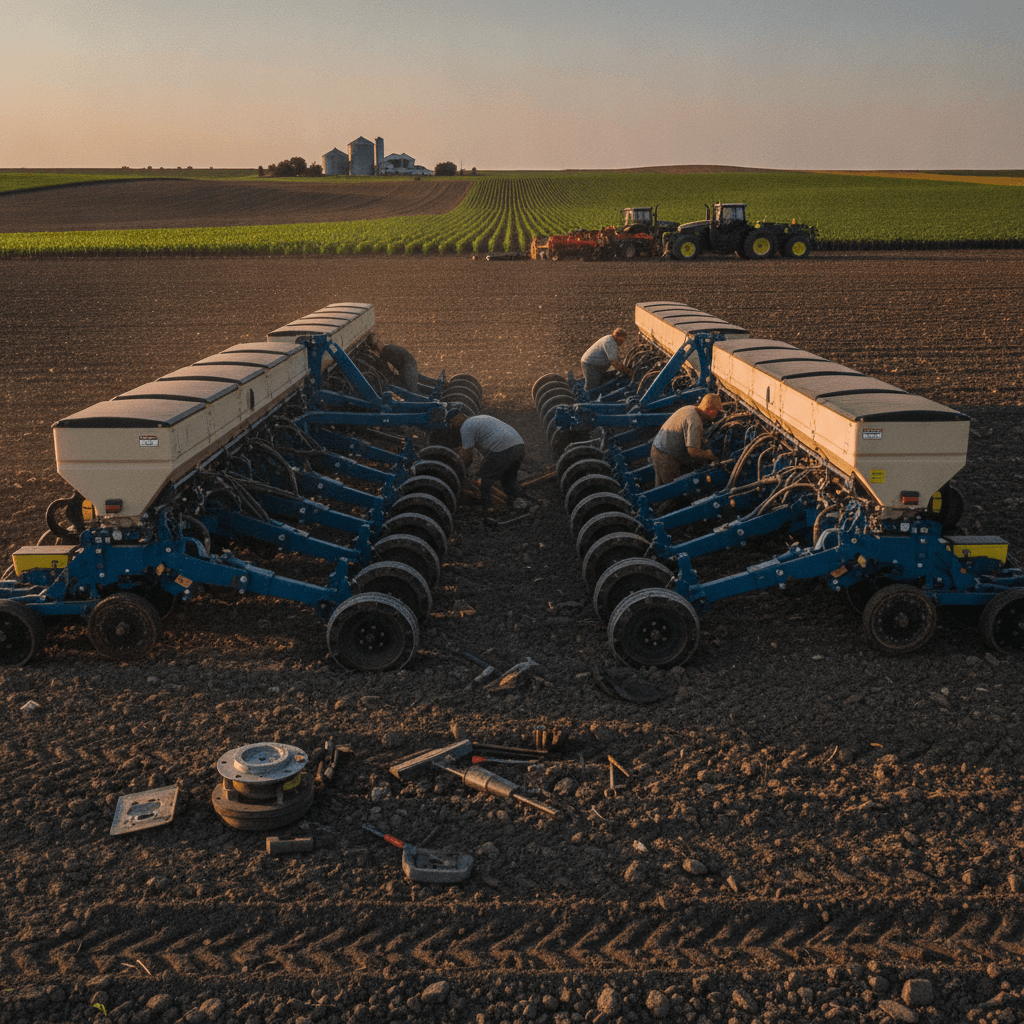
How Do Custom Planters Near Watertown Protect Their Equipment Investment When Running Back-to-Back Planting Jobs?
If you run a custom planting operation near Watertown, you already know the answer to this one the hard way: you protect your equipment, or you eat the cost of not doing it. When you’re moving from farm to farm across Codington County with a planting window that might close in two days, there’s no margin for a gauge wheel that’s plugged solid with gumbo or a tire lip that’s ground down to nothing. You don’t get to call in sick. The next customer is already watching the sky.
This is a corner of the planting equipment conversation that most manufacturers don’t bother with. They write for the farm that owns one planter and parks it in the shed after corn goes in. They’re not thinking about the custom operator who’s got four or five jobs lined up back-to-back, logging serious acres across South Dakota and into Minnesota or North Dakota, and can’t afford a single breakdown day without it costing real money — not just theirs, but their customer’s too.
- The Custom Operator's Problem Is Different — And Most Parts Suppliers Ignore It
- What Gauge Wheel Plugging Actually Costs a Custom Operator
- Tire Lip Wear: The Cost That Sneaks Up on You
- Wheel Retainers: The Safety Item Nobody Talks About Until Something Goes Wrong
- Buying Parts as a Custom Operator Near Watertown: What to Think About
- FAQ: Custom Planting Equipment and Parts Near Watertown
- Ready to Talk Parts Before Next Season?
The Custom Operator’s Problem Is Different — And Most Parts Suppliers Ignore It
Here’s what’s different about running custom planting versus farming your own ground: your equipment doesn’t get to rest between fields. You pull out of one wet, heavy field and drive straight into the next one. The mud that built up on the gauge wheels in field one is still there when you start field two. The tire lip that was borderline worn at the start of the week is definitely worn out by Friday.
Most competitors in the gauge wheel and planter parts space write about replacement intervals and product specs. What they don’t address is what happens when you’re putting 1,500 to 2,000 acres on a planter in a single spring — not over three years, but in one season. That changes everything about how you think about parts selection, uptime, and what you’re actually paying per acre for protection.
The short version: cheap parts that might last one season on a 500-acre farm don’t hold up the same way when you’re running hard miles on them. And when something fails mid-field, you’re not just dealing with downtime — you’re dealing with a customer on the phone asking why you stopped.
What Gauge Wheel Plugging Actually Costs a Custom Operator
Wet springs near Watertown and across the Northern Plains are normal. The clay and gumbo soils in this part of South Dakota pack into solid rubber gauge wheels fast, and once they’re plugged, you’ve lost depth control. You’re not planting at 1.75 inches anymore — you’re guessing. And when you’re getting paid to put seed in the ground right, guessing isn’t an option.
An open-spoke gauge wheel design sheds mud as it turns instead of packing it in. That’s the practical reason curved spoked gauge wheels matter to a custom operator — not just the agronomic argument about depth consistency, but the operational argument about getting through a field without stopping to clean wheels by hand. Every time you stop, you fall behind. In a tight planting window, falling behind has a dollar amount attached to it.
Tire Lip Wear: The Cost That Sneaks Up on You
Gauge wheel tire lips wear down gradually, and most operators don’t notice until the lip is gone and the tire is riding on the rim. At that point you’ve already lost depth accuracy, and you’re looking at a tire replacement that costs more than the protection that would have prevented it.
The steel ring from Jung Enterprise was designed specifically to address this. It mounts to the tire with six screws, protects the lip from wear, and doubles as a built-in scraper that keeps mud from packing against the tire face. One part handles two jobs — you don’t need a separate scraper bolted on. It’s covered under US Patent 11,707,013 B2, and it’s been field-tested to only 1/16″ of wear after 13,000 planted acres over three years.
For a custom operator near Watertown putting heavy acres on a planter in a single season, that durability matters. You’re not replacing parts every fall because you ran them into the ground. You’re running them, and they hold up. That’s a different conversation than what most parts suppliers want to have, because it means you’re buying less often — but it’s an honest one.
Wheel Retainers: The Safety Item Nobody Talks About Until Something Goes Wrong
If you’ve ever had a gauge wheel come off a planter mid-field — or watched it happen to someone else — you know what a wheel retainer does. It keeps the gauge wheel from dislodging off the row unit during operation. It’s a simple part with a straightforward job, and it’s easy to overlook until the moment you need it.
For custom operators moving equipment between farms, the risk of vibration and normal field stress working on connections is real. A wheel retainer is inexpensive insurance against losing a gauge wheel in the middle of a customer’s corn field. Installs easily, does its job quietly, and you don’t think about it again — which is exactly what you want from a safety part.
Buying Parts as a Custom Operator Near Watertown: What to Think About
When you’re sourcing parts for a custom planting rig, the questions are a little different than for a single-farm operation. You’re thinking about compatibility across multiple planter configurations, durability across a full season of heavy use, and whether the parts supplier can actually get you what you need before planting starts — not two weeks after.
Jung Enterprise is based in Ipswich, which puts us close to the farms and operations in Watertown, Aberdeen, and Huron where these planting conversations happen every spring. We’re not shipping from overseas. Parts are American-made, patented, and stocked to move when you need them — not when the supply chain cooperates.
If you’re sourcing through a local ag dealer, ask them specifically about steel ring and gauge wheel options that include built-in scrapers. A lot of what’s on dealer shelves is OEM replacement stock — functional, but not designed with the custom operator’s abuse cycle in mind. There’s a difference, and it shows up in your parts cost per acre by the end of the season.
FAQ: Custom Planting Equipment and Parts Near Watertown
Are Jung Enterprise parts compatible with multiple planter brands?
Yes. The steel rings, wheel retainers, and curved spoked gauge wheels are designed to fit across multiple OEM brands and gauge wheel sizes, which matters when you’re running different equipment across different customer farms.
How do curved spoked gauge wheels help in the gumbo soils common near Watertown and Huron?
The open-spoke design lets mud pass through rather than pack in. In heavy clay soils, this keeps the wheel turning cleanly and maintains consistent planting depth without requiring manual cleaning mid-pass.
What is the real-world durability of the Jung Enterprise steel ring?
Field-tested at just 1/16″ of wear after 13,000 acres planted over three years. For a custom operator putting high acres on equipment in a single season, that’s a part built to outlast the planting cycle rather than wear out with it.
Can I order parts for a custom planting operation before the season starts?
Yes. Reaching out in late winter or early spring — February through April — is the right time to make sure you’re stocked before the window opens. Contact Jung Enterprise directly to discuss quantities and compatibility for your specific setup.
Does the steel ring really function as a scraper, or is that marketing language?
It’s a real mechanical function. The ring’s geometry is designed to deflect debris and break up mud buildup as the wheel turns. You don’t need a separate bolt-on scraper — the ring handles it. That’s part of what the patent covers.
Ready to Talk Parts Before Next Season?
If you’re running a custom planting operation near Watertown, Aberdeen, or anywhere across South Dakota and into the Northern Plains, and you want to talk through what gauge wheel protection, steel rings, or wheel retainers make sense for your setup, reach out to Jung Enterprise directly. We’re a family-owned manufacturer in Ipswich, and we build parts for operators who can’t afford downtime. Take a look at our full product line, or contact us here to get specific answers for your equipment before planting season hits.