
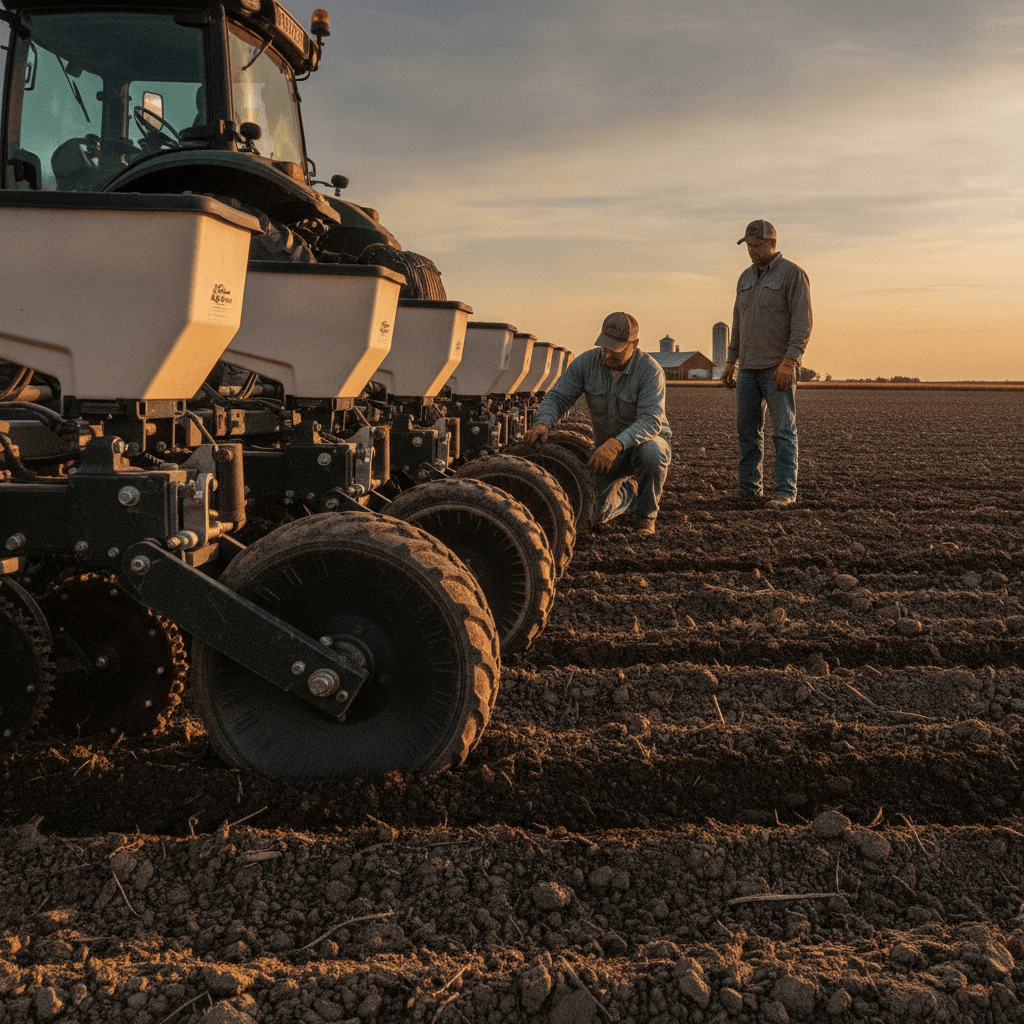
How Do Farmers Near Mitchell Choose Between Closing Wheel Systems — And Where Does the Gauge Wheel Fit Into That Decision?
Near Mitchell, South Dakota, closing wheels get most of the attention during spring planter prep. Farmers argue about spiked vs. rubber, cast iron vs. aftermarket, aggressive vs. conservative — and they’re not wrong to care. But here’s the part that often gets skipped: your closing wheel cannot fix a depth problem that started at the gauge wheel. If you’re putting money into the back of the row unit and ignoring the front, you’re spending out of order.
This article isn’t going to tell you which closing wheel to run. That’s a whole separate conversation, and honestly it depends on your soil, your tillage system, and your crop. What it will do is explain where gauge wheels fit into that system decision — and why, in the gumbo clay soils common across central and eastern South Dakota, a worn or plugging gauge wheel undoes everything else you’re trying to accomplish.
What the Gauge Wheel Is Actually Doing on Your Row Unit
The gauge wheel runs alongside the opener disk and physically limits how deep the disk cuts into the soil. It’s your depth reference point. When it’s worn, out of round, or carrying a load of mud, it can’t hold a consistent contact with the soil surface — which means your depth floats. You might be targeting 2 inches and actually planting at 1.5 inches in a dry spot and 2.75 inches in a soft spot, all in the same pass.
Inconsistent planting depth is one of the most reliable ways to lose yield before the seed even germinates. Corn and soybeans both respond to depth variation. Shallow seeds are vulnerable to early-season dry spells. Deep seeds emerge later, come up uneven, and drag down your final stand count. The closing wheel doesn’t know what depth the seed went in at — it just closes the slot. If the gauge wheel failed before that point, the closing wheel is closing a problem, not solving it.
Why Plugging Is the Gauge Wheel Problem Most Farmers Near Mitchell Hit First
Ask any farmer who works the heavier ground between Mitchell and Huron about wet spring planting, and they’ll tell you the same thing: mud management is half the battle. Central South Dakota clay doesn’t drain fast, and planting windows open before the ground is fully fit. You’re often running in conditions where mud is pulling, packing, and plugging every moving part on the planter.
Solid rubber gauge wheels — especially worn ones — are mud magnets. Once clay packs between the tire and the soil, the wheel stops rolling cleanly and starts dragging. That drag throws off depth, increases sidewall compaction, and puts more side load on the opener disk. You end up with a smeared, compacted seed furrow that no amount of closing wheel pressure is going to fix properly.
Open-spoke designs shed material better because there’s less surface area for mud to pack against and nowhere for it to build up. Jung Enterprise’s curved spoked gauge wheels are built specifically around this principle — the spoke geometry lets mud release rather than accumulate, which keeps the wheel rolling clean across passes in exactly the kind of conditions that cause problems near Mitchell in April and May.
The Closing Wheel Gap Nobody Talks About: What Happens Upstream
Here’s the content gap that most equipment manufacturers and ag suppliers skip over entirely: the closing wheel discussion almost always happens in isolation. You’ll find detailed comparisons of closing wheel styles, down-pressure settings, and soil engagement on manufacturer websites. What you won’t find is a frank conversation about how gauge wheel condition affects closing wheel performance.
Think about it this way. A good closing wheel in wet conditions is working to collapse the sidewalls of the seed furrow cleanly, press soil against the seed, and eliminate air pockets. To do that well, it needs a furrow that was opened at consistent depth with minimal smearing. If the gauge wheel was worn or plugging and the disk was cutting inconsistently, the furrow walls are already compromised. Now the closing wheel is trying to close a slot that varies in depth, width, and sidewall condition every few feet. Even the best closing wheel system struggles with that input.
Farmers who upgrade closing wheels first and don’t see the yield improvement they expected often find out later that their gauge wheels were the real limiting factor. Getting the gauge wheel right first — depth consistency, mud shedding, tire protection — sets up the closing wheel to do its job.
Tire Lip Wear: The Part of the Gauge Wheel Nobody Monitors Until It’s Too Late
Gauge wheel tires wear from the inside out in heavy soils. The tire lip — the inner edge of the rubber that contacts the furrow sidewall and the disk hub area — takes continuous abrasion from soil, grit, and metal contact. Most farmers don’t check this until they’ve already lost measurable depth control.
A steel ring mounted to the gauge wheel hub addresses this directly. It shields the tire lip from the abrasion that causes this type of wear and doubles as a built-in scraper, so mud that would otherwise pack against the tire face gets cleared with every rotation. Jung Enterprise’s patented steel ring (US Patent 11,707,013 B2) mounts with six screws and has held up to just 1/16 inch of wear after 13,000 planted acres over three years of field testing. For farmers running back-to-back seasons in South Dakota clay, that kind of durability changes the math on replacement costs significantly.
You can learn more about how the steel ring works alongside your existing gauge wheel setup at the Steel Ring product page.
Putting It Together: Building a Row Unit System That Holds Up in the Field
If you’re near Mitchell, Sioux Falls, or anywhere in central South Dakota running no-till or strip-till in heavier ground, here’s a practical way to think through your row unit system before spending money:
- Start at the gauge wheel. Check for depth variation across your planter at the end of a pass. If it’s inconsistent, the gauge wheel is the first place to look — worn tires, packed mud, or a dislodged wheel caused by a missing or failed wheel retainer.
- Assess mud management honestly. If you’re stopping mid-pass to knock mud off gauge wheels, you have a mud problem that a new closing wheel won’t solve. Open-spoke gauge wheels and steel ring scrapers address it at the source.
- Then evaluate your closing wheel setup. Once depth is consistent and mud isn’t packing on the gauge wheel, you’ll get a much more honest read on whether your closing wheel is doing its job.
- Don’t ignore the retainer. A gauge wheel that dislodges mid-pass doesn’t just cause depth problems — it can damage the row unit and costs you field time during a narrow planting window.
Frequently Asked Questions
Can I upgrade my gauge wheels without replacing the whole row unit?
Yes. Gauge wheels are a bolt-on component and most aftermarket options, including Jung Enterprise’s curved spoked gauge wheels, are designed to fit existing OEM row units across multiple planter brands and gauge wheel sizes. You don’t need a full rebuild to fix a gauge wheel problem.
How do I know if my gauge wheel or my closing wheel is causing depth variation?
Run a pass and pull seeds at multiple points along several rows. If depth varies row-to-row and pass-to-pass without a pattern, it’s usually gauge wheel wear or plugging. If depth is consistent but seed-to-soil contact is poor, look at the closing wheel setup. Both problems can coexist.
Do steel rings work on all gauge wheel tire sizes?
Jung Enterprise makes steel rings to fit the most common gauge wheel sizes used on planters and air seeders across the Northern Plains. Check the product page or contact the team directly at (605) 281-0497 to confirm fitment for your specific row unit.
Is the mud plugging problem worse in no-till vs. conventional tillage?
Generally yes. No-till fields in central South Dakota often have residue and surface moisture that conventional tillage fields don’t, and the soil surface hasn’t been disturbed to improve drainage ahead of planting. That combination puts more mud load on gauge wheels and makes open-spoke, scraper-equipped setups more valuable in those systems.
How much downtime does a dislodged gauge wheel cause during planting?
It depends on the situation, but a dislodged wheel mid-pass in a tight planting window costs you more than just the repair time — you lose the pass, potentially the day, and in some cases yield opportunity if conditions close back down. A wheel retainer is inexpensive insurance against that scenario.
If you’re running ground near Mitchell, Ipswich, or anywhere across South Dakota and Nebraska where wet springs and heavy soils are a regular part of planting, getting your gauge wheel system right before the season starts pays for itself quickly. Reach out to Jung Enterprise to talk through your specific planter setup — we’re based in Ipswich, we build these parts to work in these conditions, and we’re happy to help you figure out what actually makes sense for your operation before you spend money on the wrong fix.