
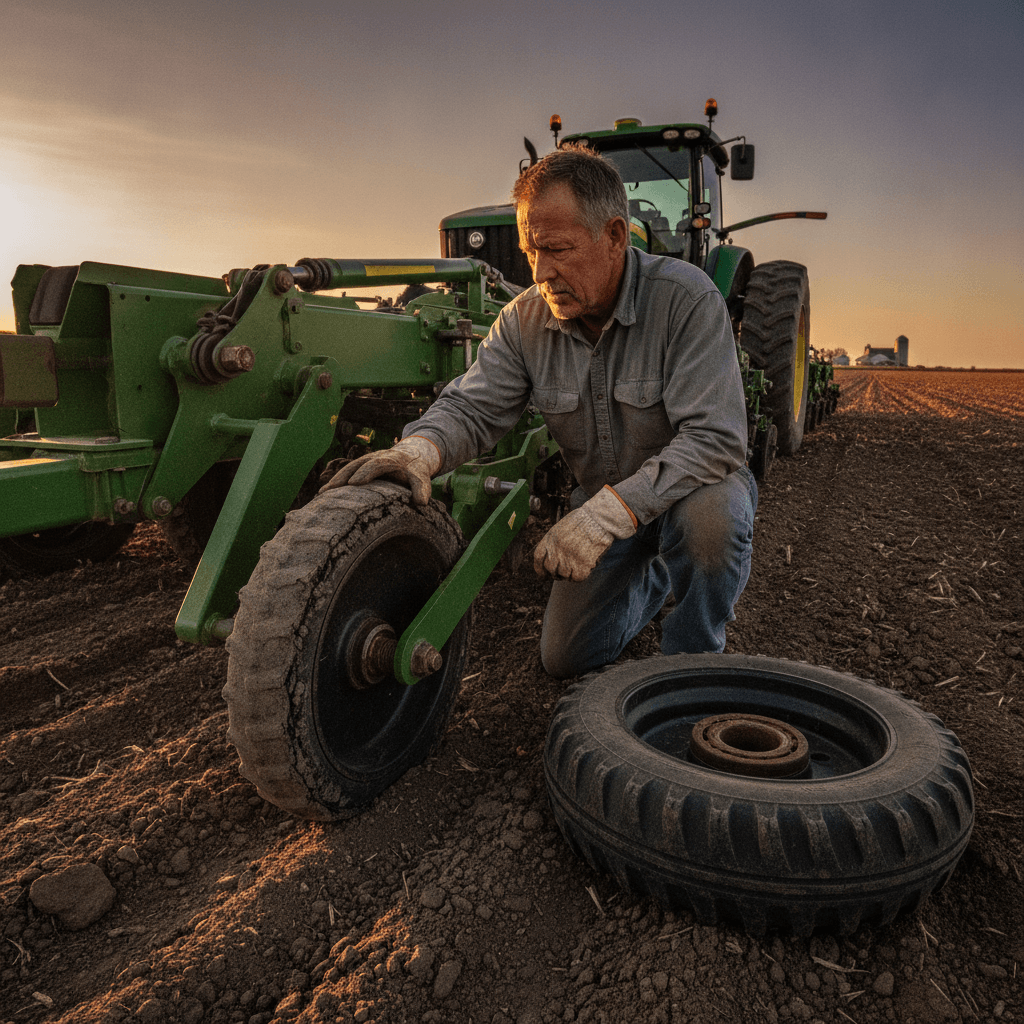
How Do Farmers Near Sioux Falls Decide Whether to Upgrade Gauge Wheels Before Planting — Or Wait Until Something Actually Breaks?
If you’re farming near Sioux Falls and wondering whether your gauge wheels have one more season left in them, here’s the honest answer: by the time you can clearly tell they’re failing, you’ve probably already lost yield. The smarter question isn’t “are they broken?” — it’s “what will they cost me when they go down in the middle of a four-day planting window?” Upgrading before you need to isn’t spending money you don’t have to. It’s insurance on the acres that actually pay your bills.
The Real Cost of Waiting Until Something Breaks
A gauge wheel doesn’t blow out like a tractor tire. It degrades slowly — the bearing gets sloppy, the tire lip starts to crack, mud starts packing into the spokes and not clearing. You’ll plant two or three hundred acres before you realize your depth control has drifted a quarter inch shallow on half your rows. By then the damage is done and you’re pulling apart a row unit in the field instead of finishing the pass.
In eastern South Dakota and into neighboring Iowa and Minnesota, planting windows in a wet spring can shrink fast. You might get five or six solid days before the next rain system moves through. A half-day of downtime to chase a gauge wheel problem isn’t just annoying — it can translate directly to lower corn or soybean populations in your worst-drained ground, which is usually the ground that was already going to give you trouble.
The farmers who come out of a rough spring in the best shape are the ones who did their maintenance in February and March, not April.
What to Actually Look for When You’re Inspecting Gauge Wheels
Most gauge wheel inspection advice you’ll find online stops at “check for cracks and bearing play.” That’s a starting point, not a complete answer. Here’s what actually matters in the field:
- Bearing slop: Grab the wheel and rock it side to side. Any noticeable lateral play is a problem. A worn bearing changes your depth consistency row to row — and you won’t see that variation until you’re pulling emergence counts.
- Tire lip condition: Look at the inside edge of the tire where it contacts the disk blade. If that lip is cracking, chunking, or visibly worn thin, your tire is losing its ability to seal the furrow wall. That’s a planting depth issue, not just a cosmetic one.
- Spoke condition and mud clearance: Solid or nearly-solid spoke designs pack in wet soils and don’t release. If you’re running solid cast wheels and farming any ground with clay content — which covers most of eastern South Dakota — you’re fighting a mud problem that’s baked into the design.
- Wheel retainer integrity: While you’re at it, check that the gauge wheel is seated securely and isn’t prone to walking off the mount. A dislodged gauge wheel mid-field is a serious operational problem, not just a wear issue.
If you’re finding two or more of these issues on the same wheel, you’re past the “watch and wait” stage.
The Gap Most Manufacturers Don’t Talk About: Proactive Upgrade vs. Reactive Replacement
Browse the product pages from most gauge wheel suppliers and you’ll see plenty of information about what their wheel is made of and how it installs. What you won’t find is a clear framework for when to replace — especially the case where your current wheels aren’t completely shot but aren’t performing the way they should either. That’s the gap that actually costs farmers money.
The answer is to think about gauge wheels the same way you think about wear parts on a combine head. You don’t run fingers until they snap off. You replace them on a schedule based on acres and conditions, not based on failure. The same logic applies here. If you’re putting in 2,000 to 3,000 acres a year on the same set of gauge wheels, you’re making a gamble that the back half of those acres will plant as accurately as the first half. That’s rarely true.
Jung Enterprise’s curved spoked gauge wheels are field-tested to show only 1/16″ of wear after 13,000 planted acres across three years. That’s the kind of durability data that actually gives you a framework for replacement intervals — not a guess.
Why the Spoke Design Matters More Than Most Farmers Realize
Open curved spokes aren’t just a style choice. In the clay and gumbo soils that show up across eastern South Dakota and into southeastern Minnesota and northeastern Nebraska, a solid gauge wheel becomes a mud paddle fast. Once mud starts packing in the wheel, it changes the effective diameter, which changes your planting depth, which directly affects seed-to-soil contact.
The curved spoke design clears mud as the wheel rotates instead of carrying it around. In a spring where you’re planting into soils that are fit but far from dry, that difference can mean the gap between consistent emergence and the kind of uneven stand you spend the rest of the season trying to manage around.
Pair that with a steel ring on the tire lip — which doubles as a built-in scraper and protects the inner tire edge from wearing against the disk blade — and you’ve got a system that stays clean and holds depth across the full planting pass, not just the first few rounds.
Pre-Season vs. Post-Harvest: When Should You Actually Buy?
The best time to upgrade is fall, right after harvest, when you’re not in a rush and parts are available. Lead times on planter components get tight in late March and early April across the Corn Belt. Farmers from Sioux Falls up through Ipswich and across into Iowa are all calling their dealers at the same time, and the parts that were sitting on shelves in October are gone.
If you missed the fall window, get your order in no later than February. That gives you time to have parts in hand, do the install, and catch any fitment issues before you’re staring down a planting date.
The full product lineup from Jung Enterprise is designed to fit multiple OEM planter brands and gauge wheel sizes, so compatibility usually isn’t the issue. It’s availability — and that’s a timing problem, not a product problem.
Frequently Asked Questions
How many acres should I expect from a set of gauge wheels before replacing them?
It depends on soil conditions and how you run your equipment, but a well-built gauge wheel in average Corn Belt conditions should hold depth performance for several thousand acres. Jung Enterprise’s curved spoked gauge wheels showed only 1/16″ of wear after 13,000 acres over three years. If your current wheels are showing bearing slop or tire lip damage well before that kind of mileage, the design or quality isn’t holding up.
Can I just replace the tire on an existing gauge wheel instead of the whole unit?
Sometimes, but not always. If the hub and bearing are still tight and the spoke structure is in good shape, a tire swap can make sense. If the bearing has play or the spokes are solid-cast and packing with mud, you’re better off replacing the whole wheel. Putting a new tire on a bad hub just delays the problem.
Do steel rings work on curved spoked gauge wheels, or only on standard wheels?
Jung Enterprise’s steel ring mounts independently on the tire lip with six screws and works alongside the gauge wheel setup to protect the inner tire edge and scrape debris. It’s a separate component from the wheel itself — you don’t have to choose one or the other. Running both together gives you the best combination of depth control and tire protection.
Will a wheel retainer actually make a difference if my gauge wheels seem secure now?
Gauge wheels that feel secure at slow speed in the shop can still walk off the mount under field conditions — especially on rough ground or in no-till where the row unit is taking more vertical shock. A wheel retainer is a low-cost part that eliminates a failure mode that’s completely avoidable. It’s worth adding when you’re already doing the upgrade.
Where can I get these parts near Sioux Falls or ship to South Dakota?
Jung Enterprise is based in Ipswich, South Dakota and ships across the region — including to farmers in Sioux Falls and surrounding areas. You can reach out directly to discuss your planter setup, gauge wheel size, and what fits your equipment before you order.
Ready to Stop Gambling on Last Year’s Gauge Wheels?
If you’ve got a planting season coming up and you’re not confident your gauge wheels will hold depth from the first pass to the last, now is the time to act. Jung Enterprise builds patented, American-made gauge wheels, steel rings, and wheel retainers that are field-tested in the same soils and conditions you’re dealing with across South Dakota and the Northern Plains.
Contact the team at Jung Enterprise at (605) 281-0497 or email help@jungenterprise.net to talk through your setup. Or reach out through the contact page and someone will get back to you directly — no automated runaround, no sales scripts. Just straight answers from people who know planters.