
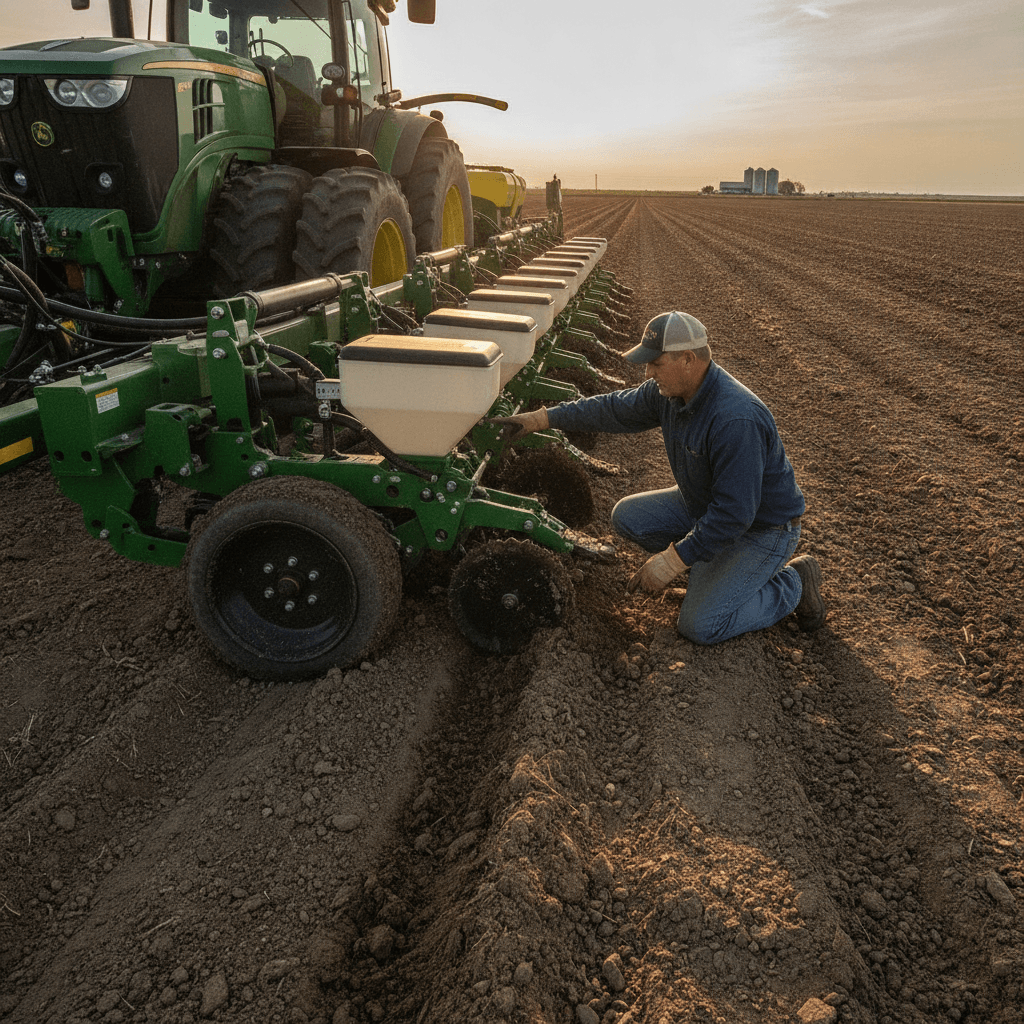
How Do Farmers Near Sioux Falls Know Whether Their Planter’s Row Units Are Applying Consistent Down Pressure — And Why Gauge Wheels Are the First Place to Check
If you’re farming near Sioux Falls and you’ve ever pulled up a stand map that looked like it was planted by two different people on two different days, inconsistent row unit down pressure is likely part of the problem. And before you start chasing springs, hydraulics, or pneumatic settings, the first thing worth looking at is your gauge wheels — because worn, plugged, or wobbling gauge wheels undermine depth control whether your down force numbers look right on the monitor or not.
Down Pressure Doesn’t Work If the Gauge Wheel Can’t Do Its Job
Here’s the thing most planting equipment content misses: down pressure and depth control are two separate problems that work together. You can dial in the right amount of force pushing your row unit into the soil, but if the gauge wheel riding next to your disc opener is worn down, caked with mud, or wobbling on a loose axle, that force isn’t translating into consistent seed depth. The gauge wheel is the physical contact point that sets depth. If it’s not riding level and clean against the trench wall, your 2-inch target becomes somewhere between 1.5 and 2.75 inches depending on field conditions — and that’s yield leaving on the table before the seed even germinates.
In the fields east of Sioux Falls and into southwest Minnesota and northwest Iowa, spring soils can shift fast. One morning you’re planting into ideal conditions, and by afternoon you’re in a stretch of heavier clay that wants to stick to everything. That’s exactly when a gauge wheel with a solid or partially worn face starts carrying a mud pack between passes, effectively changing your working diameter and throwing off depth — even with consistent down pressure applied.
What to Actually Check Before You Call It a Down Pressure Problem
Before adjusting any spring or hydraulic setting on your row units, run through this quick gauge wheel inspection on a few representative rows across the planter:
- Check for radial wobble. Grab the gauge wheel and push it side to side. Any slop in the bearing means the wheel isn’t riding square against the disc opener. Wobble translates directly to depth variation, even with correct down force.
- Check the tire lip. Run your hand around the inside edge of the gauge wheel tire. A chipped, cracked, or worn tire lip means the wheel isn’t seating flush against the disc opener — and your depth reference point is already gone. This is the wear point that gets skipped most often during pre-season inspection.
- Check for mud packing between spokes. If your gauge wheels have solid faces or even lightly spoked designs, look for compacted soil between the spokes. Mud that doesn’t shed during planting raises the effective diameter of the wheel and tells your row unit it’s deeper than it actually is.
- Check that the wheel is fully seated and retained. A gauge wheel that’s slightly dislodged from its axle seat — but not fully fallen off — can bounce under load. You won’t always see it walking down the row, but it shows up as random depth misses in your emergence data.
The Gauge Wheel Gap That Competitor Content Doesn’t Cover
Most planter parts content — whether it’s from equipment manufacturers or ag retailers — spends a lot of time talking about gauge wheel materials, bearing specs, and compatibility charts. What’s rarely discussed is the cumulative effect of multiple small failures happening at once across a 16- or 24-row planter. A wheel with a worn tire lip on row 4, a mud-packed face on row 11, and a loose bearing on row 17 won’t fail dramatically. You won’t blow a tire or lose a wheel mid-field. What you’ll get instead is a stand that looks slightly off for reasons that don’t point cleanly to any one cause — and a yield drag you can’t fully explain at the elevator.
That’s the real cost of marginal gauge wheel condition, and it doesn’t get enough attention anywhere in the industry. The answer isn’t buying new wheels every season. It’s using parts that stay consistent longer and actually protect the contact points that matter.
How Steel Rings Address the Tire Lip Problem Specifically
The tire lip — the inside bead of your gauge wheel tire — is the point that presses against the disc opener to set seed depth. It’s also the point that takes the most abuse from soil abrasion, debris, and repeated flex cycles across rocky or cloddy ground. When it wears, your depth reference wanders. When it chips or cracks, it opens gaps that let soil bridge incorrectly between the wheel and the opener.
Jung Enterprise’s patented Steel Ring (US Patent 11,707,013 B2) mounts directly to the gauge wheel with six screws and protects the tire lip from that abrasion while also functioning as a built-in scraper — so you’re not bolting on a separate scraper assembly and hoping everything clears. In field testing across 13,000 planted acres over three years, wear measured at just 1/16 of an inch. That’s the kind of consistency that keeps your depth reference stable from the first row of planting season to the last.
For farmers near Sioux Falls dealing with mixed soil types — from the heavier gumbo stretches in lower fields to sandier ground on the rises — that durability matters more than it might on uniform ground. You need a wheel that performs the same way in both conditions without requiring mid-season maintenance or adjustment.
Open-Spoke Design and Why It Matters for Down Pressure Consistency
When mud packs between gauge wheel spokes, the effective working diameter of the wheel increases. That means your row unit reads the soil surface as being higher than it actually is and reduces down pressure contact accordingly — at exactly the moment when conditions are asking for more, not less. Curved spoked gauge wheels are designed to shed mud rather than collect it, which keeps the working diameter consistent pass after pass. It sounds simple, but it’s the difference between a gauge wheel that performs the same in row 1 as it does in row 300 versus one that’s carrying a pound of South Dakota clay by the time you turn around at the end of the field.
Frequently Asked Questions
Can worn gauge wheels cause down pressure readings to look correct even when they’re not?
Yes. Down pressure sensors and monitors measure force applied, not actual seed depth. A worn or mud-loaded gauge wheel will distort the depth the unit is actually achieving regardless of what the monitor reports. That’s why a physical inspection of gauge wheel condition is essential before trusting your monitor data.
How do I know if my gauge wheel tire lip is worn enough to affect depth?
If you can see visible chipping, cracking, or a visibly rounded profile on the inside bead of the tire, it’s worn enough to affect depth consistency. If you’re unsure, compare it against a new wheel or contact Jung Enterprise for a straight answer on what acceptable wear looks like.
Do Jung Enterprise gauge wheels and steel rings fit my planter brand?
Jung Enterprise products are designed to fit multiple OEM gauge wheel sizes and brands across planters, air seeders, and no-till drills. Check the products overview page or call (605) 281-0497 to confirm fitment for your specific equipment.
If I fix my gauge wheels, do I still need to adjust down pressure settings?
Possibly. Once your gauge wheels are in proper condition, you may find your current down pressure settings were compensating for the wheel’s inconsistency. After installing new or refurbished gauge wheels, re-check depth in the field before committing to full-speed planting. Let the equipment tell you what it needs once the contact point is reliable again.
How early should I be inspecting and ordering gauge wheel parts before planting season?
For farmers near Sioux Falls and across South Dakota, February through early March gives you enough lead time to inspect, order, and install before the ground is ready to plant. Waiting until April puts you at risk of shipping delays — and a short planting window doesn’t care about backorder timelines.
The Bottom Line
If your planter’s down pressure system isn’t delivering the stand consistency you’re expecting, don’t reach for the settings before you’ve walked the gauge wheels. Worn tire lips, mud-packed faces, loose bearings, and unseated wheels all corrupt depth control at the source — before down pressure even has a chance to do its job. Getting those contact points right is the foundation everything else builds on.
Jung Enterprise builds American-made, patented gauge wheel protection and replacement parts out of Ipswich, SD, for exactly these conditions. If you want to know whether your equipment is set up to plant a consistent stand this season, reach out to us directly — we’ll give you a straight answer, not a sales pitch.