
How Do No-Till Farmers Near Ipswich Know Whether Their Planter’s Steel Ring Is Actually Surviving the Transition From Fall Tillage to Full No-Till — Or Wearing Out Faster Than Expected?
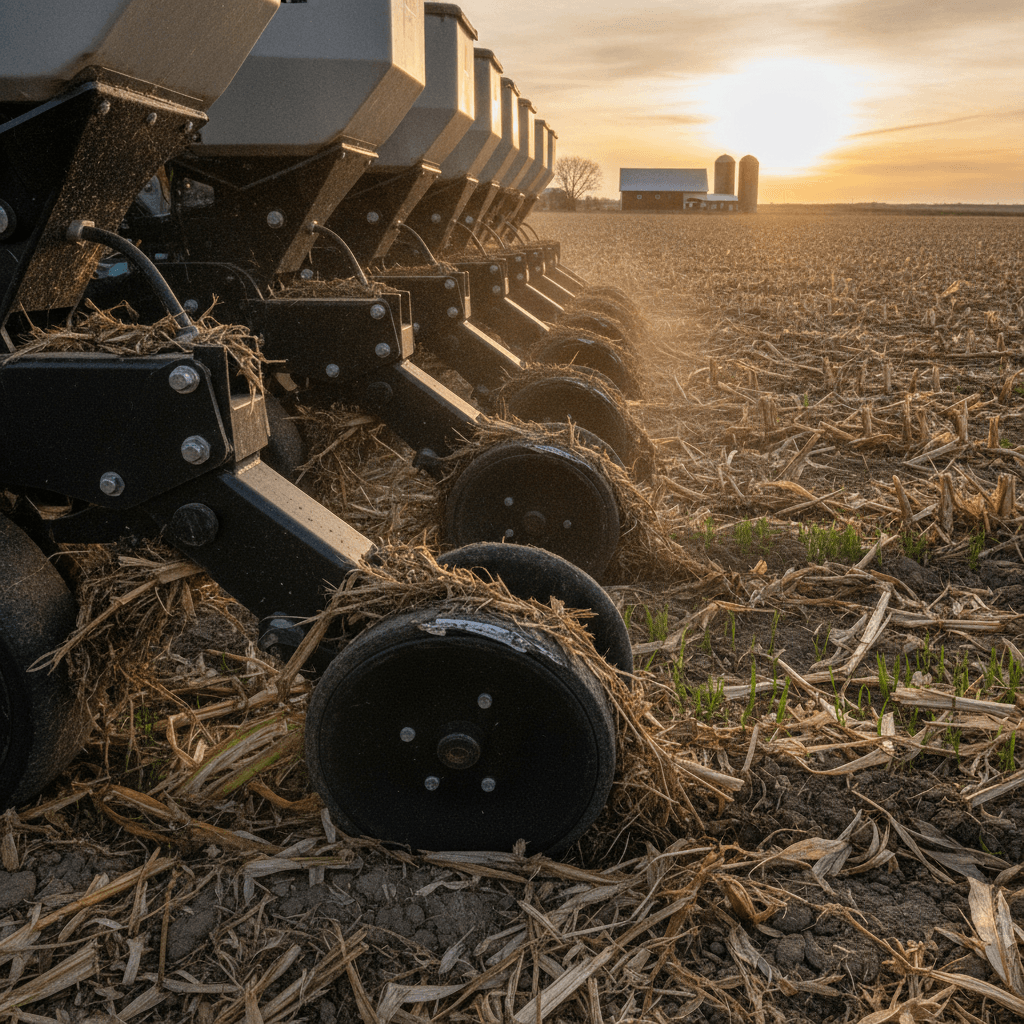
The short answer: most of them don’t — not until something’s visibly wrong or the tire lip is already chewed up. When you’re running conventional or strip-till, your gauge wheels are rolling through loosened soil with predictable resistance. The minute you go full no-till, you’re asking those same wheels to push through undisturbed crop residue, hard surface soil, and in wet springs, mud-packed trash that grinds against the tire lip on every single row unit, every single pass. That’s a fundamentally different demand. And the hardware that handled one situation fine can fail faster than you’d expect in the other.
If you’re farming near Ipswich, Aberdeen, or anywhere across the Northern Plains where full no-till adoption is accelerating, this is worth understanding before planting season — not after.
What Changes When You Go No-Till
In a tilled field, the soil surface is broken up before your planter even touches it. Gauge wheels are rolling through a prepared seedbed. There’s still wear, but it’s relatively even and slower. In a no-till field, especially in a corn-on-corn or soybean-after-corn rotation with heavy standing residue, you’re dealing with two problems at once:
- Abrasive contact: Corn stubble, root crowns, and hard soil surface create constant abrasive contact along the bottom and sides of the gauge wheel tire lip — exactly where the tire is most vulnerable to cracking and deformation.
- Debris packing: Residue and mud pack into the gap between the gauge wheel tire and the disk opener. If there’s nothing stopping that buildup, you end up with a plugged row unit that’s either riding on packed trash or not riding on anything consistent at all. Depth goes out the window.
Neither of these problems shows up the first day. They compound over a planting season. By the time you’re pulling the planter in at the end of May, you may have 20,000 acres of wear on a tire lip that was only designed to handle maybe a third of that kind of punishment.
Why This Is a Gap That Most Gauge Wheel Content Doesn’t Address
If you’ve been researching gauge wheel parts online, you’ve probably noticed that most manufacturers — whether it’s a larger Midwest competitor or a regional ag parts supplier — talk about wear in general terms. “Durable.” “Long-lasting.” “Field-tested.” What they rarely tell you is how that durability changes depending on tillage system. A part rated for excellent performance on a conventional planter may not hold up as well when you put it into a no-till operation with heavy corn residue. The abrasion profile is different. The debris management demands are different.
That’s not a small caveat. For farmers in South Dakota and across the Northern Plains who are mid-transition into no-till — or who are running a mix of no-till fields and minimally-tilled ground — it matters a lot which parts you’re putting on your planter.
What the Steel Ring Actually Does in a No-Till Environment
Jung Enterprise’s steel ring was designed with this kind of wear in mind. It wraps around the outer tire lip of the gauge wheel and does two things that are especially relevant in no-till conditions:
- It protects the tire lip from direct abrasive contact. Instead of the rubber edge of the tire grinding against residue, hard soil, and the disk blade, the steel ring takes that contact. Steel holds up against that kind of abrasion far longer than rubber does.
- It acts as a built-in scraper. That’s not a separate accessory — it’s part of the ring itself. In no-till fields with heavy residue and wet spring soil, that matters. Mud and debris that pack into the disk-to-gauge-wheel interface get pushed out instead of piling up. You keep consistent contact with the soil and consistent planting depth without stopping to hand-clean row units.
The ring mounts with six screws and fits over your existing gauge wheel. No retrofitting. No fabrication. And because it’s patented American-made hardware (US Patent 11,707,013 B2), there’s an actual engineering standard behind the fit and function — not just a generic fit-and-hope design from an overseas supplier.
The durability numbers are real and documented: 1/16 inch of wear after 13,000 planted acres over three years. That’s not a number pulled from a lab test. That’s field-measured, in actual planting conditions, across real ground. For a farmer near Huron or Brookings running 2,000 to 3,000 acres a season in a no-till system, that translates to multiple seasons of use before you’re looking at replacement.
What to Check If You’re Mid-Transition Right Now
If you switched part or all of your acres to no-till in the last one to two years and haven’t looked closely at your gauge wheel tire lips since, here’s what to actually check:
- Run your hand along the outer edge of the tire lip on each row unit. If you feel cracking, deformation, or material missing from the edge, that tire is already losing its ability to maintain consistent depth.
- Look at how much debris is packed between the gauge wheel and the disk blade after a field pass. If you’re cleaning that out by hand more than once a day, your current setup isn’t managing residue on its own.
- Compare depth across row units after a no-till pass. If outer rows and middle rows are planting at different depths, the issue may not be down pressure — it may be uneven tire lip wear causing inconsistent gauge wheel contact.
None of this requires a dealer visit to check. You can evaluate it yourself in the shop or at the edge of the field. The question is whether you’re looking before season starts or after the problem has already cost you stand uniformity across several hundred acres.
Timing and the No-Till Planting Window
In the Northern Plains, the planting window for corn and soybeans is already compressed. A wet April or early May turns that window into a sprint. If your gauge wheels are plugging in residue or losing depth consistency because of tire lip wear, you don’t have extra days to troubleshoot it. You need equipment that’s going to run clean from the first field to the last.
That’s the honest case for addressing this before you need it — not as a sales pitch, but as a practical reality of what no-till farming across South Dakota actually looks like in a wet spring. Farmers near Ipswich know this well. A few bad planting days can mean the difference between a timely stand and a replant decision.
If you’re evaluating what your planter needs going into next season, the full product lineup at Jung Enterprise covers gauge wheel protection and depth control across planters, air seeders, and no-till drills — all designed with the conditions you’re actually dealing with in mind.
Frequently Asked Questions
Does the steel ring work on no-till drills, or just planters?
It’s designed to work on planters, air seeders, and no-till drills. If your no-till drill uses gauge wheels with a compatible tire lip, the ring installs the same way and provides the same protection against residue abrasion and debris packing.
If my gauge wheels are already worn from a previous conventional season, do I need new wheels before installing the steel ring?
It depends on how much tire lip is left. If the rubber is cracked or significantly deformed, the ring won’t restore what’s already gone. In that case, replacing the gauge wheel first and then installing the ring gives you the best baseline going into a no-till operation.
How does the built-in scraper on the steel ring compare to bolt-on scraper accessories sold separately?
The main advantage is that it’s one part, not two. Separate scraper accessories can shift, loosen, or work out of adjustment over the course of a planting season — especially in heavy residue conditions. Because the scraper function is built into the steel ring itself, there’s nothing additional to adjust or lose alignment on.
Do I need to re-torque the six mounting screws during the season?
It’s good practice to check hardware after the first few hundred acres of any new installation. After that, the ring runs without significant maintenance. Checking at mid-season or during a scheduled stop is reasonable, but it’s not a daily maintenance item.
Is the steel ring compatible with gauge wheels from multiple OEM brands?
It fits across multiple gauge wheel sizes and OEM brands. If you’re running a mix of equipment or upgrading one machine at a time, it’s worth confirming your specific gauge wheel dimensions before ordering. Contact Jung Enterprise directly with your equipment specs to confirm fit.
If you’re in the middle of evaluating your planter setup for a no-till transition — or you’ve already made the switch and want to know whether your current parts are holding up — reach out to Jung Enterprise directly. We’re based in Ipswich and work with farmers across South Dakota, North Dakota, Minnesota, Nebraska, and the broader Northern Plains. Contact us here to ask about fit, compatibility, or what makes sense for your specific operation before planting season.