
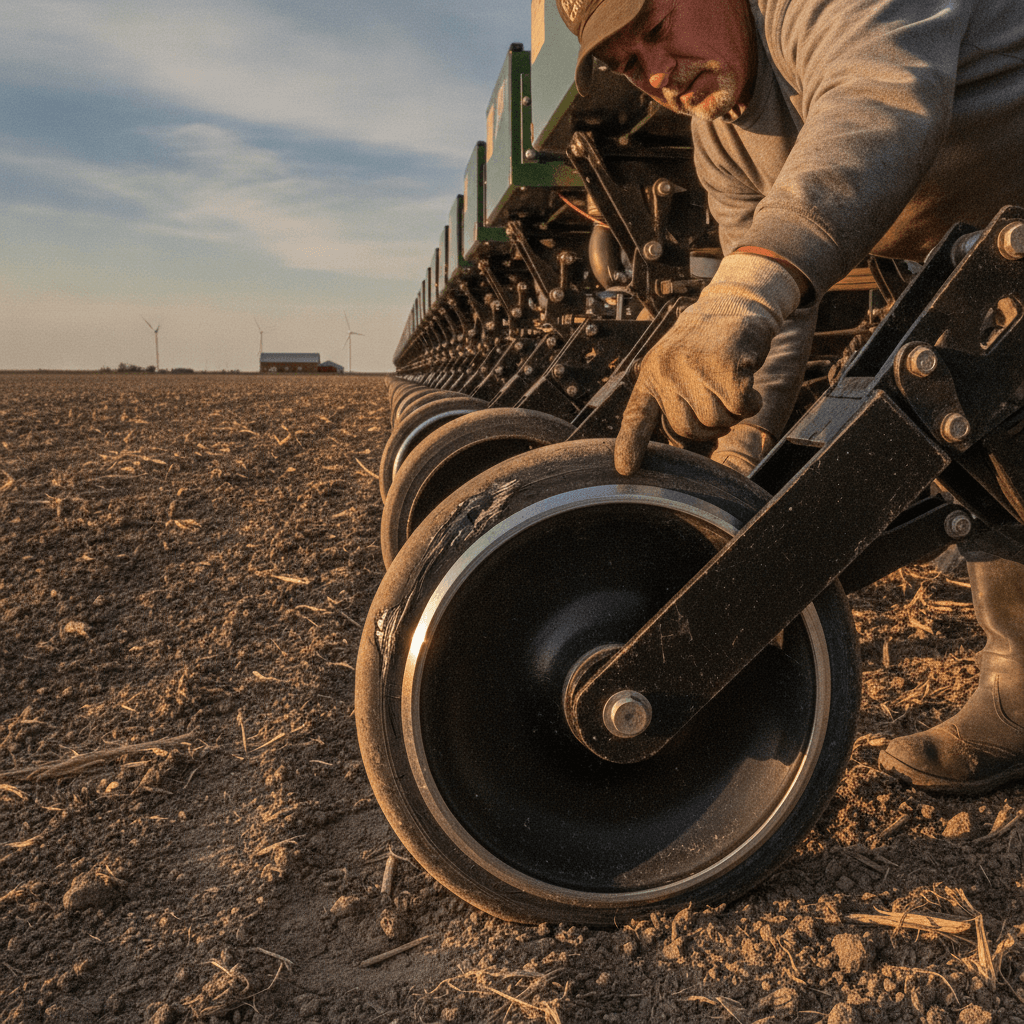
How Do Farmers Near Aberdeen Know Whether Their Planter’s Steel Ring Is Actually Mounted Correctly — Or Just Tight Enough to Cause Problems Later?
If you’re farming around Aberdeen, South Dakota and you’ve put a steel ring on your planter’s gauge wheels, there’s a good chance you did it right. But there’s also a real chance that it’s snugged down just enough to feel secure — without actually sitting where it needs to be. That gap between “installed” and “installed correctly” is where farmers lose gauge wheels mid-season, watch scrapers stop scraping, and end up pulling a planter out of the field during a window they can’t afford to lose.
This article covers what proper steel ring installation actually looks like, what goes wrong when it’s done halfway, and how to check your setup before planting starts — not after you’ve already put in 500 acres and something starts wobbling.
Why Installation Quality Matters as Much as the Ring Itself
Most of the conversation around steel rings focuses on material, durability, and whether the scraper design actually sheds mud. That’s all fair ground. But one topic that almost never comes up — even on competitor sites — is installation error. A ring made from quality steel, designed to protect the tire lip and built with a scraper integrated into the same part, still fails if it’s not seated and fastened correctly.
The Jung Enterprise Steel Ring mounts using six screws, which gives you even clamping force around the full circumference of the gauge wheel. That’s not just a convenience feature — it’s the reason the ring stays concentric under load. When all six screws are torqued evenly, the ring sits flush against the tire lip and the scraper maintains consistent contact with the gauge wheel surface. When one or two screws are undertorqued, or when the ring is seated on a dirty or damaged lip before fastening, you get uneven clamping. The ring shifts. The scraper migrates. And you’re back to mud buildup within a field or two.
The Most Common Mounting Mistakes Farmers Don’t Catch Until It’s Too Late
- Not cleaning the tire lip before installation. Dried mud, old rubber oxidation, or debris from last season sitting on the lip creates a false seating surface. The ring appears flush but isn’t. Once it’s under field load and heat cycles, it walks.
- Uneven screw torque. Going around the ring in order and stopping when it feels tight is not the same as checking torque consistently. The soft spots flex. The ring loosens on one side while staying tight on the other. That’s how you get wobble and scraper drift after a few hundred acres.
- Skipping the final check after the first field. A new installation settles. Screws that felt snug in the shop can back off slightly once the ring has gone through real field stress — especially in heavier soils. A quick walk-around after the first pass doesn’t cost you anything. Losing a ring at acre 400 in a gumbo field does.
- Installing on a gauge wheel tire that’s already worn or deformed. A ring designed to protect a round tire lip can’t compensate for a tire that’s already cupped or split. If the tire is worn out, put the ring on a new tire. Don’t try to save a dead tire with a steel ring.
What Correct Installation Actually Looks Like
When a Jung Enterprise Steel Ring is properly installed, the ring sits evenly around the full outer lip of the gauge wheel tire. There’s no visible gap between the ring and the tire bead at any point. The scraper — built directly into the ring — maintains consistent contact with the gauge wheel face without requiring adjustment. You shouldn’t need to add a separate scraper bracket or shim anything to make it work. That’s what the patented design (US 11,707,013 B2) is built to do: one part, doing two jobs, installed once.
After tightening all six screws, spin the gauge wheel by hand. It should rotate smoothly without the ring dragging or clicking. If you hear a click or feel a catch, a screw may be proud of flush, or the ring isn’t fully seated on one side. Fix it now, not when you’re in a field outside Aberdeen with 12 more rows to go.
Why This Gap Exists in the Competitor Coverage
Browse through the major steel ring and gauge wheel suppliers — Yetter, Schaffert, Copperhead Ag, Exapta — and you’ll find product specs, field comparisons, and compatibility charts. What you won’t find is much practical guidance on installation verification. There’s an assumption that if you’ve bolted something on before, you know how to bolt this on. That assumption costs farmers every spring.
At Jung Enterprise, we’re based in Ipswich and we talk to farmers across South Dakota, North Dakota, and into Minnesota regularly. The installation question comes up more than most people admit. It’s not that farmers don’t know how to wrench — it’s that a new part on a familiar machine can get treated like a routine swap when it actually warrants a fresh look at process.
Field-tested results don’t happen by accident. The 1/16″ of wear over 13,000 planted acres we’ve measured across three years came from rings that were installed correctly and checked. That durability number assumes the ring is doing its job from the first acre, not catching up after a loose installation gets corrected at row 200.
Pre-Season Checklist for Aberdeen-Area Farmers
Before you roll out of the shed for the first time this spring, run through these on every row unit with a steel ring:
- Confirm all six mounting screws are present and tightened evenly — not just snug, evenly torqued
- Spin the gauge wheel by hand and listen for drag or clicking
- Visually check the ring-to-tire lip gap all the way around — no visible daylight anywhere
- Confirm the scraper is positioned flush against the gauge wheel face, not cocked to one side
- Check the gauge wheel tire condition — a ring on a worn tire is not a solution
- After your first field pass, re-check screw torque on every unit before the next run
This takes maybe 20 minutes across a full planter. It’s cheap insurance compared to losing a ring or a gauge wheel in a field of gumbo clay an hour outside of Aberdeen when the forecast is closing in.
If you haven’t already looked at the full product lineup from Jung Enterprise, including the Curved Spoked Gauge Wheels and Wheel Retainer, it’s worth a few minutes. These parts are designed to work together, and getting the full setup right from the start is a lot easier than troubleshooting one piece at a time mid-season.
Frequently Asked Questions
Can I install a Jung Enterprise Steel Ring myself, or does it need a dealer?
You can install it yourself. The six-screw mount is straightforward if you’ve done basic planter maintenance. The key is following the torque sequence and doing a post-first-field check — not just installing it and assuming it’s set for the season.
What happens if I install the ring on a gauge wheel with a slightly worn tire lip?
If the tire lip is worn enough to affect seating, the ring won’t clamp evenly and you’ll get movement under load. Inspect the tire lip before installation. If it’s cracked, deformed, or the bead area is compromised, replace the tire first.
How do I know if my steel ring has shifted after a few fields?
Check for mud buildup on the gauge wheel face — if the scraper has migrated out of position, it’ll show up as mud accumulation in the area where it should be scraping. Also re-check screw torque. A loose screw early on is a warning sign the ring wasn’t fully seated from the start.
Does the Jung Enterprise Steel Ring fit all gauge wheel sizes?
The steel ring is designed to fit multiple gauge wheel sizes across common planters, air seeders, and no-till drills. Contact Jung Enterprise directly to confirm fitment for your specific equipment before ordering.
How soon after installing should I do a post-field check?
Do it after your first full field pass, before you go back out. New installations settle under real-field load. A 10-minute check at that point catches anything that needs a quarter-turn of torque — and saves you from a bigger problem later in the season.
Get It Right Before the Season Starts
If you’re near Aberdeen and you’re prepping for planting, or if you’re coming off harvest and thinking about upgrading your gauge wheel setup before next spring, reach out to Jung Enterprise in Ipswich. We can walk you through fitment, installation specifics, and what to expect in your soil conditions. Don’t leave it until the first warm week in April when everyone needs parts at once. Contact Jung Enterprise here and let’s get your planter squared away the right way.