
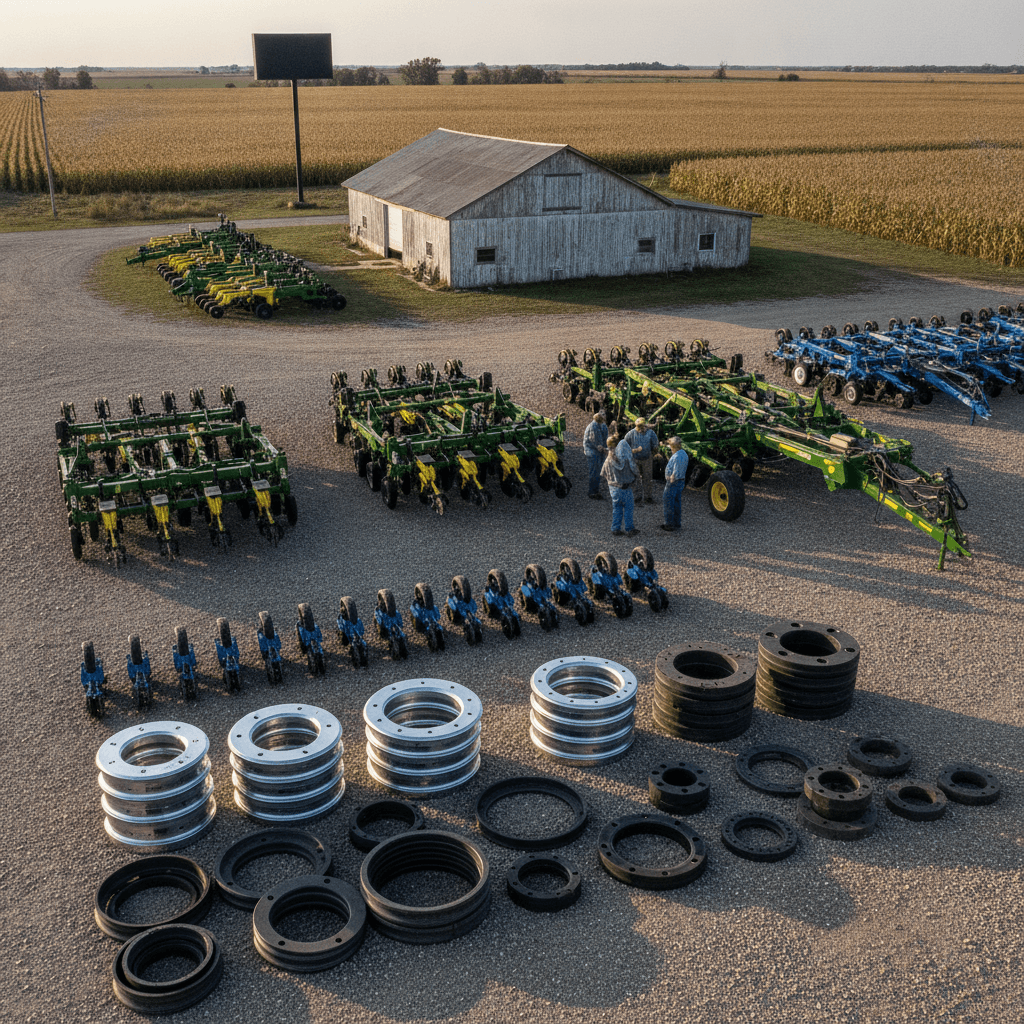
What Do Ag Dealers Near Pierre Actually Need to Know Before Adding Gauge Wheel Parts to Their Lineup?
If you run an ag dealership near Pierre and a farmer walks in during the second week of May asking for a gauge wheel that fits his John Deere 1775, the wrong answer is “we can order that.” Planting season doesn’t wait. The question of whether to stock gauge wheels, steel rings, and wheel retainers isn’t just about margin — it’s about whether your customers can count on you when the window is open and the field is ready. Here’s what actually matters when you’re evaluating these parts for your shelf.
Why Dealers Across South Dakota Are Taking a Second Look at Planter Gauge Wheel Parts
The Corn Belt has pushed further into the Northern Plains over the last two decades. Corn and soybeans are common now in areas that weren’t planting row crops at scale a generation ago. That means more planters, more air seeders, and more no-till drills running across central and eastern South Dakota — and more gauge wheel wear, more plugging complaints, and more calls to dealers trying to source replacement parts fast.
The problem is that most of the major competitors in this space — the Yetters and Schafferts of the world — are built around their own product ecosystems. Their content is geared toward farmers who already know what brand they’re buying. What’s missing is a dealer-focused breakdown of what actually separates the products, what questions your customers are going to ask, and what to expect from a parts supplier in terms of compatibility, durability, and support.
That’s the gap this article is meant to fill.
Compatibility: The First Question Your Customers Will Ask
Before you commit shelf space to any gauge wheel product, you need to know what it fits. The planters running in your area are not all the same. Central South Dakota has a mix — older John Deere 7000s still pulling through fields, newer 1775NTs, Case IH Early Riser planters, Kinze, White, and plenty of air seeders running out of North Dakota and Nebraska influence as you move toward the state borders.
Jung Enterprise’s curved spoked gauge wheels and steel rings are designed with multi-brand compatibility in mind. That matters for your counter — you don’t want to stock something that only fits two planter models. Ask any supplier you’re evaluating for a clear compatibility chart before you write a purchase order.
The wheel retainer is a slightly different story. It’s a simpler part — its job is to keep the gauge wheel from dislodging off the planter or air seeder during operation. But simple doesn’t mean unimportant. A gauge wheel that comes off in the middle of a field creates immediate downtime and a potential safety issue. Dealers who stock wheel retainers as a bundled add-on to gauge wheel sales are doing their customers a real service.
What Durability Actually Looks Like — Not What the Brochure Says
Every supplier will tell you their part is tough. Here’s a number that means something: Jung Enterprise’s steel rings showed only 1/16″ of wear after 13,000 planted acres over three years of field testing. That’s not a lab spec — that’s real wear measurement in real field conditions.
For your customers, that translates directly into fewer replacements and less mid-season scrambling. For you as a dealer, it means less warranty headache and more customers who come back because the part actually worked.
The steel ring itself does two things that separate it from basic gauge wheel covers: it protects the tire lip from the wear and damage that comes from running through heavy soils and residue, and it acts as a built-in scraper that knocks mud and debris off the wheel as it rotates. One part, two functions. In wet spring conditions — which anyone farming near Pierre knows well — that scraper function is not a nice-to-have. It’s what keeps the gauge wheel doing its job instead of balling up with mud and riding on top of the soil.
The steel ring mounts with six screws and carries two active U.S. patents (US 11,707,013 B2 and related patents). If a customer asks whether it’s an engineered solution or just a steel band, you have a real answer.
The Margin Question: What Dealers Rarely Talk About Openly
Gauge wheels are not high-glamour inventory. They don’t move the way a new planter does. But they move consistently — every season, before planting and sometimes during — and they carry decent margin for the shelf space they take up.
The more important margin question isn’t unit price, it’s return rate. A cheaper part that comes back as a warranty claim or that your customer blames for a bad plant stand is a cost that doesn’t show up in your initial margin calculation. American-made parts with real field documentation behind them tend to stay sold.
Jung Enterprise is a family-owned manufacturer based in Ipswich, South Dakota — not an import distributor putting a house brand on overseas parts. That distinction matters to the farmers you serve, and it matters to the story you get to tell when someone asks where the part comes from. See more about the company background at the Jung Enterprise about page.
Stocking Strategy: What Sells and When
If you’re near Pierre and you want to time your inventory well, the pattern is fairly predictable. Demand spikes February through April as farmers are prepping equipment ahead of planting. There’s a second wave in September through November — post-harvest, when farmers are assessing what wore out and planning ahead. The worst time to be out of stock is late April or early May when someone needs a part to finish a planter pass.
Gauge wheels and steel rings are the volume movers. Wheel retainers are a lower-velocity part but worth carrying as an add-on — farmers who are already buying a gauge wheel should be buying a retainer at the same time, and most don’t think to ask. That’s a conversation you can have at the counter that adds value for them and adds to your ticket.
If your customer base includes custom planting operations or no-till farmers running air seeders into North Dakota or Minnesota, open-spoke gauge wheel designs that shed mud become a more active conversation. The curved spoked design handles wet soils differently than solid wheels — there’s less surface area for mud to cling to, which means less plugging and more consistent depth control across a field pass.
What to Ask a Supplier Before You Sign On
Not all gauge wheel suppliers are set up to work with dealers the way they should be. Before you commit to carrying any line, get clear answers on these:
- What’s your lead time on restocks? Two weeks during planting season is too long.
- What compatibility documentation do you provide? You need to be able to answer fitment questions at the counter without calling the manufacturer every time.
- What’s your warranty policy? And is it the kind that gets resolved or the kind that gets argued?
- Is the product patented and American-made? Your customers will ask, and so will your competitors if you’re the dealer who stocks it.
- Do you have field test data? Brochure specs and actual wear data are different things.
Jung Enterprise can answer all of these. You can review the full product lineup or reach out directly to talk through what makes sense for your dealership’s customer mix.
FAQ: Ag Dealers Near Pierre Considering Gauge Wheel Parts
Do I need to stock all three products — gauge wheels, steel rings, and wheel retainers — or can I start with one?
You can start with gauge wheels and add from there. Steel rings are a strong second add because they protect gauge wheel tires from the exact wear your customers are already coming in to replace. Wheel retainers are a natural bundle with any gauge wheel sale.
How do I know which gauge wheel sizes to stock for my area?
That depends on the planters and air seeders your customers are running. Contact Jung Enterprise with a general breakdown of the equipment brands in your customer base and they can help you identify the sizes that will move.
Are these parts compatible with air seeders, or just row crop planters?
Both. Jung Enterprise’s products fit planters, air seeders, and no-till drills across multiple OEM brands. That matters in central South Dakota where a lot of operations run both planters and drills depending on the crop year.
What’s the honest durability comparison versus OEM gauge wheels?
OEM parts are designed to fit and meet baseline specs. Jung Enterprise parts are designed to outlast OEM in field conditions — the 1/16″ wear measurement over 13,000 acres in three years is the benchmark. That’s significantly less wear than most farmers see from stock gauge wheels under the same conditions.
Does Jung Enterprise work with dealers directly, or only sell to farmers?
Jung Enterprise works with both farmers and dealers. If you’re near Pierre and want to talk about carrying their line, direct contact is the right starting point — they’re a South Dakota manufacturer that understands regional dealer relationships.
Ready to Talk About Stocking Jung Enterprise Parts?
If you’re an ag dealer near Pierre — or anywhere across South Dakota, North Dakota, Minnesota, Iowa, or Nebraska — and you want to add a proven gauge wheel line to your inventory, Jung Enterprise is worth the conversation. They’re based in Ipswich, they build American-made patented parts, and they’ve got the field test numbers to back up what they sell. Reach out through the contact page to ask about dealer pricing, compatibility, and what makes sense for your customer base.