
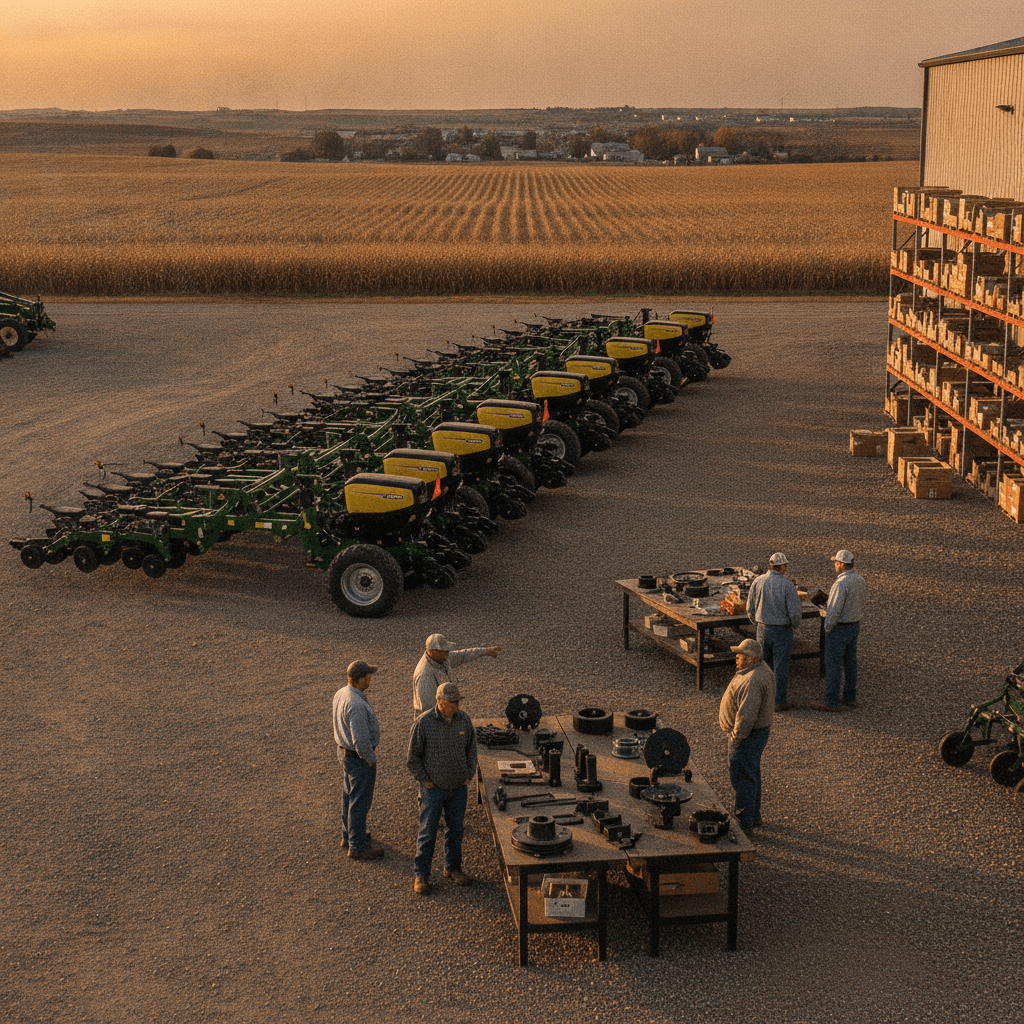
How Do Ag Dealers Near Sioux Falls Know Whether Their Gauge Wheel Inventory Is Actually Matched to What Local Farmers Are Running — Or Just Taking Up Shelf Space?
If you’re an ag dealer or distributor near Sioux Falls, here’s a problem that probably sounds familiar: a farmer walks in or calls during the first week of planting, needs a gauge wheel or steel ring for his planter, and you either don’t have it or you have something close — but not quite right. He drives two hours to find the part, or he orders online and waits four days. Either way, you lost that sale and probably some goodwill along with it.
Stocking the wrong gauge wheel parts isn’t just a cash flow problem. In a region where the planting window can be as short as ten days before soil conditions turn against you, a dealer who has the right part on the shelf is worth a lot more to a farmer than one who has to order it in. This guide is specifically written for dealers and distributors — not the farmer doing the planting, but the business selling to him. It covers how to figure out what your local market is actually running, what parts make sense to stock, and what separates a gauge wheel product line worth carrying from one that creates more problems than it solves.
Start With What’s Actually in Your Area — Not What the Catalog Says
The biggest inventory mistake dealers make with planter parts is buying based on what’s popular nationally instead of what’s rolling through fields in their specific region. Gauge wheel compatibility is tied directly to OEM planter brands and row unit configurations. A dealer serving corn and soybean country east of Sioux Falls — over toward the Iowa and Minnesota borders — is going to see a different mix of equipment than a dealer up near Aberdeen or Watertown serving wheat and sunflower country with heavy air seeder use.
Before you commit to a gauge wheel product line, do a quick equipment audit of your customer base. Ask yourself:
- What planter brands are most of my customers running — and what row unit sizes are most common?
- Do I have significant air seeder or no-till drill traffic, or is it mostly row-crop planters?
- Are my customers largely cash grain guys, or do I have custom planters who run multiple equipment setups?
- What gauge wheel sizes come up most often when farmers call asking for parts?
That last one matters more than most dealers realize. Gauge wheels come in multiple diameters and widths, and compatibility with a given planter’s row unit isn’t always obvious just from looking at the wheel. If you’re stocking gauge wheels that don’t match what your customers are actually running, you’re tying up shelf space and money on parts that won’t move until someone happens to need that exact size — which might be never, or might be the one farmer you were hoping not to disappoint.
What Makes a Gauge Wheel Product Line Worth Stocking — And What to Avoid
Not all gauge wheel products are built the same, and as a dealer, your reputation gets tied to what you sell. If you put a farmer on a part that fails mid-season or doesn’t fit right, he’s not calling the manufacturer to complain — he’s telling you about it. So the quality and compatibility of what you carry matters more in the dealer relationship than it does in a direct-to-consumer sale.
Here’s what to look for in a gauge wheel product worth stocking:
- Broad compatibility across OEM brands and row unit sizes — a product that only fits one or two planter configurations isn’t worth shelf space unless that configuration dominates your market
- Field-proven durability with documented numbers behind it — not marketing claims, but actual wear data from real field use. Jung Enterprise’s curved spoked gauge wheels, for example, have been field-tested to just 1/16″ of wear over 13,000 planted acres across three years. That’s a number you can actually tell a farmer, and it holds up when he comes back with questions.
- American-made with patent protection — this matters to a lot of your customers, and it also gives you something to say when a farmer asks why your product costs more than what he found online. Patent numbers are easy to verify and protect against cheap overseas knockoffs flooding the market under similar names.
- Open-spoke or self-cleaning design — in the gumbo soils that show up across South Dakota and into North Dakota during wet springs, a solid gauge wheel is going to plug. Farmers near Huron and across central South Dakota know this better than most. A curved spoked design sheds mud instead of packing it, which means fewer field stops and less frustration aimed at whoever sold them the part.
On the steel ring side — which protects the tire lip from wear and doubles as a built-in scraper — look for products that mount cleanly with a simple six-screw system and don’t require a separate scraper purchase. The Jung Enterprise Steel Ring is patented under US 11,707,013 B2 and handles both functions in one part. Stocking a combined solution reduces the number of SKUs you need to carry and simplifies the sale conversation.
The Wheel Retainer Is the Part Dealers Most Consistently Forget to Stock
This is a content gap worth naming directly: most competitor product lines focus heavily on gauge wheels and scrapers, but the wheel retainer — the part that keeps the gauge wheel from physically dislodging off the planter during operation — gets very little attention in dealer stocking conversations. And yet it’s a part that fails, gets lost, and needs replacing. A farmer who loses a gauge wheel mid-field because the retainer wasn’t doing its job isn’t just annoyed — he’s stopped. That’s a $500-per-hour problem in the middle of planting season.
If you’re carrying gauge wheels, you should also be carrying wheel retainers that are compatible with the same row unit configurations. It’s a low-cost add-on that farmers rarely think to stock ahead of time, which means the dealer who has it on the shelf when someone needs it gets the sale and the loyalty that comes with it.
Timing Your Inventory Orders Around the Planting Season
The demand pattern for gauge wheel parts is predictable if you pay attention to it. Pre-planting orders — typically February through early April — are when farmers are doing their equipment checks and ordering parts they know they’ll need. That’s when you want full inventory on hand. Post-harvest, September through November, is when farmers are thinking about what wore out during the season and what they want upgraded before next year. That window is good for higher-margin upgrade conversations, including moving farmers from OEM solid gauge wheels to curved spoked designs with better mud-shedding performance.
Ordering gauge wheel parts in January for spring demand isn’t early — it’s on time. If you’re waiting until farmers start calling in March, you’re already behind, especially if the manufacturer has a backlog.
Jung Enterprise is based in Ipswich and serves dealers and distributors across South Dakota, North Dakota, Minnesota, and Iowa. If you’re a dealer near Sioux Falls, Watertown, or Aberdeen looking to build out your gauge wheel parts lineup, we’re set up to work with you directly. Check out our full product line to see what’s available and what fits your customer base.
FAQ: Gauge Wheel Inventory for Ag Dealers Near Sioux Falls
How many SKUs do I need to carry to cover most planters in my area?
It depends on your customer mix, but most dealers find that two to three gauge wheel sizes cover the majority of the planters they see. Start with a quick survey of your most active customers and match from there. Carrying broad compatibility in steel rings and wheel retainers helps since those parts are less size-specific.
Can I stock Jung Enterprise products as a dealer without a large minimum order?
Contact Jung Enterprise directly at (605) 281-0497 or at help@jungenterprise.net to discuss dealer and distributor arrangements. The team in Ipswich works with dealers across the region and can talk through what makes sense for your volume and customer base.
Do farmers near Sioux Falls actually ask for curved spoked gauge wheels, or is it mostly an upgrade sale?
Both. Farmers dealing with wet spring conditions — which show up regularly across eastern South Dakota — often come in specifically asking for an open-spoke or self-cleaning design after getting burned by plugged solid wheels. Others come in for a standard replacement and upgrade when you show them the difference. Having both the product and the wear data (1/16″ over 13,000 acres) makes that conversation easy.
What’s the most common mistake dealers make when stocking gauge wheel parts?
Buying by brand recognition instead of compatibility. A well-known name that doesn’t fit the row units your customers are running doesn’t help anyone. Map your inventory to the actual equipment in your area first, then choose the product that fits.
Are steel rings and wheel retainers high-turnover parts for dealers, or more of a slow mover?
Steel rings move steadily because tire lip wear is a regular maintenance issue, especially in abrasive soils. Wheel retainers tend to move in bursts — quiet until a farmer loses one in the field, then urgent. Keeping a small stock of both means you’re the dealer who can solve the problem the same day, which is worth more than the margin on any individual part.
If you’re an ag dealer or distributor looking to build out your planter parts inventory with gauge wheels, steel rings, and wheel retainers that are actually built to last and designed for the equipment your customers run, reach out to Jung Enterprise. We’re a family-owned, American-made manufacturer based right here in Ipswich, and we work with dealers across the Northern Plains. Contact us here to start the conversation.