
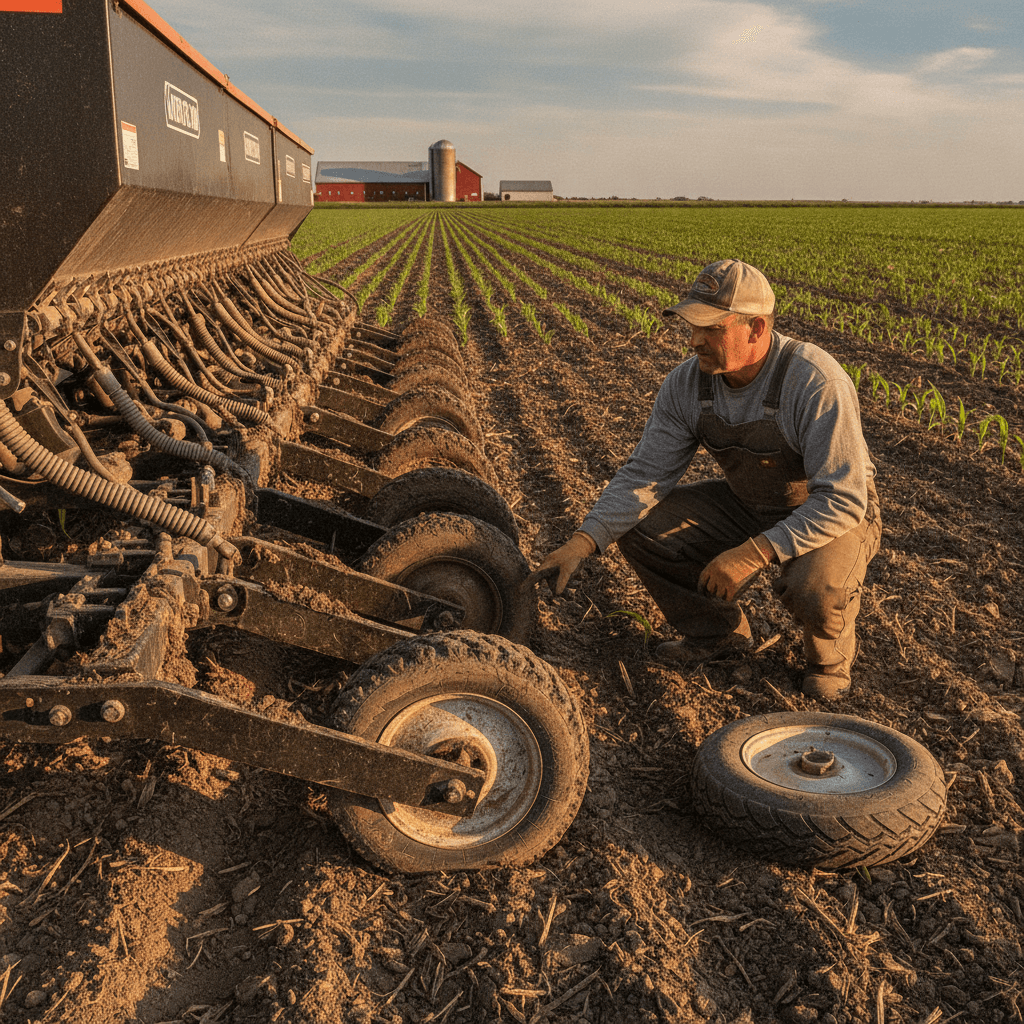
How Do Farmers Near Brookings Evaluate Whether Their Air Seeder’s Gauge Wheels Are Actually Controlling Depth — Or Just Riding Along?
If your air seeder’s gauge wheels are worn down, packed with mud, or just plain out of spec, they aren’t setting seed depth — they’re pretending to. Farmers near Brookings who run air seeders across heavy eastern South Dakota soils know this problem well, but many don’t catch it until they’re walking fields after emergence and wondering why stand counts are all over the place. The gauge wheel is one of the most underdiagnosed causes of inconsistent planting depth on air seeders, and this article gives you a straight look at how to evaluate yours before the problem shows up in your yield data.
What Gauge Wheels on an Air Seeder Are Actually Supposed to Do
The gauge wheel’s job is simple on paper: it rides the soil surface and controls how deep the opener — whether that’s a knife, disk, or hoe opener — places seed in the ground. That depth has to be consistent across every row, every pass, every field. In corn and soybeans, even a half-inch of inconsistency in planting depth can translate to uneven emergence and yield drag.
On a planter or air seeder in good working order, the gauge wheel maintains firm, consistent contact with the soil surface and gives the opener a fixed reference point. But that only works when the gauge wheel is the right size, properly mounted, and actually rotating freely. When any of those conditions breaks down, the depth you set in the shop isn’t the depth going into the ground.
Three Ways Gauge Wheels Stop Doing Their Job — Without Warning You
1. They Wear Down Past Spec and You Don’t Notice Until You Measure
Gauge wheel wear is gradual. A wheel that’s seen two or three seasons might look usable sitting in the shop — it spins, it’s still round, there’s no obvious crack. But if it’s worn down even a quarter inch in diameter, your seed is going in shallower than you think. Over a full field pass, that adds up to missed germination windows and uneven stands. If you haven’t measured your gauge wheels recently with a caliper against the original spec, you don’t actually know what depth you’re planting at.
2. Mud Packs Into Solid-Face Wheels and Changes Their Effective Diameter
This is the one that catches a lot of operators off guard in wet spring conditions. Solid or near-solid gauge wheels — especially on older air seeders — can pack mud into any recessed area or lip fast enough that by halfway through a field pass, the wheel is running on a crust of dried and compressed soil rather than the wheel surface itself. That mud buildup raises the effective riding height of the wheel, which means your opener is running shallower than your setting. In the clay-heavy soils common across eastern South Dakota and into southwestern Minnesota, this happens faster than most people expect.
3. The Wheel Isn’t Tracking Flat — and You Can’t See It from the Cab
A gauge wheel that’s slightly loose on its mount, running a worn bearing, or dislodged from its retainer doesn’t always announce itself with noise or a visible problem. It just tracks at a slight angle, making inconsistent contact with the surface. Some rows end up deeper, some shallower. You see it in uneven emergence and chalk it up to soil variation — but the real cause is mechanical.
How to Actually Check Your Gauge Wheels Before the Season Starts
This isn’t complicated, but most operators skip it. Here’s a quick field-level checklist:
- Measure diameter. Get out a tape or caliper and compare each wheel to OEM spec. If you’re running mixed wear across the bar, you’re planting mixed depths.
- Spin each wheel by hand. It should spin freely and smoothly. Drag, roughness, or wobble means a bearing problem or mounting issue.
- Check for lateral play. Grab the wheel and try to rock it side to side. Slop here usually means a worn bearing or loose retainer.
- Look at the face of the wheel. If you’ve got solid-face wheels and you can see soil buildup packed into any groove or lip, that’s where your depth consistency is going.
- Walk the field after a test pass. Use a ruler or depth probe on fresh furrows across multiple rows. If depth varies more than a quarter inch between rows, something upstream is wrong.
Why Open-Spoke Gauge Wheels Solve the Mud Problem That Solid Wheels Can’t
One of the clearest gaps you’ll find when comparing gauge wheel options — and one that most competitor product pages gloss over — is a detailed explanation of why the wheel geometry matters for mud shedding. It’s not just about having some holes in the wheel. It’s about the angle and curvature of the spokes relative to the direction of rotation, which determines whether mud releases or packs.
Jung Enterprise’s Curved Spoked Gauge Wheels are designed specifically with this in mind. The curved spoke geometry allows mud and crop residue to shed outward as the wheel rotates, rather than packing into the face. In the wet spring conditions farmers near Brookings deal with regularly — and across the Northern Plains generally — that design difference is what keeps your effective wheel diameter consistent from the first acre to the last. Consistent diameter means consistent depth.
After 13,000 planted acres over three seasons, Jung’s gauge wheels showed only 1/16 inch of wear. That’s not a marketing number — that’s a measurement. And it matters because a wheel that holds its diameter holds your depth.
The Wheel Retainer Problem Nobody Talks About on Air Seeders
Here’s something that rarely gets discussed in the context of air seeders specifically: gauge wheels can dislodge mid-pass, and when they do, the opener loses its depth reference entirely. On a planter with a dedicated operator watching row units, you might catch it quickly. On an air seeder running a wide bar at speed, you might finish the field before you realize one or more gauge wheels were running loose or completely off.
A quality wheel retainer keeps the gauge wheel seated on the hub securely, even through rough ground, hard passes, and the vibration that comes from running residue-heavy no-till fields. It’s a simple part with a direct impact on uptime and depth consistency — and it’s worth checking every season before you leave the yard. You can find Jung’s retainer on the Wheel Retainer product page.
What About the Tire Lip on Your Gauge Wheels?
If your gauge wheels use rubber tires mounted on a hub, the tire lip is a wear point that most operators don’t monitor until it fails. Soil abrasion and debris wear the lip down over time, and once it’s gone, the tire can slip on the hub or allow debris to pack between the tire and rim — both of which change the effective riding height of the wheel. A steel ring mounted at the tire lip protects against this and also acts as a built-in scraper to keep the interface between tire and hub clean. One part, two functions, no separate scraper needed.
Frequently Asked Questions — Air Seeder Gauge Wheels Near Brookings
How often should I replace gauge wheels on an air seeder?
It depends on soil abrasiveness, annual acres, and wheel material — but measuring wear rather than guessing by season is the right approach. If wear exceeds OEM tolerance for diameter, replace them. Don’t run a season on hope.
Do curved spoked gauge wheels fit my existing air seeder?
Jung Enterprise’s Curved Spoked Gauge Wheels are designed to fit multiple gauge wheel sizes and OEM configurations. Contact us directly to confirm compatibility with your specific make and model before ordering.
Can mud buildup on gauge wheels really change my planting depth mid-pass?
Yes, and it happens faster than most operators expect in wet clay or gumbo soil. A packed mud layer of even 3/16 inch on a solid-face wheel can push your seed placement shallower than your set depth. Open-spoke geometry is the most reliable way to prevent this.
Is a wheel retainer necessary if my gauge wheels aren’t coming off?
If they’ve never come off, you might not have noticed one riding loose. A retainer is cheap insurance — far cheaper than finding out mid-field that a wheel dislodged and you’ve been planting a row without depth control for the last 40 acres.
Where are Jung Enterprise gauge wheels manufactured?
Jung Enterprise is based in Ipswich, South Dakota. Their gauge wheels and steel rings are American-made and covered by US patents, including US 11,707,013 B2.
Don’t Wait for Emergence to Tell You Something Was Wrong
Inconsistent stands are an expensive way to diagnose a gauge wheel problem. By the time you’re walking fields and counting gaps in your corn rows near Brookings or across the border into Minnesota or Iowa, you’ve already lost whatever yield potential those missed plants represented. The better time to find out your gauge wheels weren’t doing their job is in the shop, before planting starts.
If you want to talk through your air seeder setup, check wheel compatibility, or get a straight answer on what replacement parts make sense for your operation, reach out to Jung Enterprise. We’re in Ipswich, we know these soils and these conditions, and we’d rather help you catch the problem in February than hear about it in June.