
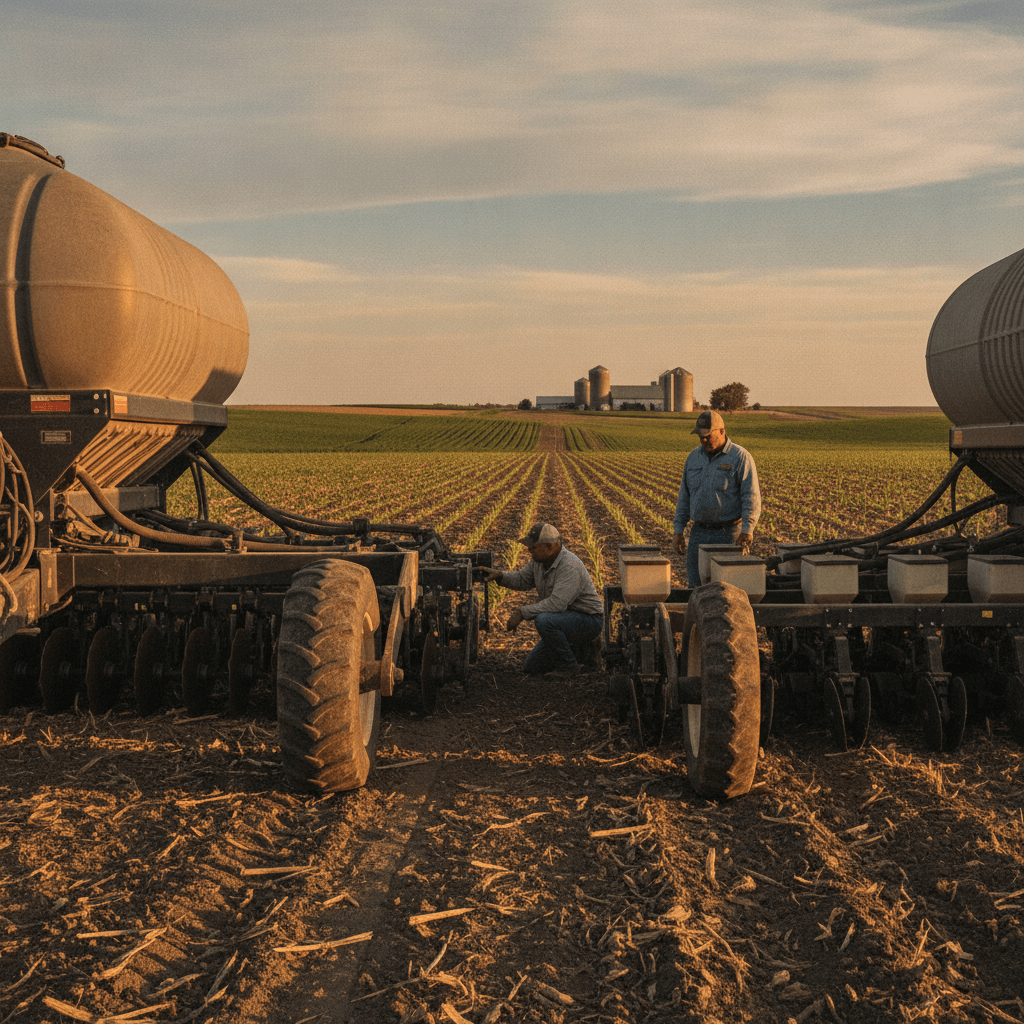
How Do Farmers Near Brookings Know Whether Their Air Seeder’s Gauge Wheels Are Actually Performing Differently Than a Standard Row Planter — Or Just Assumed to Be the Same?
If you run an air seeder and a row planter, you already know the two machines plant differently. But here is a question most farmers near Brookings have never stopped to ask: are the gauge wheels on your air seeder actually built for what that machine puts them through — or did you bolt on whatever came stock and call it good? The honest answer is that air seeder gauge wheels face meaningfully different operating conditions than those on a standard corn or soybean planter, and treating them as interchangeable parts is a quiet way to give up depth consistency without ever knowing why.
- Why Air Seeders Stress Gauge Wheels Differently Than Row Planters
- What the Competitors Mostly Miss on This Topic
- The Tire Lip Problem Is Worse on Air Seeders Than Most People Realize
- Gauge Wheel Dislodgement Is a Real Air Seeder Risk
- What to Actually Check on Your Air Seeder Gauge Wheels Before Planting
- FAQ: Air Seeder Gauge Wheels Near Brookings
Why Air Seeders Stress Gauge Wheels Differently Than Row Planters
A row planter running corn at 30-inch spacing has each row unit operating with some separation between them. That spacing gives the soil time to settle slightly between rows and lets each gauge wheel track a relatively undisturbed path. An air seeder is a different story. You are running openers much closer together — sometimes at 7.5-inch or 10-inch spacing — across the full toolbar width. That tighter spacing means adjacent openers are competing for the same disturbed soil, and each gauge wheel is constantly running through material that the opener ahead of it just moved.
That changes what the gauge wheel has to do. On an air seeder, the gauge wheel is not just riding firm ground and registering depth. It is riding through loosened, displaced, and sometimes wet soil that has been worked by an opener that just passed. In wet spring conditions — the kind that show up every April across eastern South Dakota and into Minnesota — that loosened soil turns into a mud accumulation problem fast. Gauge wheels with solid or narrow spoke designs pack up quickly. Once mud bridges across the face of the wheel, you have lost your depth reference point. The opener goes deeper than intended, seed placement gets erratic, and you do not find out until you are walking the field after emergence wondering why your stand is uneven.
What the Competitors Mostly Miss on This Topic
If you have been shopping gauge wheel solutions and reading through the usual competitor sites, you have probably noticed that most of the content treats gauge wheels as a one-size-fits-all planter part. The conversation tends to center on row planter applications — John Deere, Case IH, Kinze row units — with air seeder-specific guidance mostly absent. That is a real gap, because the farmers around Brookings running Bourgault, Morris, or similar air carts paired with seeding toolbars are dealing with soil dynamics and mud buildup that row-planter-focused gauge wheel content simply does not address.
The curved spoked gauge wheel design from Jung Enterprise was built with exactly this kind of open-face mud-shedding in mind. The open spoke geometry lets soil pass through rather than pack in. That matters on a row planter, but it matters even more on an air seeder where the wheel is constantly running through freshly disturbed ground at tight spacing intervals. You can see the full product details at the Curved Spoked Gauge Wheels page — but the short version is that the design keeps the wheel face clean so it keeps doing its actual job, which is reading the soil surface and controlling seeding depth.
The Tire Lip Problem Is Worse on Air Seeders Than Most People Realize
Here is another thing that rarely comes up in competitor content: tire lip wear on air seeder gauge wheels tends to accumulate faster than on row planters, for one straightforward reason. Air seeders typically cover more acres per season than a dedicated row planter. If you are custom seeding or running your own operation with wheat, canola, or small grains alongside corn acres, your air seeder gauge wheels are accumulating hours at a rate your row planter never matches.
Tire lip wear is not just a cosmetic issue. Once the lip starts to go, the tire loses its ability to hold consistent contact with the soil and maintain its depth reference. The tire also becomes more vulnerable to mud and debris building up behind the lip, which accelerates the wear cycle. The Jung Enterprise steel ring addresses this directly — it mounts to the gauge wheel with six screws, protects the tire lip from wear, and functions as a built-in scraper to keep mud and debris from packing behind the tire. That is covered by US patent 11,707,013 B2, and it is a single part doing two jobs instead of requiring a separate scraper attachment.
After 13,000 planted acres over three years of field testing, the steel ring showed only 1/16 inch of wear. For farmers near Brookings running high-acre air seeder operations, that kind of durability is not a luxury — it is the difference between parts that hold up through a full planting season and parts that need replacement mid-run.
Gauge Wheel Dislodgement Is a Real Air Seeder Risk
Air seeder toolbars can take a beating on rough ground. If you are running no-till or strip-till and the residue is heavy, opener frames flex and absorb more shock than they do on a lightly tilled row planter pass. That flexing puts stress on gauge wheel mounting points in ways that most farmers do not think about until a wheel walks off mid-field.
A wheel retainer is a simple fix for a problem that should not be happening in the first place. It keeps the gauge wheel seated on the opener arm so that flexing and impact do not walk it off during a run. If you have not checked your air seeder opener assemblies for wheel retention hardware this season, that is worth doing before you are halfway through a field in South Dakota or North Dakota with a wheel flopping loose. The wheel retainer from Jung Enterprise is designed for straightforward installation and works across multiple opener configurations.
What to Actually Check on Your Air Seeder Gauge Wheels Before Planting
- Mud shedding: Spin each gauge wheel by hand and look at the face. If there is old packed material bridging across the spokes or behind the tire, that wheel is already underperforming. Open-spoke designs clear themselves; solid or narrow-spoke wheels do not.
- Tire lip condition: Run your hand around the inside lip of the gauge wheel tire. If the lip is cracking, compressed, or visibly worn down, your depth reference is compromised. A steel ring can protect what is left and extend service life significantly.
- Wheel seating: Rock the gauge wheel against the opener arm. Any lateral play means the mounting is loose or the retainer is missing or failed. Tighten or replace before the season starts, not after the first field.
- Depth uniformity across the toolbar: Walk a seeded field and pull soil cores from multiple rows across the toolbar width. Depth variation of more than a half inch across the toolbar is worth investigating at the gauge wheel level before assuming the hydraulic system is to blame.
Jung Enterprise manufacturers its gauge wheel products in Ipswich, South Dakota, and they are built with field conditions across the Northern Plains in mind — not repurposed from a generic parts catalog. You can review the full product lineup at the products overview page to see what fits your air seeder configuration.
FAQ: Air Seeder Gauge Wheels Near Brookings
Do curved spoked gauge wheels from Jung Enterprise fit air seeder openers, or only row planters?
They fit across multiple OEM configurations including air seeder openers and no-till drill openers, not just row planter row units. Check the product page or contact Jung Enterprise directly to confirm fitment for your specific opener brand and size.
Why does my air seeder seem to have more mud plugging than my row planter?
Tighter opener spacing means each gauge wheel is running through soil that was just disturbed by the opener ahead of it. That loosened material, especially when wet, packs into solid or narrow-spoke gauge wheels faster than on a row planter with wider row spacing. An open-spoke gauge wheel design sheds that material instead of accumulating it.
How many acres can I expect out of a Jung Enterprise steel ring on an air seeder?
Field testing showed only 1/16 inch of wear after 13,000 planted acres across three years. Air seeder applications can cover more acres per season than row planters, so that durability matters even more. Your actual wear rate will depend on soil conditions and residue levels, but the numbers are strong by any honest standard.
Is the wheel retainer necessary on air seeders, or just row planters?
Air seeder toolbars actually tend to see more frame flex and impact stress than row planters, particularly in no-till and heavy residue conditions. That makes wheel retention hardware at least as important on air seeders as on row units — arguably more so.
Can I order Jung Enterprise parts for my air seeder directly, or do I need to go through a dealer?
You can contact Jung Enterprise directly. They work with both individual farmers and ag dealers and distributors. For farmers near Brookings and across eastern South Dakota, direct contact is the fastest way to confirm fitment and get parts ahead of planting season.
If you are running an air seeder and have questions about gauge wheel fitment, steel ring compatibility, or wheel retention for your specific opener setup, reach out to Jung Enterprise directly. The team in Ipswich can help you sort out what your machine actually needs before the planting window opens — not after you are already behind. Contact Jung Enterprise here or call (605) 281-0497.