
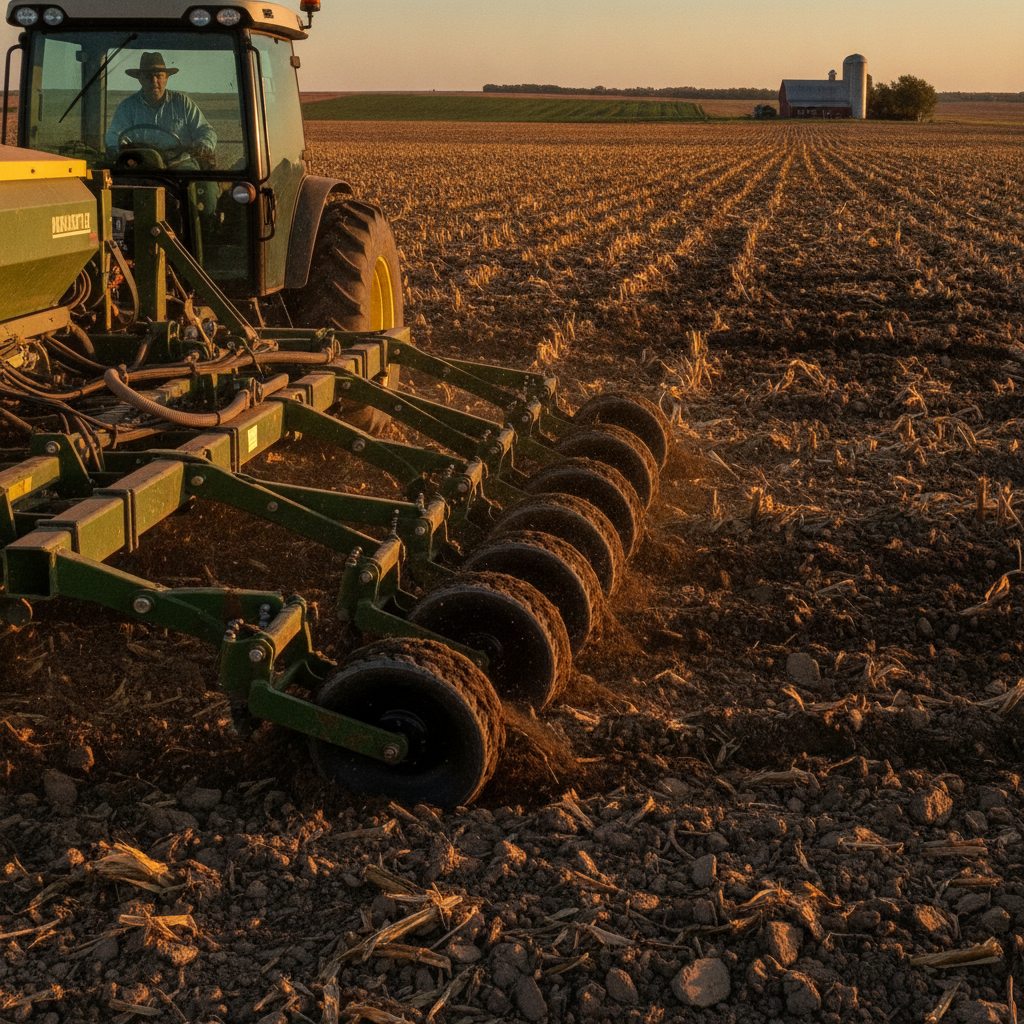
How Do Strip-Till and No-Till Farmers Near Brookings Know Whether Their Air Seeder’s Gauge Wheel Is Actually Holding Consistent Seed Depth Across Variable Field Terrain — Or Just Floating Up and Down Without Anyone Noticing?
If your air seeder’s gauge wheel is losing depth control across uneven terrain near Brookings, you’re not planting — you’re guessing. Inconsistent seed depth means uneven emergence, variable plant populations, and yield that falls short of what your inputs should deliver. The frustrating part is that it’s easy to miss. The seeder looks like it’s running fine from the cab, but the gauge wheel is bouncing over clods, riding residue mats, or packing with mud between passes, and nobody finds out until they walk the field and see the skip rows.
This is a real problem for no-till and strip-till operations across eastern South Dakota and into neighboring Minnesota and Iowa. Fields in this region carry significant surface residue, variable soil structure from freeze-thaw cycles, and in wet springs, that sticky gumbo clay that clings to everything. If your gauge wheel can’t cut through that consistently and ride the soil surface the way it’s supposed to, you’re planting at whatever depth the terrain happens to give you — not the depth you dialed in.
Why Gauge Wheel Depth Drift Is Worse on Air Seeders Than Most Operators Realize
Air seeders cover more ground faster than row-unit planters, which is exactly why depth consistency problems get magnified. A single pass might cover hundreds of acres. If your gauge wheel is running even a quarter-inch shallow or deep due to mud packing, spoke plugging, or worn geometry, that error repeats across every row on every acre. At Brookings-area corn and soybean planting populations, that kind of depth variation can directly reduce stand counts and push emergence timing out by days — which matters a lot when your planting window is already tight.
The gauge wheel’s job is straightforward: ride the soil surface consistently, control the furrow opener’s depth, and do it acre after acre without packing full of mud or wearing to the point where the depth reference changes. If the wheel can’t shed residue and wet soil between passes, it stops riding the surface and starts riding the mud ball it’s carrying. At that point your depth setting is meaningless.
What Plugged or Worn Gauge Wheels Actually Look Like in the Field
You may not catch this in real time. Here’s what to look for when you walk behind the machine or pull into the field for a check:
- Soil packed into the spoke pockets — If you’re pulling clay out of the gauge wheel with your hand between rounds, it was carrying that mud during planting and your depth reference was off.
- Furrow depth variation row to row — Pull a few seeds and measure actual placement depth in multiple rows. More than a half-inch of variation across your rows is a gauge wheel issue, not a seeder setup issue.
- Seed skip patterns that follow terrain changes — If skips cluster around low wet areas or slope transitions, the wheel is floating rather than riding the surface.
- Visible tire lip wear — The tire lip is what actually contacts the soil sidewall. Once that’s worn, the depth relationship between the opener and the gauge surface has shifted, and you won’t fix it by adjusting the depth stop.
That last point matters specifically for air seeders that run hard, season after season. Tire lip wear is gradual and easy to miss until the gauge wheel is running noticeably sloppy. By then you’ve already planted a lot of acres at the wrong depth.
How the Curved Spoked Gauge Wheel Design Addresses This
The Curved Spoked Gauge Wheels from Jung Enterprise are built specifically to solve the mud-packing problem that kills depth control in conditions like what Brookings-area farmers deal with every spring. The open-spoke curved design sheds soil and residue as the wheel turns instead of letting it accumulate in the pockets. That means the wheel is riding clean soil surface each pass rather than a mud shell it built up three rows ago.
The geometry also matters for depth precision. Consistent spoke curvature means consistent ground contact, which means your depth setting is actually what you’re planting at — not an approximation. That’s the difference between a gauge wheel that controls depth and one that just looks like it does.
These wheels are field-tested to only 1/16 inch of wear after 13,000 planted acres over three years. For operators near Brookings running high-acreage no-till or strip-till seasons, that kind of durability means you’re not replacing gauge wheels mid-season or discovering at spring startup that last fall’s wear means this year’s planting depth is already off before you turn a wheel.
Don’t Overlook the Tire Lip While You’re Evaluating Your Gauge Wheels
Gauge wheel depth consistency isn’t just about the spoke design. The tire lip — the part of the gauge wheel that contacts the sidewall of the seed furrow — wears down with use, and once it goes, your depth reference goes with it. The Steel Ring from Jung Enterprise mounts directly to the gauge wheel with six screws, protects the tire lip from that wear, and doubles as a built-in scraper so you’re not adding a separate part to solve the mud problem. It’s covered under US Patent 11,707,013 B2, and it’s designed to work with the gauge wheel rather than fight it.
If you’re already thinking about gauge wheel upgrades heading into next planting season, it makes sense to look at the full system — the wheel, the tire lip protection, and the wheel retainer — rather than patching one part and leaving the rest to fail. You can review the full product lineup here.
Frequently Asked Questions: Air Seeder Gauge Wheel Depth Near Brookings
How do I know if my air seeder’s gauge wheel is causing depth variation versus something else on the machine?
Start by measuring actual seed depth in several rows, not just the depth the machine is set to. Then pull the gauge wheel and check for mud packing in the spokes, visible tire lip wear, and any wobble when you spin it by hand. If the wheel is clean and undamaged but depth still varies, the problem may be in the depth stop, row unit springs, or machine leveling. But in wet, residue-heavy conditions near Brookings, the gauge wheel is usually the first place to look.
Does spoke design actually matter for depth control, or is that marketing?
It matters. A solid or closely-spaced spoke design gives mud somewhere to pack and nowhere to go. Once that mud load builds up, the wheel is no longer riding the soil surface — it’s riding the mud pack. Open curved-spoke designs physically shed material during rotation instead of carrying it. That’s not a claim; it’s geometry.
How often should I replace gauge wheels on a high-acreage air seeder?
That depends on soil conditions and acres per season. In abrasive or clay-heavy soils like much of eastern South Dakota, gauge wheels on stock OEM setups often show significant wear within one to two seasons of heavy use. A properly built aftermarket wheel with proven durability data — like the 13,000-acre, 1/16-inch wear standard Jung Enterprise has documented — gives you a real benchmark instead of a guess.
Can the Curved Spoked Gauge Wheel fit my existing air seeder?
Jung Enterprise’s gauge wheels are designed to fit across multiple OEM brands and gauge wheel sizes for planters, air seeders, and no-till drills. Contact Jung Enterprise directly with your machine make, model, and gauge wheel specs to confirm fitment before you order.
Is it worth upgrading gauge wheels before planting season or should I wait until they fail?
Waiting until they fail means finding out during the planting window — the worst possible time to source parts and make a swap. Pre-season is when you have time to measure, order, and install correctly. Post-harvest is even better if you want to go into spring without that variable hanging over you. Either way, mid-planting is not the time to discover your gauge wheels were running out of spec for the last 500 acres.
Ready to Stop Guessing at Seed Depth?
If you’re running an air seeder in no-till or strip-till ground near Brookings — or anywhere across South Dakota, Minnesota, or Iowa — and you’re not confident your gauge wheels are holding consistent depth through variable terrain, that’s worth fixing before the next planting season costs you yield. Jung Enterprise builds patented, American-made gauge wheels, steel rings, and wheel retainers specifically for this kind of operation, with real field data behind the durability claims.
Reach out to Jung Enterprise directly with your machine specs and planting conditions. We’ll help you figure out whether your current setup is doing its job — and what to do if it isn’t.