
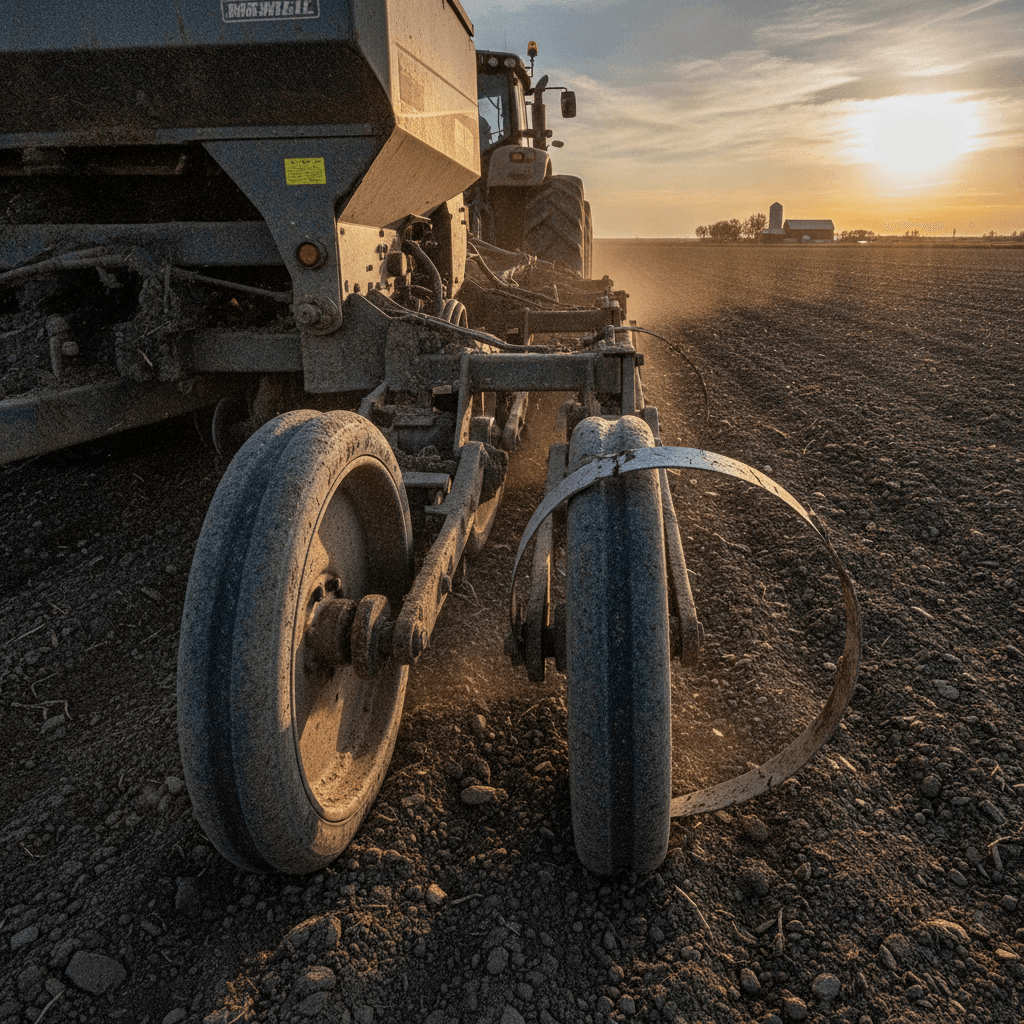
How Do Farmers Near Brookings Know Whether Their Air Seeder’s Steel Ring Is Actually Keeping Pace With High-Acre Spring Runs — Or Just Surviving One Field at a Time?
If you’re running an air seeder hard across a big acre base every spring near Brookings, this question matters a lot more than it might sound. A steel ring that technically survives one field before needing attention isn’t a steel ring that’s working — it’s a part that’s failing slowly enough that you haven’t noticed yet. The difference shows up in tire lip wear, in mud plugging mid-run, and eventually in a gauge wheel that isn’t doing its job anymore. By that point, your planting window is already getting shorter.
Here’s the honest breakdown of what separates a steel ring that’s actually built for high-volume air seeder work from one that just looks the part on a product page.
The Problem With Air Seeders and Gauge Wheel Wear That Most Competitors Don’t Talk About
Most content you’ll find from gauge wheel and steel ring manufacturers focuses on row-crop planters — corn, soybeans, that kind of operation. That’s fair, because those are the machines people think of first. But air seeders are a different animal when it comes to gauge wheel stress. You’re often covering more acres per day, moving across more varied terrain, and running into heavier residue loads depending on what was in the field before you. If you’re seeding into standing wheat stubble or heavy corn residue in eastern South Dakota or over the border into Minnesota or Iowa, your gauge wheels are taking more abuse per hour than a row-crop planter running in clean tilled ground.
The tire lip on an air seeder gauge wheel takes the brunt of that abuse. Every time the wheel rolls through abrasive residue, rocky headlands, or compacted clay, the lip is grinding. Without something protecting it, you’re burning through gauge wheel tires faster than you should — and you’re probably not catching it until the tire looks visibly chewed up or starts losing its seating against the disc opener.
A steel ring solves this by putting a hardened metal barrier between the tire lip and whatever is tearing it apart. But not all steel rings hold up across a full season of high-acre air seeder work. The ones that don’t are usually obvious in hindsight — they loosen up, they crack, or they stop doing their job as a scraper once mud starts packing in behind them.
What a Steel Ring Actually Has to Do on a High-Acre Air Seeder Run
There are really two jobs a steel ring has to do, and both of them matter on a high-acre run.
First: protect the tire lip from wear. This is the obvious one. The steel ring sits against the tire lip and absorbs the contact that would otherwise eat into the rubber. If the ring is moving around, loosening, or deforming after a few hundred acres, it’s not protecting anything — it’s just adding weight.
Second: act as a scraper to shed mud and debris. This is where a lot of steel ring designs fall short, and it’s especially critical in the wet spring conditions that farmers near Brookings and Huron deal with regularly. When gumbo or heavy clay starts packing onto your gauge wheel, planting depth goes out the window. The wheel stops rolling cleanly, mud builds up, and your seed trench quality deteriorates fast. A steel ring with a built-in scraper function addresses this without requiring a separate scraper attachment — the ring itself knocks the debris clear on every rotation.
The Jung Enterprise Steel Ring is designed to do both. It mounts with six screws, holds its position under field load, and the patented design (US Patent 11,707,013 B2) integrates the scraper function into the ring itself — no extra hardware, no extra failure points. That matters when you’re putting on thousands of acres across a short spring window and can’t afford a mid-field breakdown to adjust a separate scraper that’s migrated out of position.
How to Actually Evaluate Whether Your Current Steel Ring Is Keeping Up
Here’s a straightforward check you can do yourself after a full day of seeding:
- Pull a gauge wheel and look at the tire lip directly. Is there visible wear on the contact edge of the lip, or is it holding its profile? If you’re seeing rubber loss after a single long day, your ring either isn’t seated correctly or isn’t doing its job.
- Look at the ring itself. Is it still flush and tight against the tire lip, or has it shifted? A ring that moves is a ring that’s wearing the lip unevenly and will fail faster.
- Check the face of the ring for mud or debris accumulation. If you’re getting significant buildup behind or around the ring, you either need a better scraper function or your ring geometry isn’t matched to your gauge wheel diameter.
- Check your seeding depth consistency. If depth is wandering across the run, mud plugging or gauge wheel wear is often the culprit — and the steel ring is your first line of defense against both.
The durability benchmark worth knowing: Jung Enterprise’s steel ring has been field-tested to just 1/16 inch of wear after 13,000 planted acres over three seasons. That’s the kind of number that tells you whether a part is actually built for high-acre work or just rated for it on paper.
Why This Matters More in the Northern Plains Than in Softer Soil Country
Farmers near Brookings, Sioux Falls, and over toward the Minnesota and Iowa borders deal with a specific combination of conditions that pushes gauge wheel components harder than average. Heavy clay and gumbo soils in wet springs don’t just plug wheels — they pack in under load and stay there. Spring planting windows in eastern South Dakota are already compressed. When you lose two hours mid-field to a plugged gauge wheel or a steel ring that’s shifted out of position, you’re not just losing time. You’re losing yield potential in the rows that got planted late or at the wrong depth while you were dealing with the problem.
That’s why the scraper function built into the steel ring design matters so much for this region specifically. It’s not a nice-to-have — it’s the difference between running clean and stopping to manually clear mud off your gauge wheels every few passes.
At Jung Enterprise in Ipswich, we built these parts for exactly this kind of country. If you want to see the full product lineup, browse what we offer and compare it against what’s on your air seeder right now.
Frequently Asked Questions
Does the Jung Enterprise Steel Ring fit air seeders, or is it only for row-crop planters?
It fits both. The steel ring is designed to work across planters, air seeders, and no-till drills. Compatibility depends on your gauge wheel size — contact Jung Enterprise to confirm fitment for your specific machine before ordering.
How often should I expect to replace a steel ring on a high-acre air seeder operation?
With the right ring, you shouldn’t need to replace it every season. Jung Enterprise’s steel ring showed only 1/16 inch of wear across 13,000 acres over three years. If you’re replacing your current ring more frequently than that, it’s worth looking at whether the design is actually matched to high-acre air seeder use.
Do I need a separate scraper if I install a steel ring on my air seeder gauge wheels?
Not with Jung Enterprise’s design. The scraper function is built into the steel ring itself. That eliminates one more part to install, adjust, and potentially lose in the field.
What’s the installation process for the steel ring on an air seeder gauge wheel?
The ring mounts with six screws. Most operators can install it without specialized tools. If you have questions about installation on your specific gauge wheel setup, reach out directly and we’ll walk you through it.
Is there a difference between what air seeder operators near Brookings need versus what row-crop farmers farther north are running?
The core product is the same, but the conditions it’s working against vary. Heavy gumbo soils common in the eastern South Dakota corridor — including around Brookings and Huron — tend to create more mud plugging issues than sandier ground farther north. That makes the built-in scraper function more critical in this region than in some others. Either way, the steel ring is designed to handle it.
Ready to Stop Replacing Parts That Should Last the Whole Season?
If you’re running an air seeder across a serious acre base and you’re not confident your current steel ring is keeping pace, it’s worth a conversation. Jung Enterprise is based in Ipswich and builds American-made, patented gauge wheel protection parts that are field-tested in the same kind of country you’re farming. Get in touch with us directly to talk through your setup and what will actually work for your operation — no runaround, just a straight answer.