
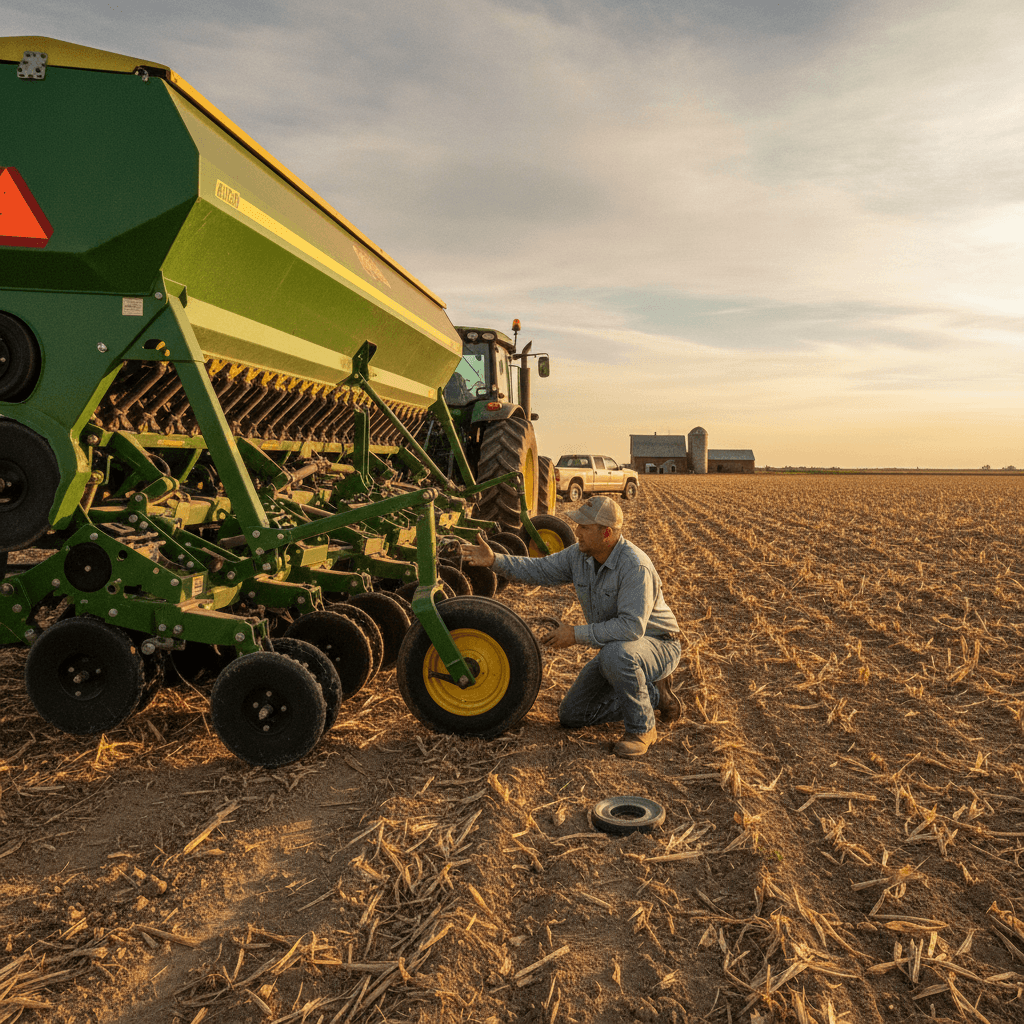
How Do Air Seeder Operators Near Bismarck Know Whether Their Wheel Retainer Is Actually Preventing Gauge Wheel Dislodgement Between Fields — Or Just Holding Until the Next Hard Stop?
If you’re running an air seeder in the Northern Plains and you’ve ever pulled to a field end, walked the machine, and found a gauge wheel hanging loose or completely off the row unit — your wheel retainer either failed or was never doing the job in the first place. For operators near Bismarck and across North Dakota, this isn’t a rare edge case. It’s a real planting season problem, and it rarely announces itself before it costs you time, seed placement accuracy, and in bad cases, a damaged row unit.
The honest answer is this: most operators don’t know their wheel retainer is failing until the wheel is already off. And by then, you’ve likely seeded a stretch of field with a row unit running unconstrained — which means inconsistent depth, wasted seed, and yield drag you won’t see until harvest. Here’s how to get ahead of that.
Why Gauge Wheel Dislodgement Is a Bigger Problem on Air Seeders Than Most People Acknowledge
Air seeders cover ground fast. A 60-foot machine moving at 6–7 mph across a North Dakota field is putting a lot of repetitive lateral and vertical stress on every row unit component, including the hardware that keeps your gauge wheels seated. Road transport between fields — even short hauls — adds vibration load that most OEM wheel retainers weren’t designed with high-cycle air seeder use in mind.
The other factor specific to this region is soil type. Heavy clay and gumbo soils around Bismarck and across the Missouri Coteau don’t give much. When a gauge wheel hits a wet, compacted spot at seeding speed, the lateral force spikes. A marginal retainer that was holding fine in tilled ground will show its weakness the first time you cross a wet clay flat at full seeding speed.
What makes this worse is that most competitors selling gauge wheel components — whether it’s Yetter, Schaffert, or others — focus their content and product engineering heavily on planter row units, specifically corn and soybean planters in the central Corn Belt. Air seeder-specific guidance on wheel retention is genuinely thin. If you’ve been trying to find straight answers on this for your operation near Bismarck or Fargo, that’s not an accident. It’s a gap that most manufacturers haven’t filled.
What a Wheel Retainer Is Actually Supposed to Do — and How to Tell If It’s Not
The wheel retainer’s job is simple: keep the gauge wheel seated on the row unit spindle under real field conditions. That means across speed changes, terrain variation, wet soil, and transport. It is not a set-it-and-forget-it part. It’s a working component that takes load every single time that gauge wheel contacts the ground.
Signs your current retainer isn’t doing the job:
- Gauge wheel has visible side-to-side play when you grab it by hand and push laterally
- You’ve found a wheel partially dislodged at a field end or during transport at least once in the last two seasons
- The retainer shows visible deformation, cracking, or wear at the contact surface
- You’re re-tightening or re-seating wheels mid-season more than once — that’s a retainer problem, not a loose bolt problem
- The wheel walks outward on the spindle during operation, leaving an uneven track
If any of those sound familiar, your retainer is giving you warning signs. The question is whether you address it before planting season or deal with it mid-field when time costs real money.
What Jung Enterprise’s Wheel Retainer Does Differently
Jung Enterprise is based in Ipswich, South Dakota — close enough to the Northern Plains to understand exactly what operators from Bismarck to Fargo are dealing with in spring seeding conditions. The Wheel Retainer from Jung Enterprise is designed specifically to prevent gauge wheel dislodgement from planters and air seeders, and it’s built to hold under the kind of lateral and vertical stress that air seeder operations actually generate.
The design is straightforward and the install is simple — this isn’t a complicated retrofit. It fits across multiple OEM brands and gauge wheel sizes, which matters when you’re running a mixed equipment lineup or trying to standardize parts across multiple machines. For ag dealers and distributors across North Dakota and Minnesota who stock parts for air seeder operators, that broad compatibility reduces SKU complexity and returns calls from customers asking whether it’ll fit their rig.
What you won’t get from Jung Enterprise is a retainer that’s been spec’d for a trade show and tested in a lab. The parts are field-tested under real Northern Plains conditions — the same kind of wet clay, heavy residue, and cold spring soil that operators around Bismarck deal with every April.
The Cost of Getting This Wrong During a Short Planting Window
In North Dakota, the planting window for small grains, sunflowers, and other row crops is tight. You don’t have two weeks of buffer. When a gauge wheel dislodges mid-field, you’re stopped. If it happens during transport, you might not catch it until you’ve already made a pass. Either way, you’ve lost seeding depth control on that row for however long it took you to notice.
Replacing or fixing a failed retainer mid-season isn’t just a parts cost. It’s the labor, the lost time, and the downstream yield impact from inconsistent seeding depth. For custom seeding operations working across multiple farms — and there are a lot of those running out of central South Dakota and into North Dakota — one equipment failure on a customer’s field carries reputation risk on top of the direct cost.
A retainer that holds all season is one less thing to manage. That’s the honest value proposition. It’s not glamorous, but it’s real. See the full Jung Enterprise product lineup to understand how the wheel retainer fits alongside steel rings and curved spoked gauge wheels for a complete row unit solution.
FAQ: Wheel Retainers for Air Seeders in the Northern Plains
Does the Jung Enterprise Wheel Retainer fit air seeders, or is it just for row planters?
It fits both. The retainer is compatible with planters and air seeders across multiple OEM brands and gauge wheel sizes. If you’re unsure whether it fits your specific setup, contact Jung Enterprise directly — they’ll tell you straight rather than guess.
How do I know if my current wheel retainer is worn out versus just loose?
Grab the gauge wheel with both hands and push laterally. More than a small amount of play means the retainer isn’t holding properly. Also check for visible deformation or cracking at the retainer contact surface. A loose bolt can be tightened. A worn retainer needs to be replaced.
How often should wheel retainers be inspected on an air seeder?
At minimum, inspect them at the start of each season. If you’re putting on a lot of acres or seeding in heavy, wet conditions, check them mid-season as well. Transport between fields adds vibration stress that can loosen or fatigue retainers faster than field use alone.
Can a failed wheel retainer damage other row unit components?
Yes. When a gauge wheel dislodges or walks out of position, it can put uneven load on the spindle, bearing, and row unit arm. Catching a retainer failure early is almost always cheaper than the secondary damage a loose or missing wheel causes over several passes.
Do ag dealers near Bismarck or Fargo stock Jung Enterprise parts?
Dealer and distributor availability varies. Contact Jung Enterprise directly to ask about your nearest stocking dealer or to discuss distributor options for your area. Jung Enterprise supports dealer relationships and doesn’t cut out the supply chain to sell direct.
Talk to Jung Enterprise Before Your Next Planting Season
If you’re an air seeder operator or ag dealer in the Northern Plains — North Dakota, South Dakota, Minnesota — and you want a straight answer on whether the Jung Enterprise Wheel Retainer fits your equipment, reach out. The team in Ipswich knows the region, knows the soil conditions, and can tell you what the part will and won’t do for your operation without the sales pitch.
Contact Jung Enterprise here to ask about the Wheel Retainer, get compatibility information for your air seeder, or find out about dealer and distributor options in your area. Planting season doesn’t wait, and neither should you.