
How Do Corn and Soybean Farmers Near Bismarck Know Whether Their Planter’s Gauge Wheel Tire Is Actually Failing From the Inside Out — Or Just Showing Normal Wear on the Surface?
If you’re pulling your planter out of storage near Bismarck and the gauge wheel tires look a little rough on the outside, that’s not automatically the problem — it might just be surface oxidation or cosmetic scuffing from last season’s gumbo. The question you actually need to answer is what’s happening at the tire lip, because that’s where the real structural failure starts. A tire that looks okay from ten feet away can already be grinding down on the inside edge where rubber meets the cast iron gauge wheel body, and by the time that failure becomes obvious, you’re already losing depth consistency in the field.
Surface Wear vs. Lip Failure: Why the Difference Matters
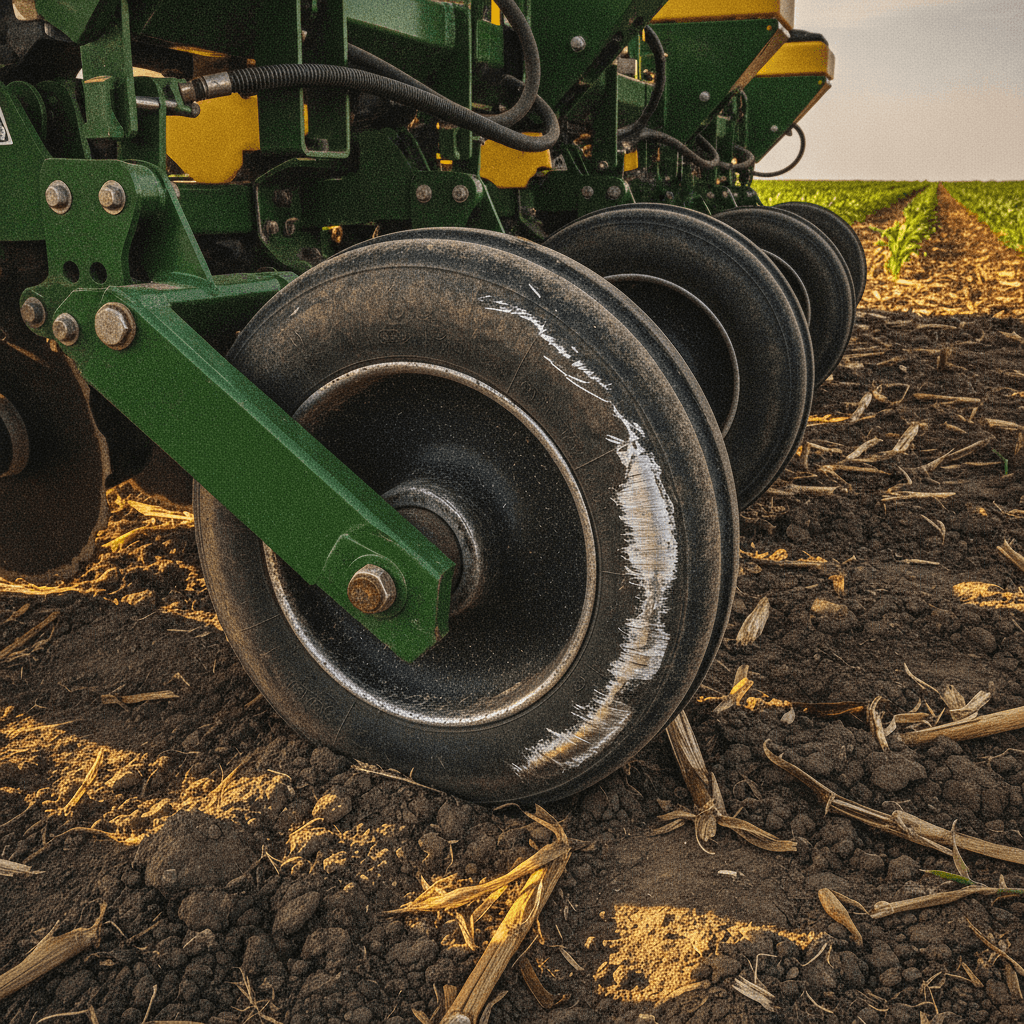
Surface wear on a gauge wheel tire — minor cracking, tread scuffing, general rubber degradation — is something you can usually monitor and plan around. It’s visible, it’s gradual, and it doesn’t blow up your planting window overnight. Tire lip failure is a different animal. It starts where the tire bead seats against the gauge wheel rim, and the damage happens underneath where you can’t easily see it during a quick walk-around inspection.
Here’s what actually happens: as the tire spins against soil and residue, the bead area gets worked constantly. On steel gauge wheels without any protection, the metal rim edge contacts the rubber lip directly. That contact point becomes a wear zone. Over time, the lip thins, loses its seat, and the tire starts to move independently of the wheel — which means your planting depth is no longer controlled by the gauge wheel, it’s controlled by whatever the loose tire happens to compress to at any given moment. In a corn or soybean field near Bismarck where you’re targeting a 2-inch seeding depth, half an inch of depth variation row-to-row adds up fast.
How to Check for Lip Failure Before It’s Too Late
You don’t need a shop manual for this. Pull the gauge wheel off the row unit and do three things:
- Squeeze the tire lip by hand. If you can feel movement between the rubber bead and the wheel rim — any looseness or shift — the seal is already compromised. A properly seated tire lip shouldn’t have any play.
- Look at the inside face of the tire bead. Shiny, glazed, or visibly thinned rubber on the inside edge means metal-on-rubber grinding has been happening. This is inside-out wear — you won’t catch it from a quick outside glance.
- Check the wheel rim edge itself. If the rim edge is showing bright, polished metal where it contacts the tire bead, that’s confirmation. The tire and rim are wearing each other, and the tire is losing that fight.
If you see two or more of those signs, the tire isn’t just worn — it’s structurally compromised. The real cost isn’t the tire replacement, it’s the depth control you lose every acre you plant on it.
What’s Actually Causing Inside-Out Tire Lip Wear — And What Stops It
The root cause is unprotected metal contact at the tire lip. Most OEM gauge wheels ship without any kind of lip protection. The rim edge is just cast or stamped steel, and it sits in direct contact with the rubber tire bead every revolution of that wheel. In heavy clay soils and gumbo conditions common across North Dakota and into South Dakota, mud loading on the gauge wheel creates additional lateral pressure on the tire lip — accelerating the wear cycle.
This is the problem Jung Enterprise’s Steel Ring was designed to solve. The Steel Ring mounts directly over the tire lip using six screws and puts a hardened steel barrier between the rim edge and the ground — while also acting as a built-in scraper that prevents mud and debris from packing behind the tire. That dual function — lip protection and scraping — means you’re not buying a separate scraper attachment and hoping it stays aligned. It’s one part doing both jobs.
After 13,000 planted acres in field testing over three years, measurable wear on the Steel Ring itself was only 1/16 of an inch. The tire lip underneath? Protected the entire time.
The Gap Most Planter Parts Suppliers Don’t Cover
Here’s something worth noting: most of the planter parts suppliers and manufacturers that farmers near Bismarck are familiar with — Yetter, Schaffert, Exapta, and others — have written plenty about closing wheels, row cleaners, and downforce. What you’ll rarely find from them is a clear explanation of why gauge wheel tires fail from the inside edge out, or how to diagnose it before it’s costing you depth consistency. That diagnostic gap is real, and it means a lot of farmers replace gauge wheel tires on a time-based schedule rather than a condition-based one — sometimes too early, sometimes too late, and almost always without addressing what caused the tire to fail in the first place.
Protecting the tire lip before wear starts is far cheaper than replacing tires mid-season in the middle of a North Dakota planting window when parts lead times are stretched.
Practical Timing for Farmers in North Dakota and the Northern Plains
Post-harvest is the right time to do this inspection — not two days before you start planting corn near Bismarck in late April or early May. Pull each gauge wheel, go through the three-point check above, and document which row units have lip wear. If you’re seeing it on more than a few units, that’s a systemic issue with how your gauge wheels are built, not a random failure. Addressing it with proper lip protection before spring means you go into planting season with wheels you can trust.
For farmers running no-till or strip-till in North Dakota, this matters even more. No-till residue loads and harder soil entry points put more stress on gauge wheel components than tilled ground. A tire that might hold up two seasons in conventionally tilled fields may only give you one in continuous no-till corn or soybean rotations. That’s not a scare tactic — it’s just physics, and it’s something worth building into your replacement and maintenance planning.
Jung Enterprise is built and operated out of Ipswich, South Dakota, and serves farmers across the Northern Plains — North Dakota, South Dakota, Minnesota, Nebraska, and beyond. All of our products are American-made, patented, and field-tested under real planting conditions — not just spec-sheet rated.
Frequently Asked Questions
What does gauge wheel tire lip failure actually look like?
Look for rubber thinning or glazing on the inside edge of the tire bead, visible play between the tire and the rim when you flex it by hand, or bright polished metal on the wheel rim edge where it contacts the rubber. Any of those signs mean the lip has been wearing against unprotected metal.
Does surface cracking or tread wear mean my gauge wheel tire needs to be replaced?
Not necessarily. Surface oxidation and minor cracking are common after a season of outdoor storage and UV exposure. The more critical question is whether the tire lip is still properly seated and intact. A tire with surface crazing can still control depth accurately if the lip is sound. A tire that looks okay on the outside but has a compromised lip can’t.
Can I protect my existing gauge wheel tires, or do I have to start fresh?
If the tire lip is still in good shape, adding a Steel Ring now will protect it going forward. If the lip has already thinned significantly or the tire is moving on the rim, you’ll want to replace the tire first and then install protection so the next one lasts. Don’t put a protective ring over a tire that’s already structurally failed — fix the foundation first.
Does the Steel Ring fit all gauge wheel sizes?
Jung Enterprise’s Steel Ring is compatible with multiple gauge wheel sizes across planters, air seeders, and no-till drills from common OEM brands. Contact us with your specific gauge wheel size and we’ll confirm fit before you order.
How long does the Steel Ring last compared to replacing gauge wheel tires?
In field testing across 13,000 planted acres over three years, the Steel Ring showed only 1/16 inch of measurable wear. Most gauge wheel tires without lip protection need replacement far sooner than that under similar conditions, especially in heavy residue and clay soils like those common across North Dakota and South Dakota.
Ready to Stop Guessing at Gauge Wheel Wear?
If you’re running corn or soybeans near Bismarck or anywhere across the Northern Plains and you want to know exactly what’s protecting — or not protecting — your gauge wheel tires this season, we’re straightforward to deal with. No upsell, no runaround. Reach out to Jung Enterprise in Ipswich with your planter setup and we’ll help you figure out what you actually need.