
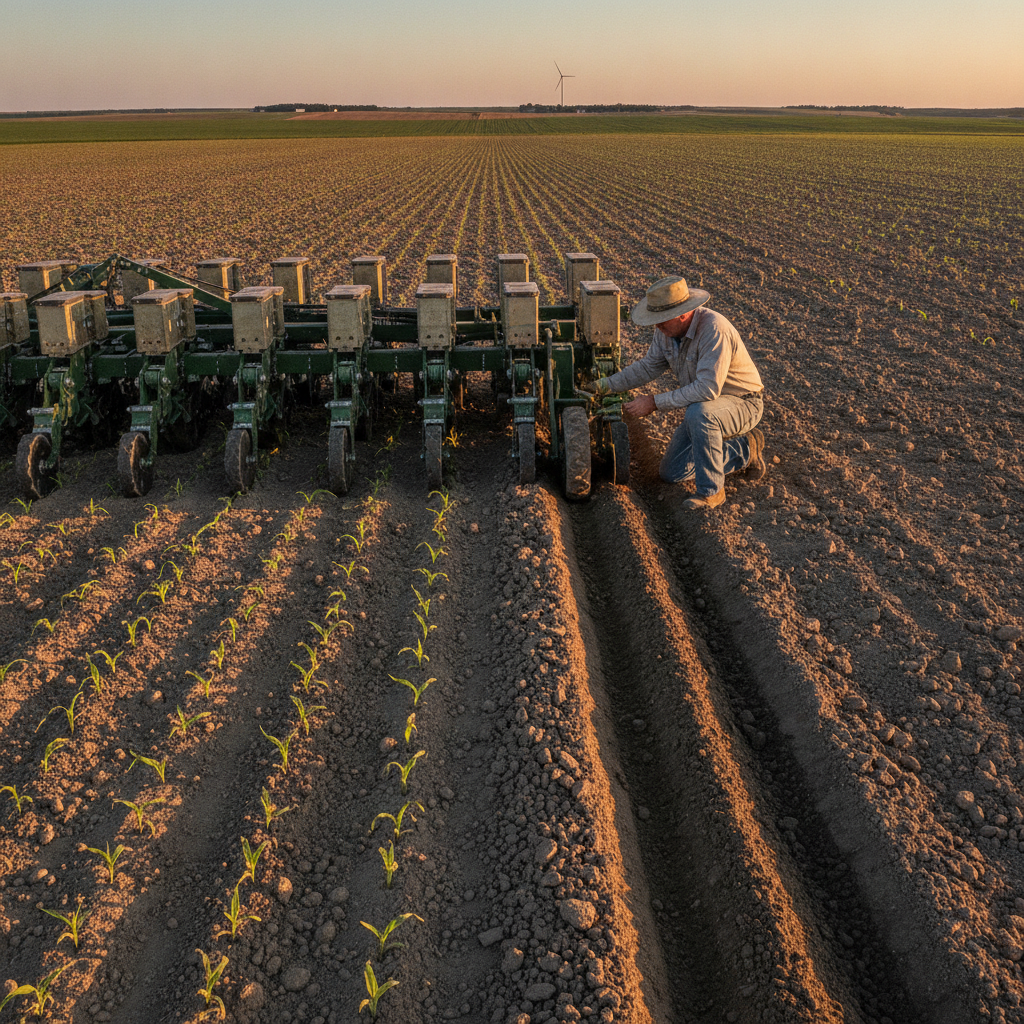
How Do Row-Crop Farmers Near Brookings Know Whether Their Closing Wheel Setup Is Actually Firming the Seed Trench — Or Just Pushing Dirt Around Without Making Real Seed-to-Soil Contact?
If your closing wheels are spinning and the trench looks closed from the cab, but your corn or soybean emergence is still uneven, here’s the hard truth: a closed trench and a firmed trench are not the same thing. Farmers near Brookings deal with spring soils that can swing from bone-dry and cloddy to saturated gumbo within the same field — sometimes within the same pass. In those conditions, closing wheels that just drag dirt over the slot aren’t doing the job. And if the rest of your row unit — specifically your gauge wheels — isn’t holding consistent depth or staying square on the row, your closing wheels can’t save you.
What “Firming the Trench” Actually Means in the Field
Seed-to-soil contact isn’t just about the seed touching dirt. It’s about the soil around the seed being pressed firmly enough that moisture can wick to the seed coat and germination can start uniformly. When closing wheels push loose or wet soil back over the slot without firming it, you get air pockets, uneven moisture, and inconsistent emergence — which shows up as a rough stand and yield drag, even when your population count looks fine on paper.
In no-till and strip-till systems across eastern South Dakota and western Minnesota, residue adds another wrinkle. If your closing wheels are dragging crop trash into the trench instead of seating it aside, you’re creating a barrier between the seed and the soil — not a contact zone. This is especially common in soybean-after-corn rotations where stalk pieces are still present at planting.
The fix isn’t always a different closing wheel. Sometimes the problem starts two steps earlier — with what your gauge wheel is doing.
Why Gauge Wheel Performance Directly Affects Closing Wheel Results
Your gauge wheel controls the depth at which the disk opener cuts. If the gauge wheel is riding inconsistently — bobbing over residue, losing contact with the soil surface on headlands, or wearing unevenly — the trench depth changes with it. A shallow trench in wet ground barely closes. A trench cut too deep in dry soil leaves a gap the closing wheel has to bridge, which it often can’t do without packing the sidewalls instead of the bottom.
Gauge wheels that plug with mud make this worse. When mud builds up on the wheel face or between the spokes, the effective diameter of the wheel changes — which means your depth changes — and the buildup can also start acting as a wedge that pries the trench open rather than helping close it. Jung Enterprise’s curved spoked gauge wheels are designed with an open spoke pattern specifically to shed mud and residue instead of accumulating it, keeping your depth setting honest across a full day of planting.
The Part Most Operators Don’t Think About: Wheel Retainer Stability
Here’s the angle that almost nobody in the closing wheel conversation talks about — and it’s one of the clearest content gaps across competitor sites that focus on closing wheel styles and down-force settings without ever addressing what keeps the gauge wheel on the row unit in the first place.
If your gauge wheel can dislodge — even slightly — during a hard field entry, a sharp turn on a headland, or a rough pass through standing residue, you’ve lost depth control at exactly the moment when consistent trench geometry matters most. A gauge wheel that’s shifted even a fraction of an inch laterally is no longer running parallel to the disk opener. The trench it cuts won’t match what the closing wheel is designed to close.
A properly installed wheel retainer keeps the gauge wheel locked in place on the row unit, preventing that lateral drift or outright dislodgement. This is a basic mechanical foundation that has to be right before any closing wheel upgrade will give you consistent results. If you’re chasing uneven emergence and you haven’t confirmed that your wheel retainers are holding the gauge wheels square and secure, start there before spending money downstream.
What to Check Before You Blame the Closing Wheel
Before assuming you need a different closing wheel style or more down-force, walk through these checkpoints on your planter:
- Gauge wheel mud buildup: Are your gauge wheels accumulating mud between spokes mid-field, or are they shedding it? Buildup changes your depth and your trench geometry.
- Gauge wheel tire lip wear: A worn tire lip loses its contact edge, which means the wheel starts rocking instead of riding flat. That translates directly to variable trench depth.
- Wheel retainer condition: Is the gauge wheel still seated squarely on the row unit after a full day of planting? Pull one and check it. A loose or missing retainer is a silent cause of erratic trench closure.
- Trench sidewall condition: Are the sidewalls crumbling into the trench (dry soil) or smearing (wet soil)? Each condition calls for different closing wheel pressure — but neither can be fixed if the trench geometry is inconsistent to begin with.
- Closing wheel tracking: Are both closing wheels running in the same plane as the slot? If the row unit is twisted or the gauge wheel has drifted, the closing wheels will be off-center and won’t firm the bottom of the trench.
How Jung Enterprise Parts Address the Root Cause
At Jung Enterprise in Ipswich, the products are built around this exact problem chain. The wheel retainer keeps gauge wheels from dislodging so your row unit geometry stays consistent. The curved spoked gauge wheel sheds mud so your depth setting stays accurate. And the steel ring protects the tire lip from the kind of wear that causes depth drift over a season — with field-tested results showing only 1/16″ of wear after 13,000 planted acres over three years.
That’s not a marketing number. That’s what happens when you run parts through real Northern Plains conditions — clay soils, wet springs, heavy residue — and measure the results rather than guess at them. Farmers from Brookings to the Iowa border and over into Minnesota have soil conditions that will expose weak gauge wheel setups fast. These parts are built to hold up through that.
Frequently Asked Questions
Can a closing wheel upgrade fix uneven emergence if my gauge wheels are the real problem?
Not reliably. If your gauge wheels are inconsistent in depth or lateral position, the trench geometry will vary — and no closing wheel style compensates for a trench that’s cut at different depths across the field. Fix the gauge wheel setup first.
How do I know if my wheel retainer is actually holding the gauge wheel in place?
After a full day of planting, visually check whether each gauge wheel is still seated squarely on the row unit. If you see lateral movement, scoring on the axle, or a wheel that wobbles when you grab it, the retainer isn’t doing its job. Replace it before the next field.
Do open-spoke gauge wheels actually shed mud better in Brookings-area soils?
Yes — in heavy clay and gumbo conditions common in eastern South Dakota and southwestern Minnesota, solid gauge wheel faces pack up fast. Open curved-spoke designs let mud pass through rather than accumulate, which keeps your effective wheel diameter and your depth setting stable throughout the day.
How does gauge wheel tire lip wear affect trench closure?
A worn tire lip loses the firm, consistent edge that holds the wheel level against the soil. As the lip wears, the wheel starts to rock or tilt slightly, which changes the angle of the trench cut. The closing wheels then have to close a trench that isn’t square — which usually means poor contact at the seed and variable emergence.
Are Jung Enterprise gauge wheel parts compatible with the planters most farmers near Brookings are running?
Jung Enterprise parts are designed to fit planters, air seeders, and no-till drills across multiple OEM brands and gauge wheel sizes. Contact them directly to confirm fitment for your specific row unit configuration before ordering.
Ready to Fix the Root Cause Instead of Chasing Symptoms?
If you’re a row-crop farmer near Brookings — or anywhere across South Dakota, southwestern Minnesota, or northern Iowa — and you’ve been struggling with inconsistent emergence despite running your planter hard, start at the row unit foundation: gauge wheel accuracy, retainer security, and tire lip integrity. Those three things set the stage for everything the closing wheel does downstream.
Jung Enterprise builds patented, American-made parts designed for exactly the conditions you’re planting in. Reach out to the team in Ipswich to talk through your setup, confirm part compatibility, or get guidance on what to check before the next planting season. No runaround, no upsell pressure — just straight answers from people who’ve run these parts in Northern Plains fields.